

Introduction
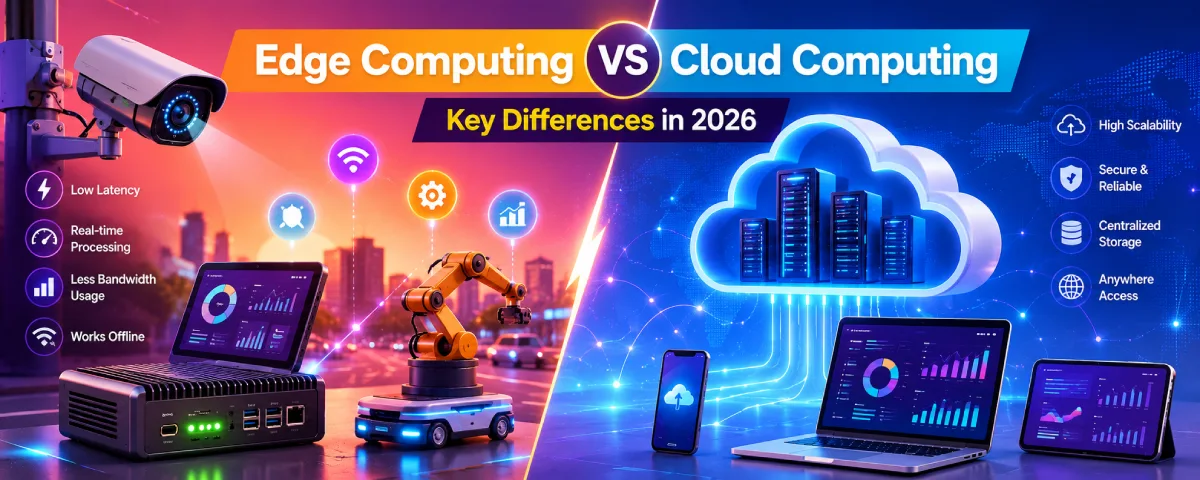
With growing digitization in the field of enterprises, the selection of computing solutions becomes crucially important. Among the most frequently chosen options are edge computing and cloud computing. The above mentioned technologies enable businesses to process, store and manage data; however, each of them performs its functions differently and is targeted at distinct purposes.
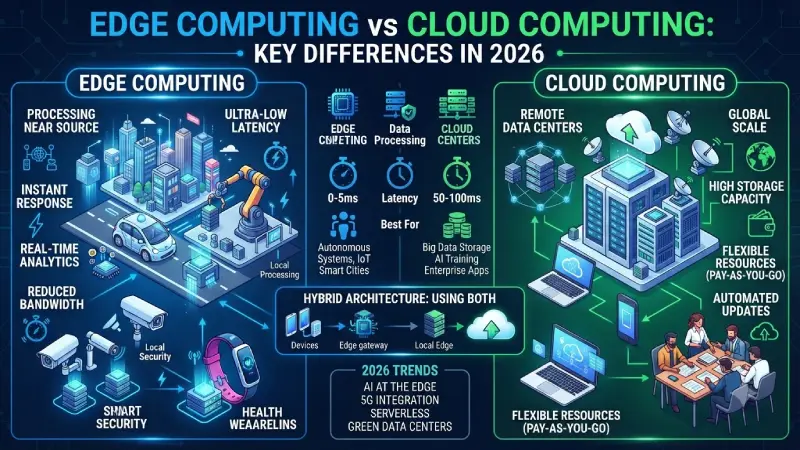
While cloud computing implies processing and storing of data in remote data centers that can be accessed through the Internet, edge computing means performing the above mentioned operations at a place close to the source of data creation (devices, sensors, etc.). Cloud computing is mostly used for website hosting, cloud storage, software applications, backup, and business management.
Each technology cannot be viewed as the best option in all situations. Depending on business requirements, budget, speed, and application of business, companies can implement one or another solution or both of them together to improve the efficiency and productivity.
This article will explain how edge computing differs from cloud computing regarding working mechanism, pros and cons, use cases, cost, and other features.
What Is Edge Computing?
The term edge computing refers to the practice whereby data processing takes place at the location where the data is generated, rather than sending it to the central cloud server to be analyzed. In other words, the process happens near the source of data generation, which means that the process is quicker.
For instance, the smart security camera will process the video feed and identify any strange activity without uploading the video feed to the remote cloud server. It means that there is less network traffic.
Edge computing has various applications such as smart factories, autonomous vehicles, IoT, health devices, and smart cities.
Key Features of Edge Computing
- Processes data near the source
- Reduces network delays
- Supports real-time applications
- Works with IoT devices
- Reduces internet bandwidth usage
- Improves response speed
What is Cloud Computing?
Cloud computing is the provisioning of computing resources over the internet. Through cloud computing services, companies have access to resources such as storage, computing power, databases, software, and networking anytime from wherever.
The cloud computing provider manages hardware and software infrastructure in their data center. The users have access to their applications and data by connecting to the internet.
Cloud computing is extensively used for web hosting, file storage, business applications, data backup, artificial intelligence, software development, and collaboration. Companies use cloud computing because they don’t have to invest in costly infrastructure.
Key Features of Cloud Computing
- Access resources over the internet
- Highly scalable infrastructure
- Pay only for the resources used
- Easy remote access
- Automatic updates and maintenance
- Built-in backup and security
Edge Computing vs Cloud Computing at a Glance
| Feature | Edge Computing | Cloud Computing |
| Data Processing | Near the device | Remote data center |
| Speed | Very fast | Fast |
| Latency | Very low | Moderate |
| Internet Requirement | Low | High |
| Best For | Real-time processing | Storage, applications, and business systems |
Edge computing and cloud computing are really important for information technology. Edge computing is great because it can process things fast right next to the devices that need it. On the hand cloud computing is good, for having lots of resources that can be used by many people and it is easy to manage everything from one place. Lots of organizations use edge computing and cloud computing together to make solutions that are efficient and secure and work really well. They use edge computing and cloud computing to get the best of both worlds.
To take the next step, see our detailed guide on cloud computing providers
Edge vs Cloud: Speed and Latency
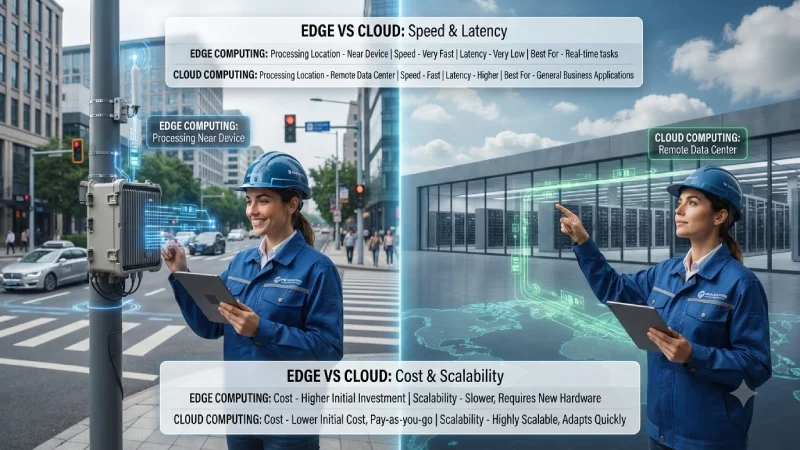
Speed and latency are two things that set edge computing and cloud computing apart. When we talk about latency we are talking about how it takes for data to go from a device to the system that works with it. Edge computing is good because it works with data near the device so it is really fast. On the hand cloud computing sends data to centers that are far away and this can make things a little slower because of the internet and how far it has to travel. Edge computing is about being close to the device, which is why it is so much faster, than cloud computing.
| Feature | Edge Computing | Cloud Computing |
| Processing Location | Near the device | Remote data center |
| Speed | Very Fast | Fast |
| Latency | Very Low | Higher |
| Best For | Real-time tasks | General business applications |
Edge vs Cloud: Cost and Scalability
Edge computing needs machines to work so it costs more money at the start. On the hand cloud computing is cheaper to begin with because companies just pay for what they actually use. Cloud computing is also really good at adapting to changes so companies can easily get more or less of what they need fast, when things change with edge computing and cloud computing. Edge computing and cloud computing have ways of doing things but cloud computing is better, at growing or shrinking quickly.
| Feature | Edge Computing | Cloud Computing |
| Initial Cost | Higher | Lower |
| Maintenance | Business managed | Provider managed |
| Scalability | Moderate | Excellent |
| Pricing Model | Hardware investment | Pay-as-you-go |
Performance Comparison
| Category | Better Choice |
| Real-time Processing | Edge Computing |
| Low Latency | Edge Computing |
| Large Data Storage | Cloud Computing |
| Business Scalability | Cloud Computing |
| Remote Access | Cloud Computing |
| IoT Applications | Edge Computing |
| AI Model Training | Cloud Computing |
| Backup and Disaster Recovery | Cloud Computing |
Edge computing performs very effectively where instant processing is required, while cloud computing is ideal for scalable processes in an enterprise, central storage of data, and access from anywhere. There are some enterprises that use both types of computing.
Uses Cases for Edge Computing and Cloud Computing
The uses cases of both edge computing and cloud computing cover a lot of industries, but edge computing is more suitable for the real-time applications, whereas cloud computing is more fit for centralized storage and collaboration.
| Industry | Edge Computing | Cloud Computing |
| Manufacturing | Machine automation | Production management |
| Healthcare | Medical devices | Patient records |
| Retail | Smart checkout | Inventory management |
| Transportation | Self-driving vehicles | Fleet tracking |
| Smart Cities | Traffic monitoring | City data analytics |
When to Choose Edge Computing
Choose edge computing if your business requires:
- Real-time data processing
- Very low latency
- IoT devices and smart sensors
- Offline or limited internet operation
- Instant decision-making
When to Choose Cloud Computing
Choose cloud computing if you need:
- Data storage and backup
- Website and application hosting
- Remote collaboration
- Business software
- Flexible and scalable resources
Hybrid Architecture: Using Edge and Cloud Together
Several firms deploy an architectural strategy that involves both edge computing and cloud computing technologies. Using such technology, data which is critical will be processed in the edge devices while the data storage, analytics, and batch processing will be taken care of in the cloud. This technique improves efficiency and decreases network congestion.
This approach has been referred to as the Hybrid Cloud Architecture whereby companies use an on-premises, edge, and cloud environment to improve efficiency and security. Learn more about hybrid cloud architecture here:
2026 Trends in Edge and Cloud Computing
In 2026, companies will be integrating both edge computing and cloud computing in order to make things more efficient and effective. Some of the important technologies emerging in this context include artificial intelligence in edge devices, 5G technology, edge and cloud hybrid architecture, cybersecurity advancements, serverless computing, and green data centers.
Advantages and Disadvantages
| Edge Computing | Cloud Computing |
| Advantages: Very low latency, real-time processing, reduced bandwidth usage. | Advantages: High scalability, lower upfront cost, easy remote access, automatic updates. |
| Disadvantages: Higher hardware costs and more complex management. | Disadvantages: Depends on internet connectivity and may have higher latency for real-time tasks. |
Frequently Asked Questions
Which is faster, edge or cloud computing?
Edge computing works faster since data processing takes place near its origin.
Can businesses use both technologies together?
Yes. Many organizations integrate edge and cloud computing to improve efficiency and flexibility.
Which is better for IoT?
Edge computing is suitable for IoT applications since it provides timely processing with reduced latency.
Conclusion
Both edge computing and cloud computing provide distinctive advantages. The former is suitable for real-time processing because of its rapid response time, whereas the latter provides excellent storage and can be used for business apps and remote access. Rather than pitting these two against each other, many companies deploy both to develop a robust, efficient, and future-proof system. Knowing the needs of your business will make the decision easier.