


The working capital is the funds invested in the operations of the firm. This is the gap between the resources that you have at the moment and which can be converted to cash quickly (current assets) and the obligations that you have at the moment and which require cash soon (current liabilities). When the working capital is effectively managed, then there is adequate liquidity in the business. If not, then the cash is locked up despite the profitability of the business.
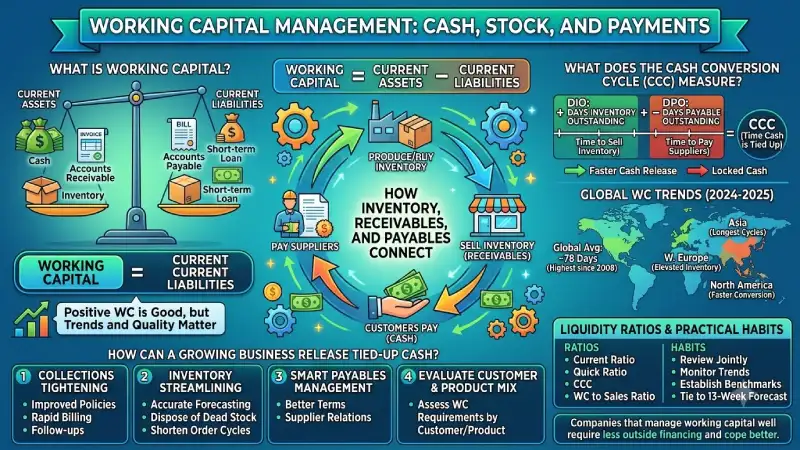
There are essentially three locations where most of the cash that is held in working capital resides. These are the inventory, receivables, and payables.
What is working capital and how is it calculated?
The basic formula is straightforward:
Working Capital = Current Assets – Current Liabilities
Common examples of current assets may include:
- Cash and cash equivalents
- Accounts receivable
- Inventory
- Others
Common examples of current liabilities may include:
- Accounts Payable
- Loans that are to be repaid within one year
- Short term debt portion
Working capital is considered positive when current assets outweigh current liabilities. This is always good; however, the numerical value of the working capital is not so important as the trend and quality of its constituent parts. Even though a company has adequate working capital, it may find itself in cash trouble due to the high amount of capital tied up in inventories and accounts receivable.
How do inventory, receivables, and payables connect?
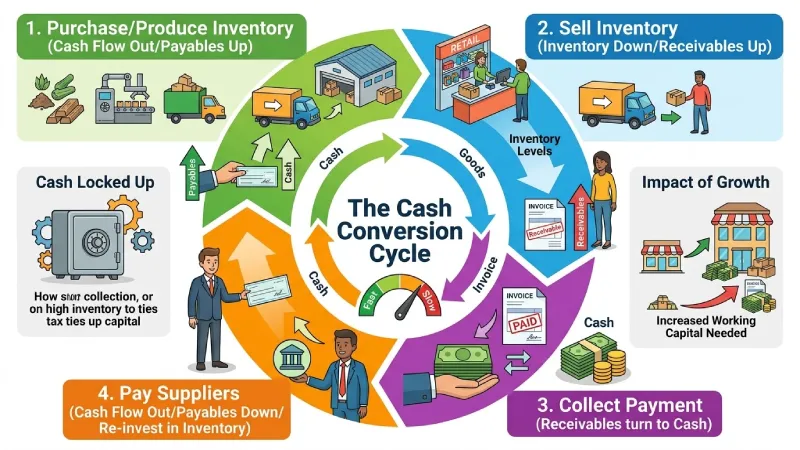
All these three elements form a continuous cycle.
- Firstly, you get or produce the inventory (cash is flowing out or payables are increased).
- Then you sell the inventory and have receivables (inventory is decreased and receivables are increased).
- The customers pay the money and the receivables turn into cash.
- Finally, you use this cash (or payables are increased) to purchase the inventory.
The rate of this process defines the amount of cash which is locked for good. The slow collection, the high level of inventory, or very quick payments to the suppliers lead to the increased cash requirement. Fast collection, reduced inventory, or extended but reasonable payables period decrease the cash requirement.
Growth often makes the problem more obvious. High sales typically lead to high inventory and high receivables. If payables do not elongate in parallel, the working capital increases and cash is sucked up even as the profit and loss account shows great results.
What does the cash conversion cycle measure?
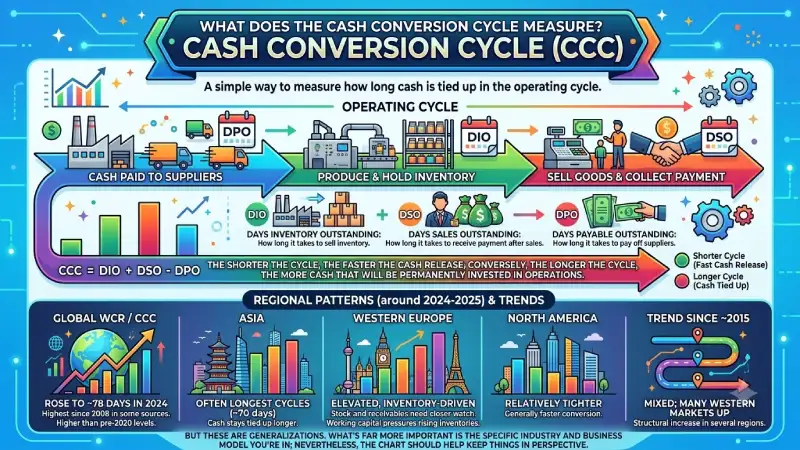
The cash conversion cycle (CCC) is a simple way to measure how long cash is tied up in the operating cycle. It combines three metrics:
CCC = DIO + DSO – DPO
- Days Inventory Outstanding (DIO) – how long it takes to sell the inventory.
- Days Sales Outstanding (DSO) – how long it takes to receive payment after sales have been made.
- Days Payable Outstanding (DPO) – how long it takes to pay off suppliers.
The shorter the cycle, the faster the cash release; conversely, the longer the cycle, the more cash that will be permanently invested in operations. Differences by region and year-on-year are significant. According to recent research, the global average for working capital has reached about 78 days in 2024, the highest value since 2008 in some sources. Usually, Asia has the highest working capital cycle values, and North America the lowest. Western Europe experiences increased working capital pressures due to rising inventories.
| Region / Focus | Recent pattern (around 2024–2025) | Practical implication |
| Global WCR / CCC | Rose to ~78 days in 2024 | Higher than pre-2020 levels in many markets |
| Asia | Often longest cycles (~70 days) | Cash stays tied up longer |
| Western Europe | Elevated, inventory-driven | Stock and receivables need closer watch |
| North America | Relatively tighter | Generally faster conversion |
| Trend since ~2015 | Mixed; many Western markets up | Structural increase in several regions |
But these are generalizations. What’s far more important is the specific industry and business model you’re in; nevertheless, the chart should help keep things in perspective.
How can a growing business release tied-up cash?
The issue is not growth; the problem is uncontrolled growth that consumes cash. These are the practical tools:
- Collections tightening: improved policies, more rapid billing, follow-ups, and close monitoring of aging accounts.
- Inventory streamlining: accurate forecasting, disposal of dead stock, and shortened order cycles whenever feasible.
- Smart management of payables: getting better terms from major suppliers without compromising relations and supply.
- Evaluating customer and product mix: certain customers and products have much higher working capital requirements than others at the same margin.
Small changes multiply their effects. Reduction by five days of the DSO or DIO, or an addition of five days to the DPO, makes a lot of difference in cash flows of a growing company without additional borrowing.
Which liquidity ratios and trade-offs need attention?
A few simple ratios help monitor the situation:
- Current ratio (Current Assets ÷ Current Liabilities) — a broad view of short-term cover.
- Quick ratio (Current Assets minus Inventory ÷ Current Liabilities) — a stricter view that excludes stock.
- Cash conversion cycle — the operating view of how long cash is tied up.
- Working capital to sales ratio – helpful in monitoring whether there is an imbalance of funds due to growth.
Trade-offs are always going to happen. A stricter inventory policy will generate funds but run the risk of running out of stock. Extended supplier credit will generate funds but impact pricing and delivery. Shortened collection period will generate funds but impact customer relations if not done carefully. It is not the objective to optimize one particular measure on its own.
Practical habits for better working capital management
- Review all three (inventory, receivables, and payables) elements jointly, and not separately.
- Monitor cash conversion cycle or at least trends in DSO, DIO, and DPO.
- Establish internal benchmarks which take into account both cash generation and practical considerations.
- Tie your working capital management process to the 13-week cash flow forecast in order to catch timing problems early.
- Take action on slow-moving inventory and overdue receivables before they turn into a permanent issue.
Working capital management is much less a matter of complicated mathematics than regular attention to cash locked up in inventories, customers, and vendors. Companies that manage their working capital well tend to require less outside financing and cope with challenges better.
FAQs on Working Capital Management
- Is increased working capital always a good thing?
It may indicate increased liquidity; however, on the other hand, it may also indicate excess funds tied up in inventories or accounts receivable. The quality and trends are far more important than the amount itself.
- How frequently should I calculate my cash conversion cycle?
Calculations on a monthly basis will be enough for most companies. If you attempt to cut the cycle down or your cash flow situation is tight, then you should do it weekly.
- Can there be negative working capital and yet the company is doing well financially?
It is indeed possible sometimes (for example, for certain retailers and subscription-type companies that collect their money at the start of the deal). Negative working capital becomes a problem if it reflects bad collections, excess inventory, or difficulties with suppliers..
- Which is the fastest method for releasing cash in working capital?
A combination of collecting outstanding receivables and selling off slow-moving stock. It can be beneficial to lengthen the period of payment to suppliers provided that good relations have been maintained.
- In what way does working capital tie into the 13-week cash forecast?
The 13-week cash forecast identifies the timing of cash flows. The working capital ratios provide an explanation of the reason for the timing.
Conclusion
Working capital is the money that exists in inventories, accounts receivable, and accounts payable during the period the company is operating. Cash conversion cycle is the measure that tells us for how long the money remains trapped. Growing companies require additional working capital; however, uncontrolled growth could drain cash resources faster than the profit generates them. Just watch out the three components as a whole, monitor several indicators and make constant improvements to collection practices, inventory management, and payment terms. That is the recipe of having more cash and becoming stronger overall.