


The receivables are the amount of money owed to you by the customers because you have already provided them with your services or products. Receivables are recorded as assets on the balance sheet, but they only remain as a mere promise until the money reaches your account. Effective receivables management is the art of getting your promise fulfilled to get money into your bank account, without affecting the relations with the customers.
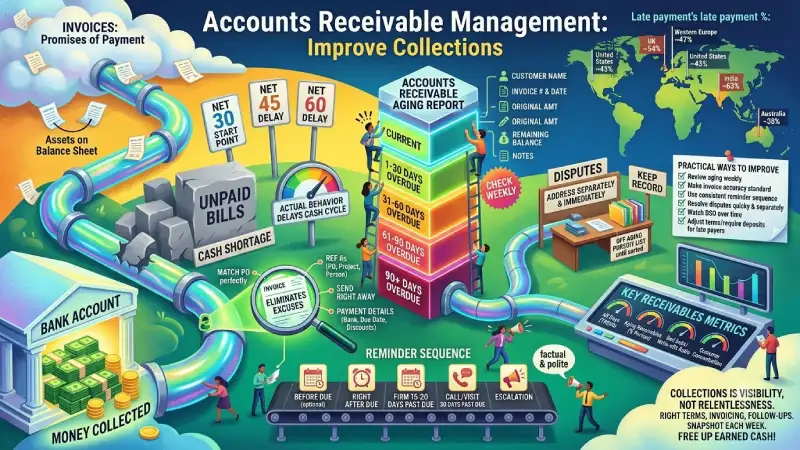
This problem is the beginning point of most problems of cash flow. Your business can be active and profitable, yet you can face cash shortage owing to the fact that most money is tied up in the form of unpaid bills.
How do payment terms influence collection timing?
The payment terms establish the official starting point. For Net 30 terms, the customer is supposed to pay within 30 days after the date of the invoice. Terms such as Net 45 or Net 60 delay the expected payment. Extending terms might help you get more business, but it will delay the cash cycle.
It is not important what the terms say but how the customers behave. The majority of customers pay beyond their terms. If the client usually delays payment by 15 days for Net 30 invoices, then he/she takes 45 days to pay. A good receivables management process should begin with an analysis of the actual behavior of the client instead of the terms on the invoice.
When deciding about or reviewing the terms, take into account:
- How fast you need the cash
- What is the usual practice in your industry
- The credit standing of the customer
- Whether you can provide early payment discounts
Short terms facilitate cash flow. Long terms might be helpful to make sales.
What should an accounts receivable aging report show?
The aging report is the single most useful tool for managing receivables. It groups outstanding invoices by how long they have been unpaid:
- Current (not yet due)
- 1–30 days overdue
- 31–60 days overdue
- 61–90 days overdue
- 90+ days overdue
A good aging report also shows:
- Customer name
- Invoice number and date
- Original amount and remaining balance
- Total by aging bucket
- Sometimes a notes column for promised payment dates or dispute status
Check the aging report once a week. Pay attention to two things: the overall volume aging into older categories, and any particular client with aging amounts in their account. The 60- and 90-day accounts present the increased risk of not collecting the money. The longer the invoice sits unpaid, the lesser the chances of its full collection.
How do accurate invoices reduce payment delays?
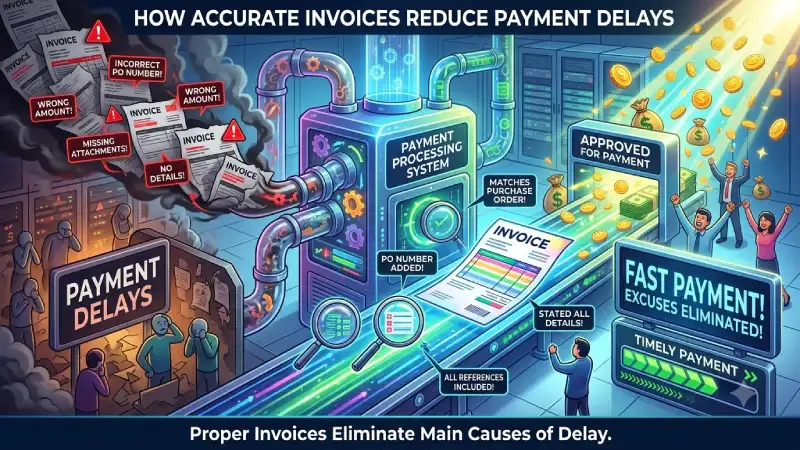
A lot of payment delays occur because of the invoice itself. In case the purchase order number is incorrect, if there are incorrect amounts of products, if there are no attachments or details regarding payments, then there will be an excuse for delay for the accountants of the purchasing company.
Basic practices that will help avoid delay:
- Trying to make the invoice correspond perfectly to the purchase order/agreement of the purchasing company
- Adding all needed references (PO number, project code, person name)
- Sending the invoice right away after the delivery or completion of work
- Stating all the details regarding payments (payment bank, due date, any discounts)
An invoice which is made properly eliminates the easiest excuses for payment delay. It does not guarantee timely payment, but eliminates the main cause of delay.
How do reminders and disputes affect collections?
In most cases, clients who are behind schedule in their payments are not doing so because they have anything against you or your company. The problem may just lie within the process of payments itself. A good series of reminders should definitely help.
The common practice many firms follow:
- Reminder a few days before the due date (optional)
- First reminder right after the due date
- Firm reminder 15-20 days past due
- Call or visit at 30 days past due
- Escalation (escalating contact, formal letter, etc.) when it is still outstanding
Stay factual and polite. Mention the invoice #, amount, and due date. Ask for a definite payment date.
If there is a dispute about the invoice, it has to be addressed separately. In case the client brings a legitimate concern (quality, quantity, price), try to solve the problem immediately. Putting a disputed invoice through the regular collection process only delays things and irritates both parties. Keep a record of the dispute, agree what to do next, and get the invoice off your aging pursuit list until the dispute is sorted out.
Which receivables metrics should you monitor?
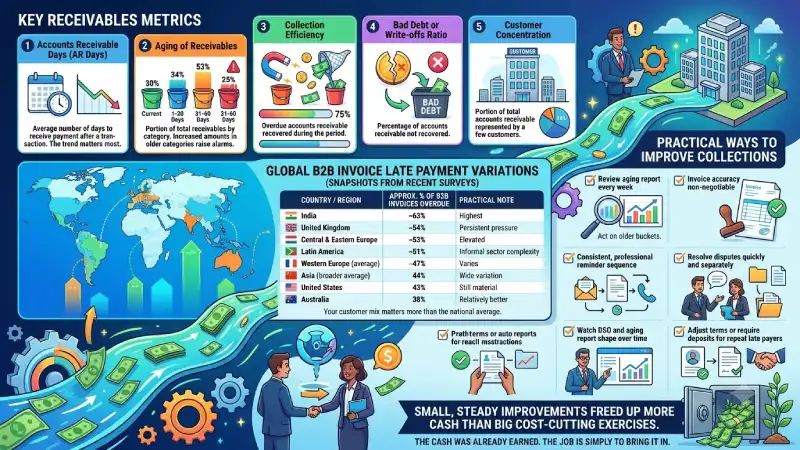
You do not require scores of figures. A handful of well-defined indicators is all that is needed:
- Accounts Receivable Days (AR Days) – the average number of days required to receive payments after a transaction. What matters here is the trend rather than the figure itself.
- The aging of receivables – the portion of total receivables accounted for by each category (current, 1-30, 31-60, etc.). Increased amounts in the older categories raise an alarm.
- Collection efficiency – the amount of overdue accounts receivable recovered during the period.
- The bad debt or write-offs ratio – the percentage of accounts receivable that are not recovered.
- The level of customer concentration – the portion of total accounts receivable represented by a few customers.
Country and market variations matter. Late payment survey data suggests that late payment B2B invoices in percentages is most widespread in countries like India (63%), the United Kingdom, and certain areas of Central and Eastern Europe. Countries like the US and other Asian regions have lower numbers but are important nonetheless.
| Country / Region | Approx. % of B2B invoices overdue | Practical note |
| India | ~63% | Highest in many surveys |
| United Kingdom | ~54% | Persistent late-payment pressure |
| Central & Eastern Europe | ~53% | Elevated |
| Latin America | ~51% | Informal sector adds complexity |
| Western Europe (average) | ~47% | Varies by country |
| United States | ~43% | Still material |
| Asia (broader average) | ~44% | Wide variation between markets |
| Australia | ~38% | Relatively better |
These are snapshots from recent surveys. Your own customer mix will matter more than the national average, but the table is a useful reality check.
Practical ways to improve collections
- Review the aging report every week and act on the older buckets.
- Make invoice accuracy a non-negotiable standard.
- Use a consistent, professional reminder sequence.
- Resolve disputes quickly and separately.
- Watch DSO and the shape of the aging report over time.
- Adjust terms or require deposits for customers who repeatedly pay late.
Small, steady improvements in collections often free up more cash than big cost-cutting exercises. The cash was already earned. The job is simply to bring it in.
FAQs on Accounts Receivable Management
- How frequently should I examine the accounts receivable aging report?
Weekly is preferred. Monthly is the bare minimum. The more time passes, the older the invoices get, which makes collecting them more difficult.
- What should be my DSO target?
There is no one-size-fits-all solution. It depends on the industry and your payment terms. Look at the trend. Increasing DSO in absence of changes in the payment terms means poor collections. Start by comparing yourself to your past performance, and then compare yourself to industry average if available.
- Should I give any discounts for early payment?
It could be effective if the discount rate is lower than the benefit that the earlier collection brings. Try out small discounts for those who normally pay late and see how it works.
- When do I cut off supplies to a late payer?
“When the danger exceeds the margin and the relationship.” Many companies establish an unambiguous policy within their organization (such as, “no new orders if outstanding receivable exceed $X at 60 days”). Follow the policy consistently.
- Is it appropriate to use third-party collection services?
Yes, in cases when accounts are aged, large, and not resolved by internal attempts to collect. Use the service selectively. With regular customers, internal collections are preferable.
Conclusion
Collections is not about being relentless in going after money. Collections is about having the right terms, proper invoicing, consistent follow-ups, and having a snapshot each week of what is outstanding. Maintain visibility on your aging report, focus on the older buckets, and track a few key metrics. This money has already been earned, it just needs to come in quickly – one of the best business habits you can develop..