


Introduction
It is fascinating to think of having a startup company, but it takes much more than just fascination and want to turn it into a reality. It is necessary for the rookies that they should have a clear idea about their customers, market, competitors, business, working, and finances. This is when a business plan comes into play. It is a document that combines all of the above elements.
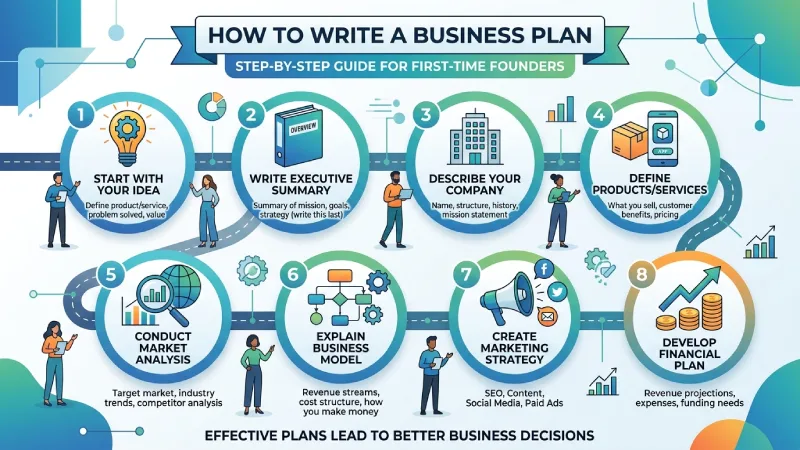
How to write a business plan? The process may seem complicated; however, you can make it easy for yourself by organizing your thoughts into different sections and proving them with reasonable research and data.
An effective business plan should cover what your company is all about, its target audience, how it will operate on the market, how it will generate income, and what is needed to make it work. It will help you detect possible obstacles at an early stage without wasting your time and efforts.
This article provides step-by-step instructions on major business plan sections, discusses executive summary writing tips, presents company description and mission statement samples, gives tips on conducting market analysis for a business plan, and demonstrates how to present financial projections.
What Is a Business Plan?
A business plan is a structured document describing a company’s goals and how the company will achieve these goals.
Typically it includes:
- A business idea
- Product(s) or service(s)
- Target customers
- Market opportunity
- Competitors
- Marketing strategy
- Sales strategy
- Operations
- Management team
- Expected financial results
- Needed finances
Business plans may have various uses.
For an entrepreneur, it may act as a guideline to start a business. For an existing firm, a business plan may assist in guiding expansion and new strategy. In raising capital, a business plan can assist in informing the investor/lender of the business opportunity.
Effective business plans are action-oriented plans. Business plans must assist you in making decisions.
Why Should First-Time Founders Write a Business Plan?
Writing a business plan forces you to examine your business idea from different perspectives.
You may discover that:
- Your target market is smaller than expected.
- Customers have different needs than you assumed.
- Competitors are stronger than anticipated.
- Your pricing strategy needs improvement.
- Startup costs are higher than expected.
- Your original business model needs to change.
Finding these issues before launching can save time and money.
A business plan also helps you:
- Clarify your business idea.
- Understand your target audience.
- Research your market.
- Analyze competitors.
- Define your strategy.
- Estimate financial requirements.
- Set measurable goals.
- Identify potential risks.
- Communicate your vision to others.
Business Plan Sections Explained
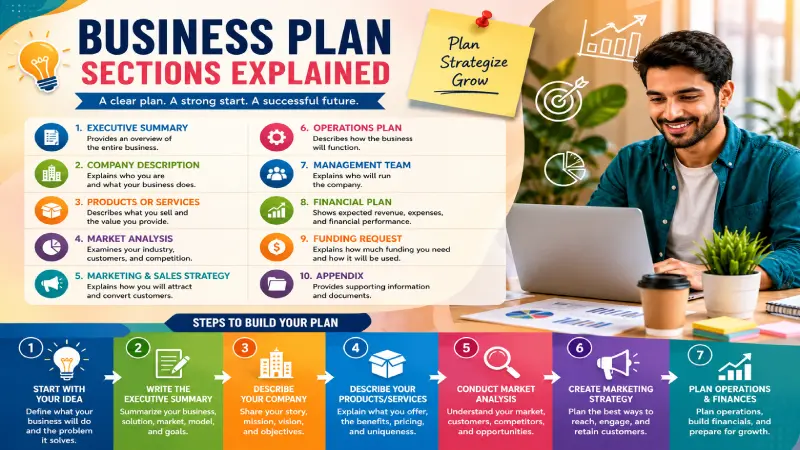
Before writing your plan, it helps to understand the main sections.
A traditional business plan usually contains the following:
| Business Plan Section | Purpose |
| Executive Summary | Provides an overview of the entire business |
| Company Description | Explains who you are and what your business does |
| Products or Services | Describes what you sell and the value you provide |
| Market Analysis | Examines your industry, customers, and competition |
| Marketing and Sales Strategy | Explains how you will attract and convert customers |
| Operations Plan | Describes how the business will function |
| Management Team | Explains who will run the company |
| Financial Plan | Shows expected revenue, expenses, and financial performance |
| Funding Request | Explains how much funding you need and how it will be used |
| Appendix | Provides supporting information and documents |
Not every company requires each section to be explained in the way.
For example a small service business might need a plan than a technology startup that is looking for millions of dollars, in funding.
Step 1: Start With Your Business Idea
Before writing your business plan define what your business will do.
Answer these basic questions:
- What product or service will you offer?
- What problem does it solve?
- Who experiences this problem?
- Why is your solution valuable?
- How will customers buy from you?
- How will the business generate revenue?
Try to say what you want to do in a couple of easy to understand sentences.
For example:
“We provide affordable bookkeeping software for freelancers who need an easier way to track income, expenses and invoices.”
This simple statement gives you a starting point for developing the rest of your bookkeeping software plan, for freelancers.
Step 2: Writing the Executive Summary
While the executive summary would usually be the part of the business plan that is first read, it can in fact be easier to write the executive summary after the other sections of the business plan have been written.
This is because the executive summary is basically an overview of your company, which should encourage further reading.
Executive Summary Writing Tips
A strong executive summary should briefly explain:
- What your company does
- The problem you solve
- Your target market
- Your products or services
- Your competitive advantage
- Your business model
- Your current stage
- Your financial highlights
- Your funding requirements, if applicable
Keep the language clear and direct.
Avoid:
- Excessive technical language
- Long paragraphs
- Unsupported claims
- Unrealistic promises
- Too many unnecessary details
Example Executive Summary
GreenBox Delivery is a company that brings food to peoples homes. They make meals that are easy to buy and do not cost too much money. It is working with people who grow food and chefs who make food to deliver meals to the people who buy them. People can pay every week or every month to get these meals. It is going to start in one city and then move to cities later.
This example quickly communicates the business concept, target audience, revenue model, and growth direction.
A Simple Executive Summary Formula
You can use this structure:
Company + Problem + Solution + Target Market + Business Model + Competitive Advantage + Goals
This method helps new entrepreneurs make an concise summary without including extra details. It helps first-time founders create a summary without writing unnecessary information. This method helps new entrepreneurs make an concise summary without including extra details.
Step 3: Describe Your Company
The purpose of a company description is to inform the reader about the nature of the company, how it functions, and its purposes.
The description should contain sufficient information such that the reader understands the nature of the business even without previous knowledge.
Include information such as:
- Business name
- Business structure
- Location
- Industry
- Founding date
- Business stage
- Mission
- Vision
- Short-term goals
- Long-term objectives
You could also tell the history of the company.
If you have established your business because you have found some problem from your experience, then tell it briefly.
Examples of Company Descriptions and Mission Statements
Your mission statement will describe the reason for your business.
Example 1: Technology Company
Our goal, at the Technology Company is to assist businesses. We want to make it easy for them to manage their work. The Technology Company does this by providing the Technology Companys technology solutions. These solutions are not expensive. They are easy to use.
Example 2: Sustainable Fashion Brand
The Sustainable Fashion Brand has a plan. The plan of the Sustainable Fashion Brand is to make it easy for people to buy fashion. The Sustainable Fashion Brand makes clothes that’re good quality. The Sustainable Fashion Brand uses materials to make these clothes. The Sustainable Fashion Brand gets these materials in a way.
Example 3: Local Food Store
“Mission: The goal is to help families who’re always busy to get healthy food in easy meal packs that use fresh products from local sources.”
A good mission statement should be:
- Clear
- Specific
- Meaningful
- Relevant to your customers
- Easy to remember
Avoid generic statements that could apply to almost any business.
Step 4: Describe Your Products or Services
Explain exactly what your business sells.
For each product or service, describe:
- What it is
- Who it is for
- How it works
- What problem it solves
- How much it costs
- Why customers will choose it
- How it differs from competing solutions
Focus on customer benefits rather than simply listing features.
For example, instead of saying:
“Our software includes automated reporting.”
Explain the benefit:
“Automatic reporting allows small business resources owners to save time as it generates performance reports automatically without the need for data entry.”
If you are creating a product that is not on the market yet, describe its current development status and expected launch date.
Step 5: Conduct a Market Analysis for Your Business Plan
Market analysis is perhaps one of the most crucial components of your business plan.
It shows that you know the environment within which your business will be operating.
Your market analysis should answer questions such as:
- How big is your market?
- Who are your perfect customers?
- What are their requirements?
- How are they solving their problems at the moment?
- Who are your competitors?
- What trends have an impact on your industry?
- What are the opportunities?
- What are the threats to your business?
Define Your Target Market
Start by identifying the specific customers you want to serve.
Depending on your business, consider:
- Age
- Gender
- Location
- Income
- Occupation
- Industry
- Lifestyle
- Buying behavior
- Business size
For B2B companies, consider factors such as:
- Company size
- Industry
- Annual revenue
- Decision-makers
- Purchasing process
When you have a good idea of who your target consumer is it is a lot easier to figure out how you want to market and sell things to them.
Analyze Customer Problems
Understanding your customers requires more than knowing their demographics.
Identify:
- Their biggest challenges
- Their current solutions
- What frustrates them
- What they value
- How much they are willing to pay
What influences their buying decisions
Analyze Your Competitors
Identify both indirect competitors.
Direct Competitors
These businesses provide products or services to the same customers.
Indirect Competitors
These businesses solve the customer problem but use a different method.
For example a meal delivery company may compete with:
- Other meal delivery companies
- Restaurants
- Grocery stores
- Meal preparation, at home
Create a simple competitor comparison.
| Factor | Your Business | Competitor A | Competitor B |
| Price | Medium | Low | High |
| Product Quality | High | Medium | High |
| Customer Service | High | Medium | Medium |
| Delivery Speed | Fast | Medium | Slow |
| Target Customer | Professionals | Families | Premium Customers |
It is not about making yourself seem better than everyone else in everything you do. It is rather about identifying what makes you different.
Step 6: Explain Your Business Model
Your business model explains how your company creates value and earns revenue.
Consider:
- Who pays you?
- What are they paying for?
- How often do they pay?
- What are your main revenue streams?
- What are your largest costs?
- What channels will you use to sell?
Common business models include:
- Subscription
- Direct sales
- E-commerce
- Advertising
- Commission
- Marketplace
- Freemium
- Licensing
- Consulting
- Service-based
A business can also combine multiple revenue models.
For instance, a software company can have subscription services and also earn money through premium services.
Step 7: Create Your Marketing Strategy
The marketing strategy describes how you are going to capture the attention of your target customers.
Consider:
Search Engine Optimization
Create the kind of content that will help potential customers find your business using search engines.
Content Marketing
Develop content pieces that are helpful in solving your customer’s problems.
Social Media
Use platforms where your target audience is active.
E-Mail Marketing
Establishing good relations with prospects and your existing customers by sending them targeted e-mails.
Paid Advertisement
Utilizing marketing tools like search advertisements, social media advertisements, display advertisements, and so forth, to reach out to potential customers.
Partnership
Partnering with other businesses that offer similar services to your target market.
Referral Marketing
Marketing through encouraging your customers to spread a good word about you.
Marketing strategies vary from one industry to another.
FAQs
How long is an ideal business plan?
This will depend on your objective. For instance, if you are writing a plan for your own use, it should be relatively short. But when it is for the purpose of convincing lenders and investors, it will be relatively longer than the first one. The aim is to provide information required.
What should I start with in my business plan?
You need to start with outlining the key elements of your plan, namely what you intend to accomplish, your customer, problem and the solution to the problem.
With this in mind, now you are ready to continue writing the rest of the business plan.
What are the five key parts of a business plan?
The five parts of a business plan are the executive summary, business description, market analysis, marketing and sales strategy, and finance.
Conclusion
Knowing how to develop a business plan allows for first-time entrepreneurs to develop a strategy from an idea. An effective business plan will provide a definition of the target customer, market analysis, business model and realistic financial goals.
The business plan should expand along with the development of the business itself and the market environment. Start with the idea, carry out market research, set realistic objectives and take decisions based on the information gathered.. Although a business plan does not ensure success, it helps you be prepared and makes better business decisions.