

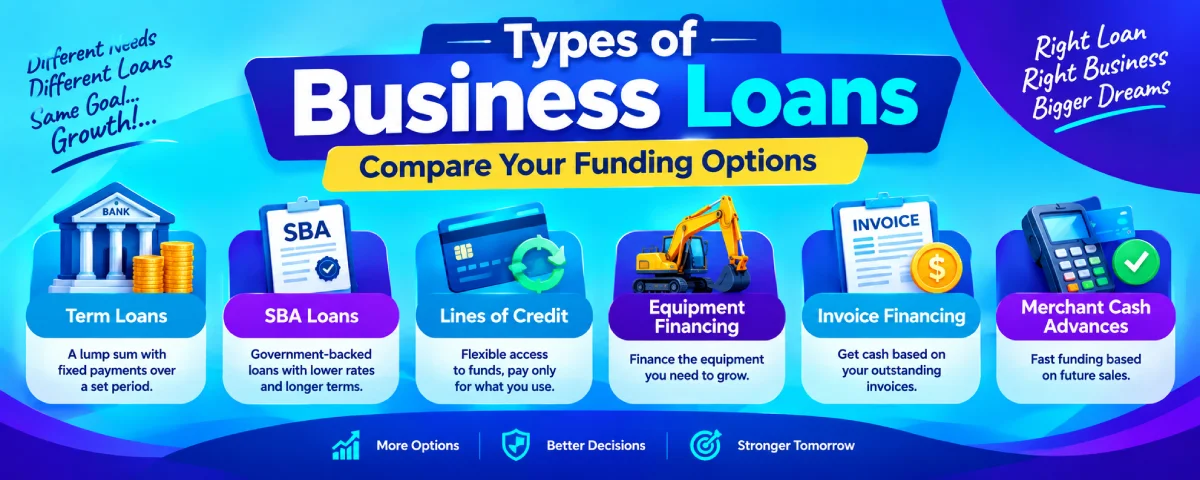
Types of Business Loans: Compare Your Funding Options
Types of business loans give owners different ways to bring in capital without the same rules, costs, or timelines. After reading the main Business Loans guide, this focused page helps you compare the main options side by side so you can pick the one that actually fits your need, cash flow, and timeline. In 2026, bank term loans still sit in the roughly 6.4%–11% range for stronger files, SBA products remain among the lowest-cost longer-term choices, and online options trade higher rates for speed. The goal here is simple: understand each type clearly, see real differences, and match the right product to the right situation.
Where This Fits in the Sequence
You already have the big-picture pillar. Now dig into the specific products. After this page, the natural next steps are usually:
- Check whether you qualify → Business Loan Requirements
- Understand exact rates and fees → Business Loan Interest Rates
- Decide secured vs unsecured → Secured vs Unsecured Business Loans
- Walk through the application → How to Apply for a Business Loan
- Plan how you’ll pay it back → Business Loan Repayment
This keeps the information continuous and easy to follow.
How Do Business Term Loans Work?
A business term loan is the classic “borrow a fixed amount and pay it back over time” product. You receive a lump sum once. Then you make regular payments (usually monthly) that cover both principal and interest until the balance reaches zero. The term can run from a few months to 10 years or longer, depending on the lender and the purpose.
Here’s the everyday version of how it works:
- You decide how much you need and why (equipment, expansion, inventory, refinance, etc.).
- You apply and share credit, revenue, time in business, and financial statements.
- The lender approves a specific amount, rate, and repayment schedule.
- Funds land in your business account.
- You start making fixed payments on the agreed schedule.
- When the last payment clears, the loan is done.
In 2026, traditional bank term loans for qualified small businesses often price between about 6.4% and 11%. Online and fintech lenders commonly start higher—frequently 14% and up, sometimes much higher for thinner files. Longer terms lower the monthly payment but increase total interest paid. Shorter terms cost more each month but finish faster and usually cost less overall in interest.
Two common structures:
- Fully amortizing — every payment reduces principal from day one. Most bank and SBA term loans work this way.
- Interest-only period followed by amortizing payments — sometimes offered for a short window at the start. Useful if you expect a revenue ramp-up, but the principal still has to be repaid later.
I’ve watched owners take a five-year term loan for a short-term cash gap and later regret the long commitment. Term loans work best when the need is clear, the amount is fixed, and the repayment schedule matches real cash flow. If your revenue is lumpy or seasonal, a different product often fits better.
Pros of term loans
- Predictable monthly payments
- Can lock in a fixed rate for budget certainty
- Larger amounts available from banks and SBA lenders
- Builds business credit history when paid on time
Cons
- Harder to qualify for the lowest rates
- Takes longer to fund than many online products
- Prepayment penalties sometimes apply
- Less flexible if your needs change mid-term
When Is a Business Line of Credit Useful?
A business line of credit works more like a business credit card than a traditional loan. The lender approves a maximum amount you can borrow. You draw only what you need, when you need it. Interest is charged only on the outstanding balance. As you repay, the available credit usually replenishes so you can draw again.
This makes a line of credit especially useful in a few real situations:
- Seasonal businesses that need extra inventory or payroll before the busy season and can pay it down afterward
- Companies with uneven cash flow that occasionally face gaps between paying suppliers and collecting from customers
- Ongoing working-capital needs where you don’t want a new loan every time
- Unexpected expenses (equipment repair, sudden opportunity, temporary slowdown)
In 2026, bank lines of credit for solid files often land in the 7%–14% range. Online lines can start lower for strong credit but frequently run higher overall, sometimes into the 20%+ territory. Some lines are secured (backed by receivables or inventory); others are unsecured and rely more on credit and cash flow.
Key practical points:
- You pay interest only on what you actually use.
- Many lines require periodic interest-only payments or minimum principal reductions.
- Some lenders re-evaluate the line annually and can reduce or cancel it if your numbers weaken.
- Drawing the full amount and leaving it outstanding turns the line into something closer to a term loan—usually not the best use.
A line of credit shines when flexibility matters more than locking in a fixed long-term rate. It is less ideal when you need a large one-time sum for a specific purchase that will be paid off over several years.
What Are Equipment Loans and Invoice Financing?
Equipment loans (or equipment financing)
These are term loans specifically for buying machinery, vehicles, technology, or other tangible assets. The equipment itself usually serves as the primary collateral. Because the lender has a clear asset to reclaim if something goes wrong, approval can be easier and rates can be lower than a general unsecured term loan—especially for newer or slightly lower-credit businesses.
Typical 2026 ranges: rates from roughly 4%–8% on the strong end up to 20%–45% for higher-risk files. Terms often match the useful life of the asset (commonly 3–7 years). You can sometimes finance 80%–100% of the purchase price. Down payments of 10%–20% are common but not always required.
Best for: trucks, manufacturing equipment, medical devices, restaurant equipment, computers, and similar purchases where the asset has resale value.
Invoice financing and invoice factoring
These products turn unpaid customer invoices into cash now.
- Invoice financing — you borrow against the value of outstanding invoices and repay when customers pay.
- Invoice factoring — you sell the invoices to a factoring company at a discount. The factor collects from your customers (sometimes with your branding still on the invoices, sometimes not).
Fees typically run 1%–5% of the invoice value for a set period (often 30 days). The exact cost depends on invoice volume, customer credit quality, and how long the invoices take to pay. Approval focuses more on who owes you money than on your personal credit score. Funding can happen in 1–3 days once invoices are verified.
Best for: B2B companies with reliable customers on 30-, 60-, or 90-day payment terms that create cash-flow gaps. Not ideal if most of your revenue is consumer card sales or if customers are slow or unreliable payers.
Both products solve a specific timing problem: you have done the work or delivered the goods, but the cash is still sitting in someone else’s accounts receivable.
How Do Government-Backed Loans Differ by Country?
Government-backed loans exist in many countries to help small businesses access capital that private lenders might otherwise avoid. The details vary significantly.
United States (SBA programs)
The Small Business Administration does not lend money directly in most cases. It guarantees a portion of loans made by banks and other approved lenders. That guarantee reduces the lender’s risk and often leads to better rates and longer terms for the borrower.
Main 2026 programs:
- 7(a) — flexible use, up to $5 million, rates typically capped near prime + 3%–6.5%
- 504 — fixed assets (real estate, large equipment), rates often in the 5%–7% range, long terms
- Microloans — up to $50,000 through nonprofit intermediaries
Personal guarantees are standard for owners with 20%+ ownership. Collateral rules are more flexible on smaller loans. Processing takes longer than online loans (often 30–90 days).
Canada
The Canada Small Business Financing Program (CSBFP) provides government guarantees on loans made by private lenders for equipment, leasehold improvements, and real estate. Loan limits and guarantee percentages differ from the U.S. model. Interest rates are set by the lenders within program rules.
United Kingdom
Schemes have changed over time. Recent years have seen recovery and growth loan programs with partial government guarantees. Terms, eligibility, and maximum amounts are set by the specific scheme in force. Rates and fees are generally commercial but with the government sharing some risk.
Australia, India, and other markets
Many countries run their own small-business loan guarantee or direct lending programs through development banks or commercial banks with government support. Eligibility, maximum amounts, interest subsidies, and collateral rules differ widely. Some focus on specific sectors (export, manufacturing, women-owned, rural) or on startups.
Key takeaway
Always check the current program rules in your country. Government-backed products usually offer better long-term pricing than pure private online loans, but they come with more documentation, longer timelines, and specific eligibility rules. In the U.S., the SBA remains the most widely used framework for small-business owners seeking lower-cost, longer-term capital.
How Do You Match Loan Types to Funding Needs?
Matching starts with three honest questions:
- What exactly do I need the money for?
- How quickly do I need it?
- How will I repay it from real cash flow?
Here’s a practical matching guide based on common situations in 2026:
| Your Situation | Strongest Fit | Why It Fits | Watch Out For |
| One-time expansion or large purchase | Term loan or SBA 7(a)/504 | Fixed amount, longer repayment | Qualification and timeline |
| Seasonal inventory or cash gaps | Business line of credit | Draw and repay as needed | Interest only on what you use |
| Buying specific equipment or vehicles | Equipment financing | Asset as collateral, often easier approval | Asset must have resale value |
| Waiting on customer invoices | Invoice financing/factoring | Turns receivables into cash quickly | Fees add up; customer notification |
| Need funds in a few days | Online term loan or MCA | Speed | Higher cost |
| Lowest long-term cost, can wait | SBA 7(a) or 504 | Government guarantee, better rates/terms | Paperwork and 30–90 day process |
| Ongoing flexible working capital | Line of credit | Revolving access | Possible annual review |
| Very small amount, newer business | Microloan or equipment loan | Lower barriers | Limited size |
Extra decision tips from real experience
- If the need is temporary and the amount is modest, avoid locking into a long term loan.
- If you have strong credit, time in business, and solid revenue, start with bank or SBA options—you will likely save money over the life of the loan.
- If speed is critical and your file is thinner, online products or equipment financing often open doors that traditional banks close.
- Calculate total repayment cost, not just the monthly payment or the headline rate.
- Always read the prepayment, default, and personal-guarantee language before signing.
Side-by-Side Comparison Tables (2026 Snapshot)
Rates, speed, and amounts (approximate market ranges)
| Product | Typical Rate/Cost | Funding Speed | Typical Amounts | Collateral Usually Required? |
| Bank term loan | 6.4%–11% | 2–8 weeks | $25k–$1M+ | Sometimes |
| SBA 7(a) | ~9.75%–13.5% variable | 30–90 days | Up to $5M | Often for larger loans |
| SBA 504 | 5%–7% | 60–90+ days | $125k–$5.5M | Yes (fixed assets) |
| Online term loan | 14%–99% APR | 1–7 days | $5k–$500k | Often no |
| Business line of credit | 7%–99% APR | Same day–2 weeks | $10k–$250k+ | Varies |
| Equipment financing | 4%–45% APR | 3–14 days | Cost of equipment | Yes (the equipment) |
| Invoice factoring | 1%–5% fee | 1–3 days | Based on invoices | Invoices themselves |
| Merchant cash advance | 1.10–1.50 factor | 1–3 days | $5k–$500k | Usually no |
Best-use summary
| Need | First Choice | Alternative If You Don’t Qualify |
| Lowest long-term cost | SBA or bank term loan | Strong online term loan |
| Maximum flexibility | Line of credit | Short-term online term loan |
| Specific equipment purchase | Equipment financing | SBA 7(a) or term loan |
| Fast cash against invoices | Invoice financing | Short-term term loan |
| Very fast funding, any purpose | Online term or MCA | Line of credit if available |
These tables reflect typical 2026 market conditions. Your actual offer depends on credit, revenue, time in business, industry, and the specific lender.
Frequently Asked Questions
Which type of business loan is easiest to get?
Equipment financing and many online term loans or lines of credit are generally easier than traditional bank or standard SBA loans, especially with 6–12 months in business and decent revenue.
Are SBA loans always the best option?
They often offer the best combination of rate and term for qualified borrowers who can wait. They are not the fastest or the most flexible for short-term needs.
Can I have more than one type of financing at the same time?
Yes. Many businesses run a line of credit for daily flexibility and a term loan or equipment loan for specific projects. Just make sure the combined payments remain comfortable.
Do government-backed loans exist outside the U.S.?
Yes. Most developed economies have some form of small-business guarantee or support program. Rules, limits, and rates differ by country.
What happens if I need money faster than an SBA loan can deliver?
Look at online term loans, equipment financing, or a line of credit while you prepare a longer-term SBA application if the larger amount or better rate still makes sense later.
Troubleshooting Common Matching Mistakes
Took a long-term loan for a short-term need
Result: higher total interest and less flexibility. Fix: refinance into a shorter product or a line of credit if possible, or pay it down early if no prepayment penalty exists.
Chose the fastest option without checking total cost
Result: very high effective rates. Fix: calculate the full repayment amount before accepting. Sometimes waiting two extra weeks for a better product saves thousands.
Applied only to one lender
Result: weaker negotiating position. Fix: get at least two or three comparable offers.
Ignored cash-flow fit
Result: payments that strain the business. Fix: run a simple 12-month cash-flow projection that includes the new payment before you sign.
Choosing the right type of business loan is less about finding the single “best” product and more about matching the tool to the actual job. Use the tables and matching guide above, then move to the related cluster pages for deeper detail on requirements, rates, application steps, secured versus unsecured structures, and repayment planning. When the product fits the need and the payments fit the cash flow, financing becomes a growth tool instead of a burden.