

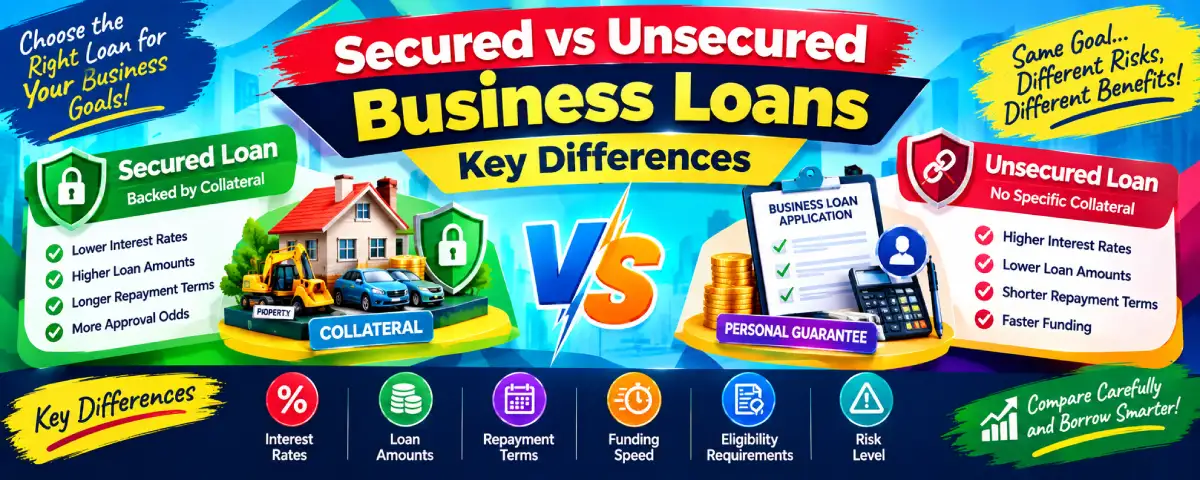
Secured vs Unsecured Business Loans: Key Differences
Secured vs unsecured business loans is one of the most important choices owners face when borrowing. The core difference is simple: a secured loan is backed by specific collateral the lender can claim if you do not repay, while an unsecured loan is not. That single distinction affects approval odds, interest rates, loan amounts, terms, speed, and what happens if the business runs into trouble. After the main Business Loans pillar and the guides on types, requirements, rates, and the application process, this page explains the practical differences so you can weigh the trade-offs clearly.
Where This Fits
You already understand the main loan types, eligibility factors, costs, and how to apply. Now decide whether pledging assets makes sense for your situation. The final related page in the sequence is usually:
- Plan repayment schedules and cash-flow management → Business Loan Repayment
This keeps the information continuous.
- What Makes a Business Loan Secured or Unsecured?
Secured business loans
The borrower pledges specific assets as collateral. Common examples include commercial real estate, equipment, vehicles, inventory, accounts receivable, or a blanket lien on business assets. The lender files a security interest (often a UCC-1 financing statement) so it has a legal claim on those assets. If the loan goes into default, the lender can seize and sell the collateral to recover what is owed.
Because the lender has a recovery path, secured loans generally offer lower interest rates, higher possible amounts, and longer terms. Equipment financing is a common form of secured lending—the equipment being purchased serves as the collateral. Real-estate-backed loans and many larger bank or SBA facilities also fall into this category.
Unsecured business loans
No specific business asset is pledged. The lender relies primarily on the business’s cash flow, credit history, time in business, and the personal guarantees of the owners. Many online term loans, some bank lines of credit, and certain SBA loans under smaller dollar thresholds are structured as unsecured (or only lightly secured).
Unsecured loans are often faster to fund because there is no appraisal or collateral documentation to complete. The trade-off is usually higher interest rates, lower maximum amounts, and shorter terms, since the lender takes more risk.
Important nuance
Even “unsecured” small-business loans almost always require a personal guarantee from owners with 20% or greater equity. A personal guarantee is not the same as collateral, but it does give the lender a path to the owners’ personal assets if the business cannot pay. Some lenders also file a general UCC lien even on loans marketed as unsecured.
In short: secured = specific assets at risk; unsecured = no specific business assets pledged, but personal guarantees are still the norm.
- How Do Collateral and Personal Guarantees Differ?
Collateral
Collateral is property or assets the business (or sometimes the owner) pledges to the lender. It has a measurable value that the lender can recover through repossession or foreclosure if necessary.
Examples:
- A delivery truck or manufacturing machine in an equipment loan
- Commercial real estate in a real-estate-backed term loan or SBA 504
- Inventory or receivables in an asset-based line of credit
- A blanket lien covering most business assets
The lender’s risk is reduced because it has something tangible to claim. That lower risk usually translates into better pricing and terms for the borrower. The downside is that the asset is at risk if the loan defaults.
Personal guarantee
A personal guarantee is a legal promise by the owner(s) to repay the debt from personal assets if the business cannot. It is standard on the vast majority of small-business loans in 2026, whether the loan is secured or unsecured. Owners with 20% or more equity are typically required to sign.
A personal guarantee does not give the lender an automatic right to seize a specific asset the way collateral does. Instead, the lender must usually go through legal collection processes (which can include lawsuits, liens on personal property, or wage garnishment depending on the jurisdiction and the guarantee language).
Key practical difference
- Collateral puts specific business assets directly at risk and often improves rate and terms.
- A personal guarantee puts the owners’ personal net worth at risk and is required in almost every case regardless of whether collateral is also pledged.
Many loans are both secured (collateral) and guaranteed (personal guarantee). Understanding both pieces helps you evaluate the real exposure.
- How Do Eligibility, Costs, and Terms Compare?
Eligibility
Secured loans can be easier to qualify for when the collateral is strong, even if credit or time in business is only moderate. The asset reduces the lender’s risk, so underwriters may be more flexible. Unsecured loans lean more heavily on personal credit, revenue consistency, and time in business. Strong credit and cash flow are usually required for the best unsecured offers.
Interest rates and costs (2026 market snapshot)
Secured loans typically carry lower rates because of the reduced risk. Bank and SBA secured facilities often land in the lower end of the 6%–12% range for qualified borrowers. Unsecured bank loans sit higher; unsecured online term loans commonly start in the mid-teens and can run much higher depending on risk.
Fees follow a similar pattern—secured loans may involve appraisal or documentation costs, while unsecured online products often charge higher origination fees or use factor-rate pricing that raises the effective cost.
Loan amounts and terms
Secured loans generally support larger amounts and longer repayment periods (especially when real estate or long-lived equipment is involved). Unsecured loans are more often capped at lower limits and shorter terms so the lender can be repaid faster.
Speed
Unsecured loans (especially online) are usually faster because there is no collateral valuation or lien perfection process. Secured loans take longer when appraisals, title work, or UCC filings are required.
Side-by-side comparison table (typical 2026 ranges)
| Factor | Secured Business Loan | Unsecured Business Loan |
| Collateral | Required (specific assets) | Not required (personal guarantee still common) |
| Typical interest rates | Lower (often 6%–12% for strong files) | Higher (bank ~7%–15%; online 14%–40%+) |
| Loan amounts | Often higher | Often lower |
| Repayment terms | Often longer | Often shorter |
| Approval difficulty | Can be easier with strong collateral | Relies more on credit and cash flow |
| Funding speed | Slower (appraisal/lien work) | Faster (especially online) |
| Main risk to borrower | Loss of the pledged assets | Personal assets via guarantee + higher cost |
Another quick view – cost and flexibility
| Priority | Generally Favors | Reason |
| Lowest possible rate | Secured | Lower lender risk |
| Largest possible amount | Secured | Collateral supports higher limits |
| Fastest funding | Unsecured | No collateral process |
| No specific assets at risk | Unsecured | Nothing pledged |
| Easier qualification with weaker credit | Secured (if collateral is good) | Asset offsets credit risk |
| Simpler documentation | Unsecured | Fewer valuation steps |
These are general patterns. Individual offers vary with credit, revenue, industry, and the specific lender.
- What Happens If the Business Cannot Repay?
With a secured loan
If the loan defaults, the lender can exercise its rights against the collateral. This may involve repossessing equipment, foreclosing on real estate, or taking control of other pledged assets and selling them to recover the balance. The process and timeline depend on the type of collateral and state law. Any shortfall after the collateral is sold can still be pursued through the personal guarantee.
With an unsecured loan
There is no specific business asset the lender can automatically seize. The lender typically relies on the personal guarantee. Collection can involve demands for payment, lawsuits, judgments, and attempts to collect from the owners’ personal assets. Credit damage occurs in both cases, but the path to recovery is different.
In both structures
Default almost always damages business and personal credit, can trigger legal action, and may make future financing much harder. Early communication with the lender if trouble appears is almost always better than waiting until payments are missed. Some lenders will discuss temporary modifications, forbearance, or restructuring if the situation is addressed proactively.
The presence of collateral does not eliminate personal exposure when a guarantee is also in place. It simply gives the lender an additional (and often faster) recovery route.
- Which Trade-Offs Should Borrowers Evaluate?
Choosing between secured and unsecured is a risk-versus-reward decision. Consider these practical questions:
Do you have usable collateral?
If you are buying equipment or own real estate or other assets with clear value, a secured structure may deliver meaningfully better rates and terms. If you have few pledgeable assets, unsecured (or lightly secured) options may be the only realistic path.
How important is the lowest possible rate?
Over a multi-year term, even a 3–5 percentage point difference in rate can add up to tens of thousands of dollars. Secured loans usually win on pure cost.
How quickly do you need the funds?
If speed is critical, unsecured online products often fund in days rather than weeks. The higher cost may be acceptable for a short-term need.
What is your risk tolerance for the assets?
Pledging a key piece of equipment or real estate means that asset is at risk if the business cannot pay. Some owners prefer to keep assets free and accept a higher rate instead.
How strong is your credit and cash flow?
Strong files can often obtain reasonable unsecured terms. Weaker files may need the support of collateral to get approved at all or to reach an acceptable rate.
What is the purpose and time horizon of the funds?
Long-term investments (real estate, major equipment, expansion) often pair well with secured, longer-term financing. Short-term working-capital needs may fit unsecured lines or shorter-term products better.
Hybrid and middle-ground options
Equipment financing is secured by design but often easier to obtain than a general bank term loan. Some SBA loans are only partially secured. A few lenders offer “partially secured” structures. Exploring these middle options can produce a better balance of rate, amount, and risk.
Practical Decision Framework
| Your Situation | Lean Toward | Why |
| Strong collateral available, want lowest rate | Secured | Better pricing and terms |
| Need funds in days, limited assets | Unsecured | Speed and accessibility |
| Buying specific equipment | Equipment financing (secured) | Asset matches the purpose |
| Excellent credit and cash flow, no desire to pledge assets | Unsecured (if rates are acceptable) | Avoids putting assets at risk |
| Marginal credit but solid assets | Secured | Collateral can offset credit weakness |
| Long-term real-estate or major expansion | Secured (often SBA 504 or bank) | Matches long horizon and lower cost |
Frequently Asked Questions
Is a personal guarantee the same as collateral?
No. Collateral is a specific asset pledged to the loan. A personal guarantee is a promise to repay from personal assets if the business cannot. Most small-business loans require the guarantee whether or not collateral is also taken.
Can I get an unsecured business loan with average credit?
It is possible through online lenders, but rates will be higher and amounts may be limited. Stronger credit improves both approval odds and pricing.
Do SBA loans require collateral?
It depends on the program and loan size. Smaller SBA loans often have more flexible collateral rules. Larger loans are generally expected to be secured to the extent possible. Personal guarantees are standard.
What assets can be used as collateral?
Common options include equipment, vehicles, real estate, inventory, and accounts receivable. Lenders prefer assets that are easy to value and sell if necessary.
Does securing a loan with collateral hurt my ability to borrow later?
It can, because the asset is already pledged. A blanket lien can also limit future flexibility. This is one reason some owners prefer to keep certain assets free.
Troubleshooting Common Concerns
I don’t want to risk my equipment or property
Look at unsecured options first and compare the total cost. If the rate difference is large, calculate how much extra interest you would pay over the full term and decide whether the peace of mind is worth it.
My credit is only fair but I have solid assets
A secured loan (especially equipment financing or an asset-based facility) is often the more realistic path to approval and reasonable terms.
I need money quickly and have good credit
Start with unsecured online term loans or lines of credit. You can always refinance into a lower-rate secured product later if the need becomes longer-term.
The lender wants both collateral and a personal guarantee
This is common. Understand exactly what is being pledged and the conditions under which the lender can act. Ask for plain-language explanations of the default and enforcement provisions.
Conclusion
Secured and unsecured business loans serve different needs and carry different risk profiles. Secured loans generally deliver lower rates, higher amounts, and longer terms because the lender has collateral to fall back on. Unsecured loans offer speed and keep specific business assets free, but they usually cost more and come with tighter limits. In almost every case a personal guarantee is still required, so owners retain personal exposure either way.
The better choice depends on the assets you can comfortably pledge, how important the lowest rate is, how quickly you need the funds, and how strong your credit and cash flow are. Use the comparison tables and decision framework above to weigh the trade-offs for your specific situation. Once you have chosen the structure that fits, return to the application and repayment guides to complete the process carefully. When the loan type, security structure, rate, and repayment plan all align with the real needs and cash flow of the business, financing becomes a tool for growth rather than a source of ongoing pressure.