


Business Budgeting: Build, Track, and Adjust Your Plan (2026 Guide)
Almost all companies know that they are supposed to have a budget. However, hardly any of them apply their budget effectively. They prepare some form of a budget at the beginning of the fiscal year, look through it several times and then forget about it until something happens. Then, most likely, it is too late already.
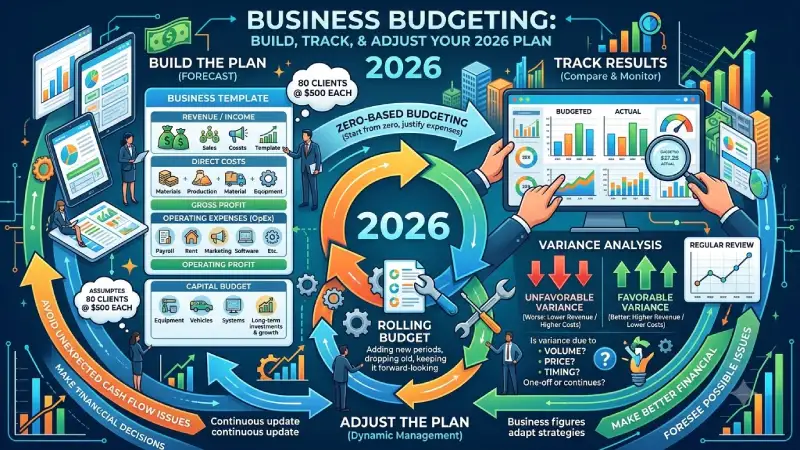
A business budget is basically a plan of your finances that includes expected income, planned expenditure and the overall balance between them. When implemented properly, it allows making better financial decisions, avoiding unexpected situations with cash flow and foreseeing possible issues before they even happen.
The aim of this guide is to tell you what is a budget of a business, its elements, main budget types used by businesses, how to make one, how to monitor it and change it according to real life circumstances.
What Is a Business Budget and What Should It Include?
The business budget refers to a financial plan within a certain timeframe, normally within one month, one quarter, or one fiscal year. The primary idea behind developing a business budget is quite simple; the question which it needs to answer is the following: how much money we expect to earn, how much we will spend, and will we be fine?
Unfortunately, many people make this idea much more complicated than it actually is. In essence, a budget is a mere prediction of the future which you are going to test against reality later. When all numbers are stated clearly, it will be much easier to spot any mistakes.
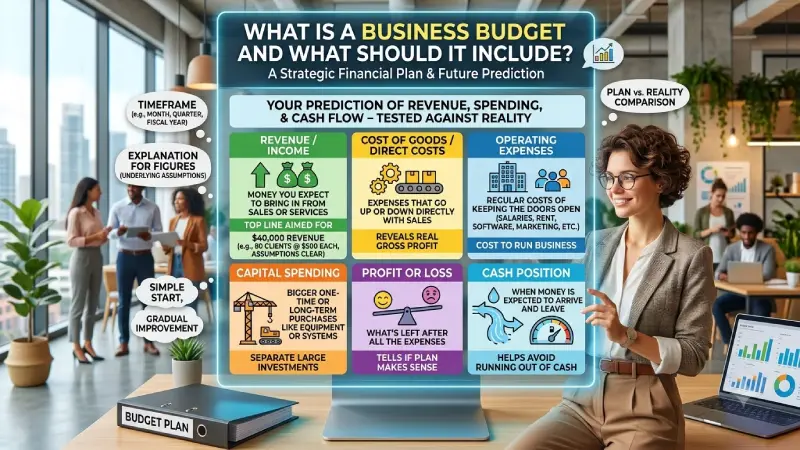
Most useful budgets contain these main parts:
| Part of the Budget | What It Covers | Why It Matters |
| Revenue / Income | Money you expect to bring in from sales or services | Shows the top line you’re aiming for |
| Cost of Goods / Direct Costs | Expenses that go up or down directly with sales | Helps you see your real gross profit |
| Operating Expenses | The regular costs of keeping the doors open (salaries, rent, software, marketing, etc.) | Shows what it actually costs to run the business |
| Capital Spending | Bigger one-time or long-term purchases like equipment or systems | Keeps large investments separate from everyday costs |
| Profit or Loss | What’s left after all the expenses | Tells you if the plan makes sense |
| Cash Position | When money is expected to arrive and leave | Helps avoid running out of cash even if the business is profitable on paper |
Another aspect to take into consideration is the explanation for your figures. If you state that revenue will be $40,000 the next month, you need to mention the underlying assumption: perhaps 80 clients with an average cost of $500 each. This way, when the real figures turn out to be different, it will be easy to understand what has gone wrong – whether there were less customers or the price dropped.
At the beginning of your business journey, it is not necessary to have a detailed and accurate budget. It is much more important to have a simpler budget that you use regularly. The perfect budget which is never used is useless while a simple budget will get improved gradually.
It is not about predicting everything with great precision. It is about having a plan and comparing it with the reality.
How Operating and Capital Budgets Differ
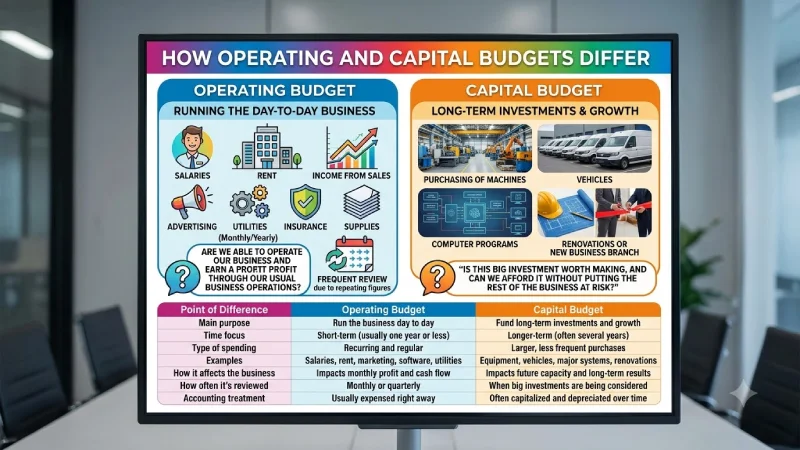
Not all money a business spends is the same. Some costs keep the lights on every month. Other costs are bigger investments that are supposed to help the business for years. This is why many companies separate their budgeting into two main types: the operating budget and the capital budget.
Operating Budget
An operating budget is a budget for all the day-to-day expenses of doing business. Salaries, rent, subscription services, advertising, utilities, insurance, supplies, and many others fall under the umbrella of operating budget. Operating budgets also consider the income expected from sales.
In layman’s language, an operating budget helps one answer the following question:
“Are we able to operate our business and earn a profit through our usual business operations?”
Since most figures included in an operating budget keep repeating themselves on a monthly or yearly basis, it is considered much more frequent in review than any other budget.
Capital Budget
Capital budgeting is aimed at large investments. It includes purchasing of machines, vehicles, computer programs, and other big purchases like renovation of your working place or creating a new business branch. This type of budgeting is not used to cover daily expenses.
The capital budget answers a different question:
“Is this big investment worth making, and can we afford it without putting the rest of the business at risk?”
Key Differences at a Glance
| Point of Difference | Operating Budget | Capital Budget |
| Main purpose | Run the business day to day | Fund long-term investments and growth |
| Time focus | Short-term (usually one year or less) | Longer-term (often several years) |
| Type of spending | Recurring and regular | Larger, less frequent purchases |
| Examples | Salaries, rent, marketing, software, utilities | Equipment, vehicles, major systems, renovations |
| How it affects the business | Impacts monthly profit and cash flow | Impacts future capacity and long-term results |
| How often it’s reviewed | Monthly or quarterly | When big investments are being considered |
| Accounting treatment | Usually expensed right away | Often capitalized and depreciated over time |
Why Separating Them Matters
When things become mixed up in business, it is more difficult to know what is happening. A large purchase of equipment could make one month look bad when in fact the ongoing business is doing well. On the other hand, an enterprise could be earning profits, yet at the cost of ignoring necessary future investments.
Keeping the two budgets separate helps in a few practical ways:
- You can judge normal operations more clearly
- You can evaluate big purchases on their own merits
- You protect day-to-day cash flow from being drained by large one-time costs
- It becomes easier to plan ahead for major expenses instead of being surprised by them
Simple Example
Imagine a small landscaping company.
- In its operating budget, it plans for crew wages, fuel, equipment maintenance, marketing, and insurance.
- In its capital budget, it plans for buying two new trucks and replacing old mowers.
If the owner put the truck purchases into the regular monthly expenses, the business would suddenly look like it was losing money that month — even if jobs and normal costs were fine. By separating them, the owner can see both pictures clearly: how the regular business is performing, and whether the big equipment investment makes sense.
Practical Tip
Small and medium sized companies have always had a very clear policy:
- Where the expense is recurring and expected to occur again, it goes in the operating budget.
- Where the expense is big, unusual and expected to provide value to the company for more than one year, it goes into the capital budget.
Doing this correctly makes the budget The segregation enables him to look at two pictures simultaneously: his normal business picture, and his picture regarding the success of spending so much money on equipment.
How to Create a Business Budget Template
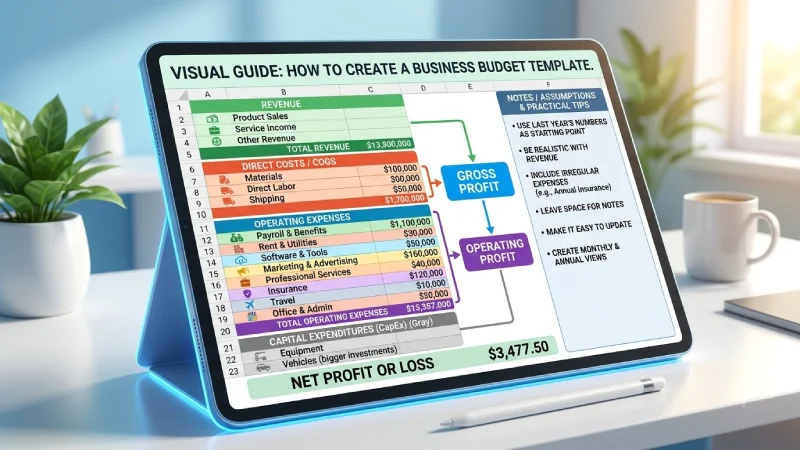
A budget template is just a clear structure that helps you organise your numbers so you can update them easily and actually use them. It doesn’t need to be fancy. Most small businesses can build a perfectly good one in Excel or Google Sheets. There is also accounting software that will work for you if you are already using one.
The key point about a template is very clear – make it easy to know how much money you are expected to receive and how much you intend to spend.
Basic structure most small businesses can use
Here’s a practical layout that works for many companies:
- Revenue section
Money you expect to bring in. If possible, break it down by product, service, or sales channel. This makes it easier to see what’s working later. - Direct costs / Cost of goods sold
The expenses that go up or down with sales (materials, product costs, direct labour, shipping, etc.). - Gross profit
Revenue minus direct costs. This shows how much you have left after the costs directly tied to delivering your product or service. - Operating expenses
The regular costs of running the business. Group these into clear categories so the budget stays easy to read. - Operating profit
What’s left after operating expenses. This is a key number for understanding if the core business is healthy. - Capital expenditures (if any)
Bigger investments like equipment, vehicles, or major systems. Keeping these separate stops them from distorting your normal operating picture. - Net profit or loss
The final number after everything. - Notes / Assumptions
A small part where you write the reasoning behind the figures (such as expected number of customers, average order size, or growth rate). It proves to be invaluable when there is any deviation from the planned results.
Helpful categories for operating expenses
Most businesses benefit from grouping expenses into clear buckets. Common ones include:
| Category | Examples | Why It’s Useful to Track Separately |
| Payroll and benefits | Salaries, wages, bonuses, benefits | Usually one of the biggest costs |
| Rent and utilities | Office rent, electricity, internet | Fixed or semi-fixed costs |
| Software and tools | Subscriptions, apps, platforms | Easy to overlook and grow quietly |
| Marketing and advertising | Ads, content, tools, agencies | Directly linked to growth efforts |
| Professional services | Accounting, legal, consultants | Can vary a lot by month |
| Insurance | Business, liability, equipment | Often paid annually or quarterly |
| Travel | Flights, hotels, transport | Useful to watch if it grows |
| Office and admin costs | Supplies, postage, small equipment | Small but adds up |
| Miscellaneous / Contingency | Unexpected or hard-to-classify costs | Gives some breathing room |
You don’t need every category. Choose the ones that matter most in your business and keep the list manageable.
Make the template match your business
The best template is one that reflects how your business actually works.
- If you sell different products or services, separate the revenue and direct costs by line.
- If you have more than one location, consider tracking them separately.
- If your business is simple, keep the template simple too. Extra detail that nobody looks at just creates work.
Many businesses create two views:
- A monthly budget so they can track progress throughout the year
- An annual summary so they can see the bigger picture
This combination is usually more useful than only having a yearly total.
A few practical tips when building your template
- Start with last year’s actual numbers if you have them. It’s easier to adjust real figures than to invent everything from scratch.
- Be realistic with revenue. Overly optimistic income numbers make the whole budget less useful.
- Include irregular expenses (like annual insurance or software renewals) so they don’t surprise you later.
- Leave space for notes. Future you will thank present you when you’re trying to remember why a number was set a certain way.
- Make it easy to update. If the template is painful to change, you probably won’t keep it current.
A good budget template doesn’t have to be flawless right from the start. What is required of it is that it should be clear enough for you to input data into it, analyze it, and make sound decisions based on it. The structure can always be improved later.
How Zero-Based and Rolling Budgets Work
There isn’t just one way to build a budget. Some businesses simply take last year’s numbers and adjust them a little. Others use more structured methods. Two approaches that are worth understanding are zero-based budgeting and rolling budgets. They solve different problems, and many companies end up using a bit of both.
Zero-Based Budgeting
This is a key figure for determining the health of the core business. You begin at zero. Every expenditure has to be proven as if you were making your first request.
Where before you might say, “We spent $2,000 on software last year, so let’s spend $2,100 next year,” now you ask, “Do we need this software anymore, and is this the right level of expenditure?”
There will likely be a higher cost in the short term. But there will be one advantage in using this approach: it prevents unneeded expenditures from creeping in unnoticed year after year.
Zero-based budgeting is often useful when:
- Costs feel like they’ve crept up over time
- The business has gone through big changes
- You want a fresh look at where money is actually going
It is not necessary that it is used for each and every line item each year. There are some companies that use it for certain areas (such as marketing, software, or overhead).
Rolling Budget
A rolling budget works differently. Instead of creating one fixed budget for the whole year and leaving it unchanged, you keep updating it as time passes.
For example, if you work with a 12-month rolling budget, every month (or every quarter) you:
- Add a new month (or quarter) at the end
- Drop the oldest period
- Update the numbers based on what you’ve learned
This way the budget always looks forward, rather than becoming outdated halfway through the year.
Rolling budgets are especially helpful when things change quickly — for example, when sales are unpredictable, costs are shifting, or the market is moving fast. They give you a more current picture than a budget that was set many months earlier.
How the Two Approaches Compare
| Aspect | Zero-Based Budgeting | Rolling Budget |
| Starting point | Starts from zero each time | Builds on the existing plan and updates it |
| Main strength | Questions every expense and removes waste | Keeps the budget current and forward-looking |
| Main drawback | Takes more time and effort | Requires regular updates |
| Best used when | You want a thorough cost review | Conditions change often and forecasts need updating |
| How often it’s done | Occasionally or for specific areas | Monthly or quarterly |
| Focus | Justifying spending | Staying up to date |
Using Both Together
Many businesses don’t choose one method and ignore the other. A practical approach looks like this:
- Create an annual budget (sometimes using zero-based thinking in key areas)
- Then keep it current with a rolling update process throughout the year
This combination gives you both discipline and flexibility. You get a clear plan at the start, and you also avoid running the business with outdated numbers six months later.
Simple way to think about it
- Use zero-based budgeting when you want to challenge costs and clean things up.
- Use a rolling budget when you want your plan to stay relevant as the year unfolds.
You don’t need to make the process complicated. Even a lighter version of these methods can make your budgeting much more useful than setting numbers once and forgetting about them
How to Compare Actual Results with the Budget

The development of the budget is the first task to accomplish. However, the true value of the budgeting process becomes evident when actual data is compared against plans. Otherwise, the budget remains a dead letter and will not be used anywhere else except the file.
This activity is also referred to as the variance analysis. Put simply, it is about analyzing the differences between expected and actual results and understanding the reasons for such variance.
Favorable vs Unfavorable Variances
| Type of Variance | What It Means | Example |
| Favorable | The actual result is better than planned | Revenue came in higher than expected, or costs were lower |
| Unfavorable | The actual result is worse than planned | Revenue was lower than expected, or costs were higher |
It’s important not to react to every small difference. Some variation is normal. What deserves attention are the larger gaps or the ones that keep appearing month after month.
What to Look for When You Review Variances
In case where the number varies significantly from the budget number, pose a few practical questions:
- Is the variance due to volume (increased or decreased activity)?
- Is the variance due to price (price higher or lower than budgeted)?
- Is the variance related to timing (it was early or late)?
- Is it a one-off occurrence or something that appears likely to continue?
- Does the variance represent a problem that needs solving, or an opportunity that can be capitalized on?
This will assist you go beyond “there is a difference between the two numbers” into “this is what should be done about the difference.”
A Simple Way to Review Variances
Many businesses find it useful to follow a short process each month:
- Compare actual results with the budget for the main categories (revenue, major costs, profit).
- Highlight the biggest differences.
- Try to explain the main causes.
- Decide whether any action is needed.
- Note anything that should change in next month’s forecast or plan.
You don’t need a long report. A short summary with the key variances and the reasons behind them is usually enough.
Why Regular Review Matters
This periodic review becomes less valuable when it is conducted just once or twice per year because assumptions prove false, situations change and new circumstances emerge. This way, reviewing the budget on a regular basis (monthly or quarterly at the very least), the budget will become an instrument of dynamic management rather than a static document.
As a result, after some time you will get better at making realistic assumptions for your budget plans.
Practical Tip
Concentrate on those differences that are significant both in magnitude and in importance to the company. A variance of a small amount regarding office supplies is irrelevant. However, a continual deficit in revenues or a continual increase in one of the expenses is important.
Through the constant comparison of actual performance with that planned in the budget and taking action based on the results, you transform the budget from a tool for planning into a tool for management.
Building a Practical Budgeting Process
Budgeting is more effective if it is integrated into the operation of the business than if it is a once-a-year process.
A simple process many businesses follow:
- Set the time period (monthly + annual is common)
- Gather past data and realistic assumptions
- Build the first version of the budget
- Review it with the relevant people
- Finalise and share it
- Track actual results every month
- Analyse the differences
- Adjust plans or actions when needed
- Update the forecast for the remaining months
Organizations which will derive the maximum benefits out of budgeting are those which consider it as a dynamic process. They will frequently review their budgets, discuss the figures and take decisions based on their observations.
Common Budgeting Mistakes to Avoid
- Making the budget too detailed and complicated to maintain
- Using unrealistic revenue assumptions
- Forgetting to include irregular or annual expenses
- Never comparing actual results to the budget
- Treating the budget as fixed even when conditions change significantly
- Focusing only on costs and ignoring cash flow timing
- Creating the budget alone without input from people who understand different parts of the business
A simpler budget that people actually use is almost always better than a complex one that sits ignored.
Best Thoughts
The budget is not an attempt at perfect forecasting. It is an attempt at creating an effective planning system, measuring reality, and adjusting where necessary. When you create a realistic budget, check it periodically, and base decisions on it, you minimize unexpected situations and gain more control over your business.
If necessary, start with a primitive budget. It should include your planned income, expenditures, and assumptions. Make comparisons between actual results each month. Draw conclusions from the differences. Gradually, your budgeting system will become more precise and valuable.
Well-budgeted businesses usually make more rational decisions than businesses without budgets. This fact alone already makes a huge difference.
Frequently Asked Questions
- How frequently should a company perform its budget evaluation?
Monthly evaluations usually work best for most organizations. Quarterly evaluations are also important.
- Explain the difference between budgeting and forecasting.
The budget is the plan that you set. The forecast is your expectation when additional information comes into the picture..
- Should small businesses adopt zero-based budgeting?
It may prove helpful at times when you feel like your expenses are getting out of hand. In general, there is usually a simpler alternative that is less burdensome.
- How detailed should a small business budget be?
As detailed as necessary, but as simple as possible for you to keep up with updates and reviews. Being overly detailed usually makes budgets hard to stick with.
- Is it more important to develop a perfect budget or to review it often?
Reviewing it frequently is more important. Even a simple budget becomes very effective when compared with the real world.
Conclusion
Business budgeting is one of the most effective tools that can be applied to facilitate operations in a more effective manner. It will aid in planning both the revenue and expenses, recognizing any problems before they even arise, and taking wiser decisions with regards to finances. The ideal way of budgeting is the way which is clear-cut, practical, and done regularly. Start by keeping it simple, measuring your progress, observing, and adapting.