


B2B Marketing Strategy: A Complete Guide for 2026
The B2B marketing strategy is the framework that helps you understand how the organization will acquire customers, engage with them, and persuade them to become customers. Without an established marketing strategy, B2B marketing would consist of a range of unrelated activities such as LinkedIn posts, paid advertising, and emails.
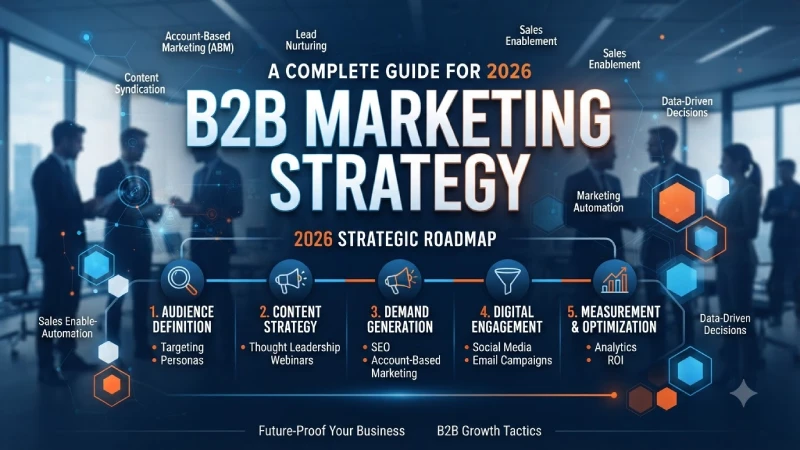
In most cases, businesses continue to approach B2B marketing by trying out various tactics and copying what the competition does. But, those enterprises which actually succeed in growing themselves sustainably have other strategies; they identify their targeted audience, core message, appropriate communication channels, and criteria for success evaluation.
This guide will provide a detailed explanation of the concept of B2B marketing strategy, its significance, types, approaches to its development, common mistakes, etc.
B2B Marketing Strategy: Meaning and Key Concepts
The B2B marketing strategy is a tangible strategy that provides the answers to several fundamental questions:
- Whom are we targeting?
- What is the solution we provide?
- How are we going to reach our target audience?
- What is the message we are going to deliver?
- How will we convert interest into the pipeline and revenue?
- How will we measure the effectiveness?
It is not a lengthy document full of theories. The best ways will be those which can be implemented easily by the team, and which can vary based on results obtained.
Key elements of a solid B2B marketing strategy
| Element | What It Covers | Why It Matters |
| Target audience | Ideal customer profile and buying roles | Prevents wasted effort |
| Value proposition | Clear reason why customers should choose you | Makes messaging sharper |
| Goals | What success looks like (leads, pipeline, revenue) | Creates focus |
| Channels | Where you will show up | Avoids spreading too thin |
| Content & messaging | What you will say and publish | Builds relevance and trust |
| Measurement | Key numbers you will track | Shows what is working |
A strategy that misses any of these usually feels incomplete and hard to execute.
Why B2B Marketing Strategy Matters
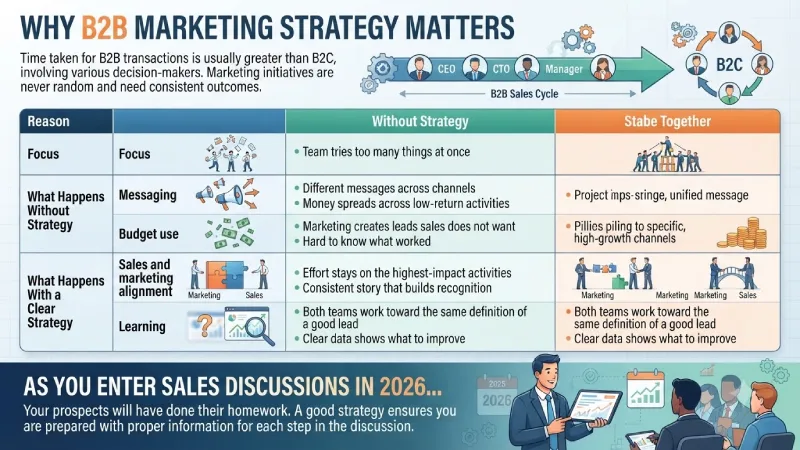
Time taken for the transaction process in B2B transactions is usually greater than most B2C transactions. Involvement of various decision-makers is common. This is the reason that marketing initiatives are never random and have inconsistent outcomes.
Main reasons a clear strategy matters
| Reason | What Happens Without Strategy | What Happens With a Clear Strategy |
| Focus | Team tries too many things at once | Effort stays on the highest-impact activities |
| Messaging | Different messages across channels | Consistent story that builds recognition |
| Budget use | Money spreads across low-return activities | Budget goes to proven or high-potential channels |
| Sales and marketing alignment | Marketing creates leads sales does not want | Both teams work toward the same definition of a good lead |
| Learning | Hard to know what worked | Clear data shows what to improve |
As you enter a discussion in sales in the year 2026, your prospects will have done their homework. To have a good strategy in place means that you will be prepared with proper information for each step in the discussion.
Key Types, Methods, and Examples
There is no single marketing strategy for all business-to-business companies. The strategy that you adopt should depend on your product, price, sales process, and other factors.
Common strategic approaches
| Approach | Best For | Main Focus | Typical Channels |
| Inbound / Content-led | Companies that can create useful content | Attracting buyers through helpful information | Blog, LinkedIn, SEO, email |
| Outbound / Prospecting-led | Higher-ticket offers with clear target accounts | Direct outreach to specific companies | Email outreach, LinkedIn, cold calling support |
| Account-Based Marketing (ABM) | Companies selling to a defined list of accounts | Personalised effort on high-value targets | Coordinated multi-channel outreach |
| Product-led | Tools that users can try easily | Letting the product drive adoption | Free trials, freemium, in-product prompts |
| Event & Community-led | Industries where relationships matter heavily | Building presence through events and groups | Webinars, conferences, communities |
Many companies use a mix. For example, they run content marketing for broader awareness and add account-based efforts for their most important prospects.
Sample
A mid-size software firm that serves operations staff realized that its earlier tactic (LinkedIn posts + sporadic advertisements) wasn’t generating enough good leads for them. They devised an approach based around a single buyer persona, three key content pillars, LinkedIn + email as key channels, and monthly pipeline analysis. In a few months’ time, the conversations had become better since the messages started making sense now.
How to Use or Apply B2B Marketing Strategy

A strategy only works if it turns into weekly and monthly actions.
Practical steps to build and apply a strategy
- Define your ideal customer
Please be specific about company size, industry, role, and key issues. - Clarify your value proposition
Select any one issue encountered with your solution and describe how it is different from the current solution. - Set realistic goals
Identify just a few goals that can be measured (such as leads, opportunities, or pipeline worth). - Choose 1–2 primary channels
Many groups work better by becoming proficient in a few media than being mediocre in lots of media. - Decide your main content themes
Pick 3–5 topics that directly relate to your customer’s problems. - Create a simple operating rhythm
Weekly content or outreach activity + monthly performance review. - Align with sales
Specify what makes for an effective lead, as well as your process for executing the handoff. - Review and adjust every 30–90 days
Keep what works, drop what doesn’t, and make improvements where needed.
Simple one-page strategy format
Many teams find it useful to keep the strategy on one page:
- Target customer
- Main problem we solve
- Key message
- Primary channels
- Content pillars
- Monthly goals
- Main metrics
This keeps the plan visible and easy to follow.
Best Practices and Common Mistakes
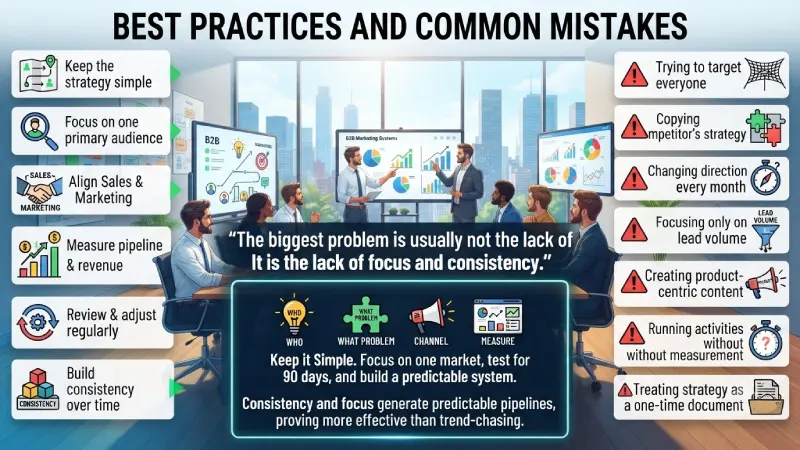
Best practices
- Keep the strategy simple enough that the team can actually follow it
- Focus on one primary audience before expanding
- Make sales and marketing share the same definition of a qualified lead
- Measure pipeline and revenue contribution, not only leads or traffic
- Review results regularly and adjust
- Build consistency over time instead of chasing every new tactic
Common mistakes
- Trying to target everyone
- Copying a competitor’s strategy without understanding why it works for them
- Changing direction every month
- Focusing only on lead volume instead of lead quality
- Creating content that talks about the product instead of the customer’s problems
- Running activities without a clear way to measure results
- Treating strategy as a one-time document instead of a living plan
The biggest problem is usually not the lack of ideas. It is the lack of focus and consistency.
Best Thoughts
There is no need to make your B2B marketing plan complex The trick is to make things simple. The moment you realize who you are communicating with, what problem you solve, via which communication channel, and how you can measure your success, everything becomes much simpler.
Create a basic plan first. Select one target market, one or two channels, and few messages. Test it for 90 days with persistent work. Evaluate your progress objectively. And refine your marketing efforts.
When B2B companies start thinking about their marketing programs as systems rather than scattered tactics, they generate much more predictable pipeline in the long run. Even now, it proves more effective than trend-chasing.
Frequently Asked Questions
- How long should a B2B marketing strategy be?
As brief as it possibly can be while still being valuable. Most successful strategies can easily fit onto one or two pages.
- How frequently should a B2B marketing strategy be revised?
Each quarter. Only substantial changes in the market environment, product, or business objectives warrant major modifications to the plan.
- Is content marketing still relevant for B2B?
It is relevant if done strategically and focuses on genuine customer needs. Posting without any kind of strategy is far less efficient.
- Is there any need for small companies in the B2B market to use ABM?
They can go for a simplified way of doing it. Complete implementation of ABM initiatives is suggested for companies that have a well-defined target customer and enough resources to make the interaction personalized.
- What is the core element of B2B marketing strategy?
It is the emphasis on the right customer and right message. All else will fall into place then.
Conclusion
Having a well-defined B2B marketing strategy prevents your team from switching among strategies arbitrarily. Everyone in the company will be working for the same people, solving the same problem, using the right channels, and achieving success according to agreed-upon metrics.
It doesn’t take a very elaborate plan for you to accomplish this goal. You just have to start with clarifying your target audience and message, choose the top one or two channels, come up with a couple of goals, and measure your progress. Most firms find themselves with improved pipeline after sticking to this approach.