

Marketing teams in the B2B environment have an extensive number of metrics they measure. These are website visits, social media likes, emails opened, and form fills. However, the issue is that most of these metrics are not useful as indicators of marketing efficiency and do not tell whether marketing helps you advance your business.
B2B marketing metrics are the metrics which help you understand what works and does not work, and where improvements need to be done. The most efficient metrics are the ones that measure marketing performance through pipeline and revenue, not actions.
In this article, we will explore what B2B marketing metrics are, their importance, different types of metrics, ways to measure them, and some of the most common errors that may occur in the process of measurement.
B2B Marketing Metrics: Meaning and Key Concepts
B2B marketing metrics are the metrics employed to measure the effectiveness and influence of marketing activities in a business-to-business environment.
Some good metrics will help us know the following:
- Are we contacting the correct firms?
- Are we creating any interest at all?
- How much pipeline are we creating through marketing?
- How effective are our customer acquisition activities?
- Are marketing activities influencing our revenues?
Key concepts to understand:
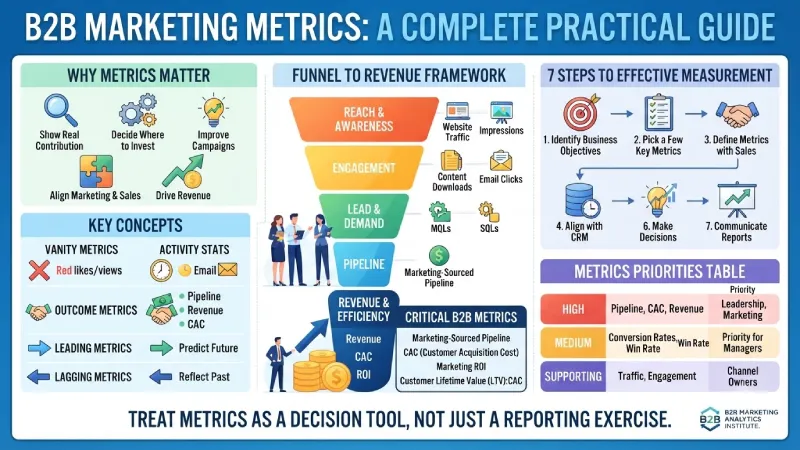
- Vanity metrics are those that look impressive but do not have any business implications (such as number of page views and social media likes).
- The activity statistics show what the team has accomplished (e.g., the number of e-mails sent).
- Outcome metrics reflect business performance (pipeline, revenue, customer acquisition cost).
- Leading metrics help in predicting future performance.
- Lagging metrics reflect past performance.
When it comes to B2B, the most effective key performance indicators tend to be those nearer to revenue rather than at the top of the funnel.
Why B2B Marketing Metrics Matters
Lack of metrics leads to decision-making based on assumptions or partial information. The marketing team continues spending resources on the usage of tools that appear to be working but actually produce no results at all.
Strong measurement helps you:
- Show the real contribution of marketing to the business
- Decide where to invest time and budget
- Improve campaigns and content based on evidence
- Align marketing with sales and leadership
- Spot problems early
- Stop activities that are not producing results
In 2025 and 2026, increasing numbers of businesses will see marketing as responsible for linking its actions directly to the pipeline and to revenue. Teams that can demonstrate their contributions will earn greater credibility and resources. Teams that only measure activity will find it difficult to make their case.
Key Types, Methods, and Examples
B2B marketing metrics can be grouped into several useful categories.
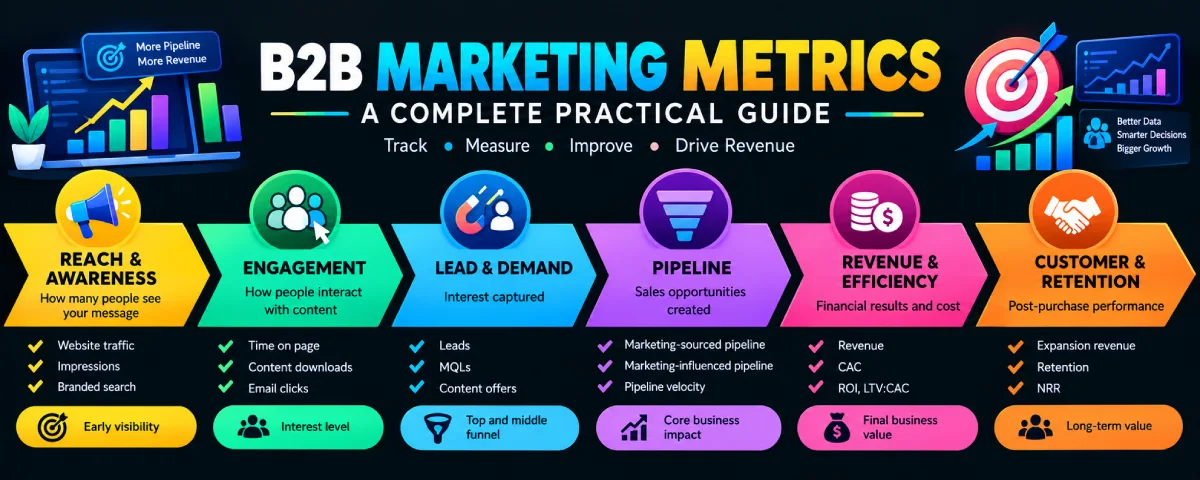
| Category | What It Measures | Example Metrics | Main Purpose |
| Reach & Awareness | How many people see your message | Website traffic, impressions, branded search | Early visibility |
| Engagement | How people interact with content | Time on page, content downloads, email clicks | Interest level |
| Lead & Demand | Interest captured | Leads, MQLs, content offers | Top and middle funnel |
| Pipeline | Sales opportunities created | Marketing-sourced pipeline, opportunities | Core business impact |
| Revenue & Efficiency | Financial results and cost | Revenue, CAC, ROI, LTV:CAC | Final business value |
| Customer & Retention | Post-purchase performance | Expansion revenue, retention, NRR | Long-term value |
Important Pipeline and Revenue Metrics
- Marketing-sourced pipeline (value of opportunities started by marketing)
- Marketing-influenced pipeline
- Pipeline velocity
- Customer Acquisition Cost (CAC)
- CAC payback period
- Marketing ROI
- Win rate by source
- Average deal size from marketing-sourced deals
Common Funnel Conversion Metrics
- Visitor-to-lead rate
- Lead-to-MQL rate
- MQL-to-SQL rate
- SQL-to-opportunity rate
- Opportunity-to-close rate
These conversion rates help you find where the process is strong or weak.
How to Use or Apply B2B Marketing Metrics
Here is a practical way to use metrics effectively.
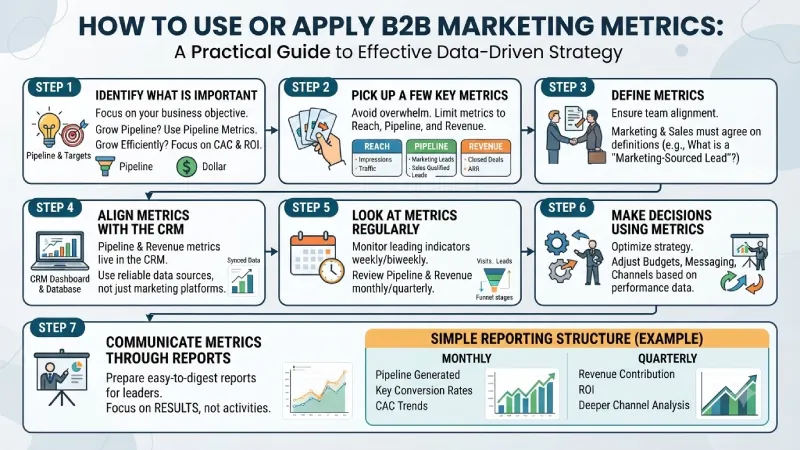
Step 1: Identify what is important
Firstly, focus on your business objective. If it is about growing your pipeline, use pipeline metrics. However, if you want to grow efficiently, focus on CAC and ROI.
Step 2: Pick up a few key metrics
Never choose a lot of metrics because you will be overwhelmed by them. Pick up a limited number covering reach, pipeline, and revenue.
Step 3: Define metrics
Make sure everyone agrees on definitions, especially between marketing and sales teams (what should be considered a lead sourced by marketing).
Step 4: Align metrics with the CRM
Pipeline and revenue metrics are normally in the CRM. Therefore, they are more reliable than marketing ones.
Step 5: Look at your metrics regularly
Monitor leading indicators on a weekly or biweekly basis. Pipeline and revenue metrics need to be reviewed on a monthly or quarterly basis.
Step 6: Make decisions using your metrics
Make changes in budgets, messaging, or channels according to metrics.
Step 7: Communicate metrics through reports
Prepare easy to digest reports for leaders. Concentrate more on results rather than activities.
A simple reporting structure many teams use:
- Monthly: Pipeline generated, key conversion rates, CAC trends
- Quarterly: Revenue contribution, ROI, deeper channel analysis
Best Practices and Common Mistakes
Best Practices
- Focus on metrics tied to pipeline and revenue
- Keep the number of core metrics manageable
- Align definitions with sales
- Use CRM data as the source of truth for pipeline and revenue
- Review metrics regularly and act on them
- Combine quantitative data with qualitative feedback
- Track both leading and lagging indicators
- Report results in a clear and honest way
Common Mistakes
- Tracking too many vanity metrics
- Reporting activity instead of outcomes
- Using different definitions across teams
- Ignoring pipeline and revenue metrics
- Looking at numbers without taking action
- Measuring without taking into consideration the industry, size of transaction, and sales cycle
- Being obsessed with short-term measurements while overlooking long-term trends
- Lack of association between marketing measurement and strategic objectives
The most effective teams treat metrics as a decision tool, not just a reporting exercise.
Simple Metrics Priority Table
| Priority Level | Metrics to Focus On | Who Cares Most |
| High | Pipeline generated, CAC, Revenue contribution, ROI | Leadership, Sales, Marketing |
| Medium | Conversion rates by stage, Win rate by source | Marketing & Sales managers |
| Supporting | Traffic, Engagement, Content performance | Channel owners |
FAQs
- What are the most critical metrics in B2B marketing?
These include marketing sourced pipeline, customer acquisition costs, marketing return on investment and revenue generated. These are linked directly to marketing actions and outcomes.
- How often should metrics in B2B marketing be checked?
Pipeline and other performance metrics should be reviewed monthly. Some leading metrics may be reviewed weekly. Quarterly analysis will be more in-depth.
- What is the difference between marketing sourced pipeline and marketing influenced pipeline?
Marketing sourced pipeline includes opportunities which originated from marketing efforts. Marketing influenced pipeline is the one where marketing had some role even though sales originated the opportunity.
- Why vanity metrics are a problem for B2B teams?
Vanity metrics are those that make things seem positive in the marketing world when there is no progress for the business. It distracts people from more meaningful metrics.
- What is the best approach for smaller B2B companies to use metrics?
Keep it simple. Start by tracking website conversion, number of opportunities created and cost per opportunity. Add additional metrics once you understand the basics.
Final Thoughts
Metrics are especially valuable for B2B marketing if they enable people to make better decisions. The purpose is not to have as many metrics as possible but to know what works and what doesn’t.
Pick out a few metrics that will help establish connections between your marketing endeavors and business performance. Ensure your metrics align with the definition of the sales team. Regularly review your metrics and optimize campaigns based on their results.
If your team treats metrics as a valuable management tool rather than a burdening reporting process, you will always squeeze out extra value from each marketing dollar spent.