

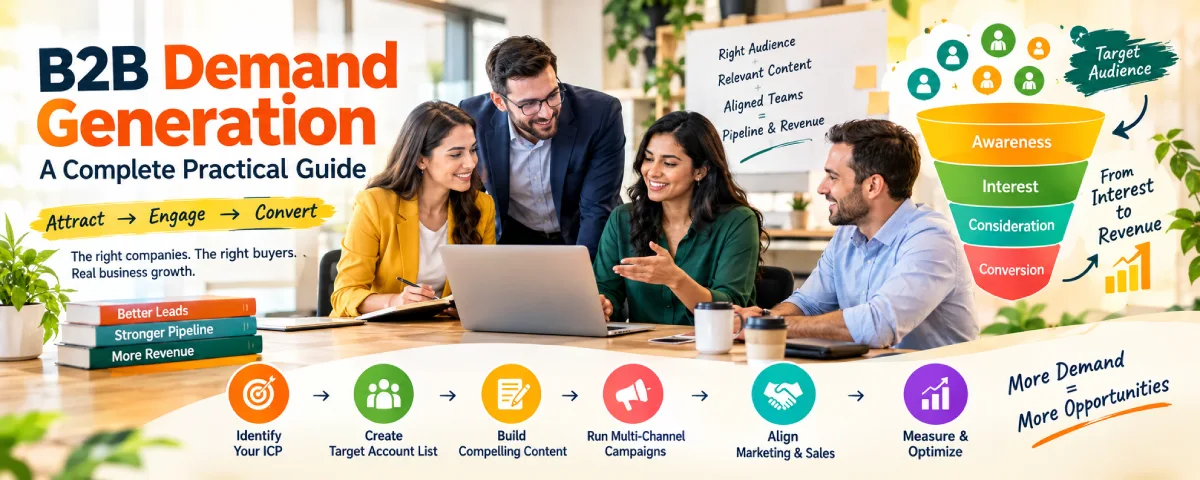
B2B Demand Generation: A Complete Practical Guide
Most B2B companies need a steady flow of interested buyers. Demand generation is the work of creating that interest and turning it into pipeline.
Unlike simple lead generation, which often focuses on collecting contact details, demand generation tries to build real interest in the problem you solve and the solution you offer. It covers the full journey — from the moment someone first hears about the problem to the point where they are ready to talk to sales.
This guide explains what B2B demand generation means, why it matters, the main types and methods, how to apply it, and the mistakes that slow teams down. The language stays clear and practical.
B2B Demand Generation: Meaning and Key Concepts
B2B demand generation is the process of creating awareness and interest in your product or service among the right businesses, then nurturing that interest until it becomes sales pipeline.
It is broader than lead generation. Lead generation usually focuses on capturing contact information. Demand generation focuses on creating demand in the first place and guiding people through the buying journey.
Key ideas behind B2B demand generation:
- Attract the right companies and buyers
- Educate them about the problem and possible solutions
- Build trust over time
- Convert interest into conversations and opportunities
- Align marketing and sales around the same goals
Demand generation works across the full funnel — from early awareness to sales-ready opportunities.
Why B2B Demand Generation Matters
In B2B, buying decisions are rarely quick or simple. Multiple people are often involved, research takes time, and trust matters. Companies that only collect leads without building real interest usually struggle with low-quality pipeline.
Strong demand generation helps in several practical ways:
- Creates a more predictable flow of opportunities
- Improves the quality of conversations sales teams have
- Reduces reliance on cold outreach alone
- Builds long-term visibility in your market
- Supports better alignment between marketing and sales
- Makes it easier to scale without proportionally increasing costs
In 2025 and 2026, many B2B teams have found that pure lead-volume tactics are becoming more expensive and less effective. Buyers do more independent research, and they respond better to useful information than to aggressive selling. Demand generation fits this reality better than older lead-gen-only approaches.
Key Types, Methods, and Examples
Demand generation is not one single tactic. It is a mix of activities that work together across different stages of the buyer journey.
Main Stages of Demand Generation
| Stage | Goal | Common Activities |
| Awareness | Make the right people notice you | Content, SEO, social, ads, events |
| Interest / Consideration | Help them understand the problem and options | Webinars, guides, case studies, email |
| Evaluation | Support deeper research | Demos, comparisons, proof, sales conversations |
| Conversion | Turn interest into pipeline | Clear offers, sales follow-up, retargeting |
Common Methods Used in B2B Demand Generation
- Content marketing (blogs, guides, original research)
- Search engine optimization (SEO)
- Paid advertising (LinkedIn, Google, retargeting)
- Email nurture sequences
- Webinars and virtual events
- Account-based approaches (for high-value targets)
- Social media and community presence
- Partnerships and co-marketing
- Intent data and behavioral signals
- Sales development outreach that feels relevant
Simple Examples
- A software company publishes practical guides about a common operational problem, runs LinkedIn ads to the right job titles, and nurtures interested readers with email sequences.
- A consulting firm hosts webinars for a specific industry, follows up with useful resources, and routes engaged attendees to sales.
- A SaaS company combines SEO content, targeted ads, and personalized outreach to accounts showing buying signals.
How to Use or Apply B2B Demand Generation
Here is a practical way to build or improve a demand generation system.
Step 1: Get clear on your Ideal Customer Profile (ICP)
Define the type of companies and buyers you want. Industry, company size, role, pain points, and buying triggers all matter.
Step 2: Map the buyer journey
Understand what your buyers care about at each stage — from first awareness to final decision.
Step 3: Choose a focused set of channels
Do not try to be everywhere at once. Pick a few channels that fit your audience and resources.
Step 4: Create useful content and offers
Focus on content that helps people understand problems and evaluate solutions. Educational content usually performs better than pure promotion.
Step 5: Build nurture and follow-up systems
Most buyers are not ready to buy immediately. Email sequences, retargeting, and sales follow-up help stay in front of them.
Step 6: Align marketing and sales
Agree on what a sales-ready opportunity looks like and how handoffs will work.
Step 7: Measure what matters
Track more than just leads. Look at pipeline created, opportunity quality, win rates, and revenue influence.
A simple starting framework many teams use:
- Define ICP and target segments
- Create core content for awareness and consideration
- Drive traffic through organic and paid channels
- Capture and nurture interest
- Hand qualified opportunities to sales
- Review results monthly and improve
Best Practices and Common Mistakes
Best Practices
- Focus on the right accounts and buyers, not just volume
- Create content that is actually useful
- Align marketing and sales early
- Use multiple channels in a coordinated way
- Nurture people who are not ready to buy yet
- Track pipeline and revenue, not only leads
- Test and improve continuously
- Keep messaging consistent across channels
Common Mistakes
- Chasing lead volume without caring about quality
- Treating demand generation as only a marketing job
- Creating too much promotional content and too little educational content
- Ignoring the middle of the funnel
- Poor handoff between marketing and sales
- Measuring only vanity metrics (clicks, form fills)
- Trying to run too many channels with limited resources
- Expecting fast results from long-term activities like content and SEO
The teams that get better results usually stay focused, create genuine value, and treat demand generation as a system rather than a collection of random campaigns.
Practical Comparison: Demand Generation vs Lead Generation
| Aspect | Lead Generation | Demand Generation |
| Main Focus | Capturing contact information | Creating interest and pipeline |
| Typical Goal | More leads | Better opportunities and revenue |
| Content Style | Often gated offers | Mix of educational and conversion content |
| Time Horizon | Shorter | Longer and ongoing |
| Sales Involvement | Later | Earlier and more collaborative |
| Success Metrics | Form fills, MQLs | Pipeline, opportunities, revenue |
Both approaches can work together. Many strong B2B teams use demand generation to create interest and lead generation tactics to capture it at the right moment.
Final Thoughts
B2B demand generation is about creating real interest among the right companies and guiding that interest toward sales conversations. It works best when it is treated as a full system rather than a set of disconnected tactics.
Start with a clear picture of your ideal customer. Create content and campaigns that help people understand their problems and evaluate solutions. Align marketing and sales. Measure pipeline and revenue, not just activity.
The companies that build consistent demand generation systems usually create more predictable growth over time. It takes discipline and patience, but the results tend to be more sustainable than short-term lead spikes.
Focus on being useful to the right buyers. That approach still works better than most complicated frameworks.