

Zero-based budgeting refers to the budgeting process in which each expense must be justified from scratch rather than basing it on previous years’ figures as the starting point.
It is opposite of what is generally practiced where the previous budget is used as the base and adjusted accordingly. Though, zero-based budgeting is labor-intensive, it can help organisations identify and eliminate unnecessary expenses that may not provide sufficient value.
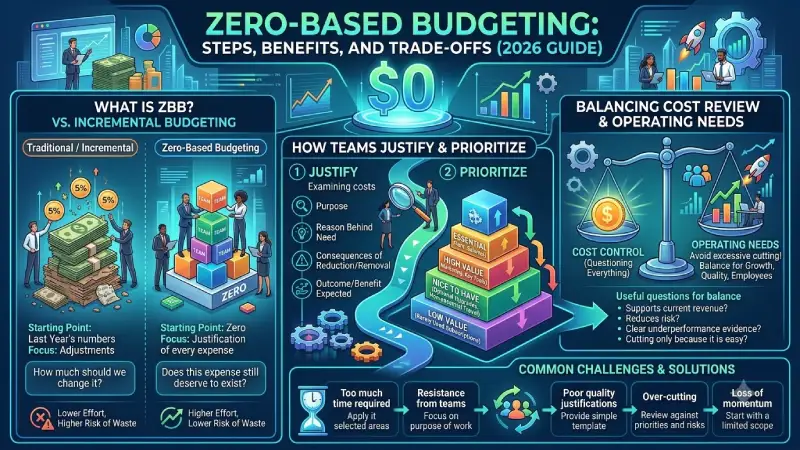
This guide covers the basics of zero-based budgeting, its difference from incremental budgeting, how justifications and priorities are determined by the team, how cost control should be balanced with operational realities, and issues involved in the process.
What Is Zero-Based Budgeting?
Zero based budgeting (usually referred to as ZBB) is a technique of budgeting wherein one starts from scratch. Instead of starting from last year’s expense figures, which will continue as usual, everything has to be justified and authorized.
The question to ask in regard to each item is:
“Is this expense still essential, and is this the correct sum to allocate to it?”
One can use this technique in general terms or in regard to some specific parts of a budget, such as marketing expenses, software, travel expenses, and overhead expenses.
Simple comparison of the basic idea
| Approach | Starting Point | Main Question Being Asked |
| Traditional / Incremental | Last year’s budget | How much should we change it? |
| Zero-based | Zero | Does this expense still deserve to exist? |
Zero-based budgeting is less about cutting costs for the sake of cutting and more about making sure money is still being used in the best way.
How Does It Differ from Incremental Budgeting?
The technique that organizations apply without much thought is incremental budgeting. All you need to do is start with the figures of the previous period and modify them in light of anticipated changes.
Zero-based budgeting does not consider past practices in any way and starts with scratch.
Key differences
| Aspect | Incremental Budgeting | Zero-Based Budgeting |
| Starting point | Last year’s numbers | Zero |
| Effort required | Lower | Higher |
| Focus | Adjustments to the existing plan | Justification of every expense |
| Risk of carrying waste | Higher (old costs can continue unnoticed) | Lower (costs must be re-justified) |
| Best used when | Business is stable and costs are well understood | Costs feel bloated or the business has changed significantly |
| Time needed | Less | More |
The incremental budgeting process is quick and easy to complete. However, zero-based budgeting is detailed yet takes more time.
How Do Teams Justify and Prioritize Spending Requests?

Zero base budgeting requires the managers or team members to justify each of their expenses along with the results it will generate.
Some of the factors that might go into a simple justification include:
- The purpose of the expenditure
- Reason behind the need
- Consequences of reduction/removal
- How it was budgeted
- The outcome/benefit expected from it
After the process of justification is completed, prioritization by the business is still required because not all requests may be funded in full.
Practical ways to prioritise
| Priority Level | Type of Spending | Example |
| Essential | Required to keep the business running safely and legally | Rent, core salaries, insurance, critical software |
| High value | Directly supports revenue or major efficiency | Key marketing channels, important tools, training that improves performance |
| Nice to have | Helpful but not critical | Extra tools, non-essential travel, optional upgrades |
| Low value | Limited impact if reduced or removed | Rarely used subscriptions, overlapping tools |
Clear priority levels make it easier to have constructive conversations about where money should go.
How Do You Balance Cost Review with Operating Needs?

However, one danger of using zero-based budgeting is falling into the trap of excessive focus on cost reduction. When all expenses are questioned, then too much of the company’s spending could be on something which should help it grow and function more efficiently.
This balanced approach would be the following:
- Is this cost really essential?
- Are there methods to accomplish the same results in a more economical way?
- What may be the downsides of reducing this cost?
Is this expense cutting going to cause future problems (e.g. loss of sales, decline in quality of products/services, overloading of employees)?
Useful questions to keep balance
- Does this expense support current revenue or important future revenue?
- Does it reduce risk or prevent bigger costs later?
- Is there clear evidence it is underperforming?
- Are we cutting something just because it is easy to cut, rather than because it has low value?
When such questions are posed, zero-based budgeting becomes a way of improving resource distribution, and not just reducing costs.
What Challenges in the Implementation Can You Expect?
Zero-based budgeting has its advantages but can also lead to certain difficulties.
Some difficulties and ways to minimize them
| Problem | What Usually Happens | Practical Way to Reduce It |
| Too much time required | Teams spend excessive hours justifying every item | Apply it to selected areas rather than the entire budget |
| Resistance from teams | People feel they have to defend their existence | Focus on the purpose of the work, not personal criticism |
| Poor quality justifications | Requests are vague or inflated | Provide a simple template for justifications |
| Over-cutting | Important activities are underfunded | Review decisions against business priorities and risks |
| Loss of momentum | The process becomes exhausting and is abandoned | Start with a limited scope and improve over time |
For many companies, it turns out to be more effective to use zero-based budgeting sporadically as a more in-depth examination process instead of applying this complex technique every single year on a large scale.
Conclusion
Zero-based budgeting is a systematic approach to starting to construct a budget from scratch to justify each major expense. The technique of zero-based budgeting differs from the incremental one in terms of challenging the expenditures instead of transferring them automatically.
The approach works well if there are clear justifications for expenses, prioritizations, and balance between reviewing costs and the actual needs of the business. It requires extra efforts and may become the source of conflicts if it is not managed properly, but at the same time, it is the way to avoid overspending and allocate the funds in the most rational way.
It is not necessary to apply the approach every year to every line item. Even the selective application of zero-based budgeting to some cost items may help.
Frequently Asked Questions
- Is zero-based budgeting only for large companies?
No. Small and mid-sized businesses can use a simplified version, especially when reviewing areas where costs have grown or feel unclear. - How often should zero-based budgeting be used?
Many businesses use it occasionally (for example every few years or when costs feel out of control) rather than every single budget cycle. - Does zero-based budgeting always lead to cost cutting?
Not necessarily. It can also redirect money from lower-value activities to higher-value ones. - What is the biggest risk of zero-based budgeting?
Spending too much time on the process or cutting costs that later turn out to be important. - Can zero-based budgeting work together with a rolling budget?
Yes. Some businesses use zero-based thinking when building the annual plan and then keep the plan current with rolling updates.
Conclusion
Zero based budgeting begins with zero and needs every expenditure to justify itself. Zero based budgeting provides a better challenge to current expenditure compared to incremental budgeting. Nonetheless, more work needs to be done and requires good management. In combination with proper balance, it guarantees the optimal utilization of company resources.