


The Accounts Payable consists of the amounts owed to suppliers for the delivery of goods or services that have been received by your business. This is a short term liability; however, the way it is handled has a big impact on your company’s cash flow, its relations with suppliers, and the reliability of operations. Proper handling of the Accounts Payable does not consist of dragging out payments to the maximum.
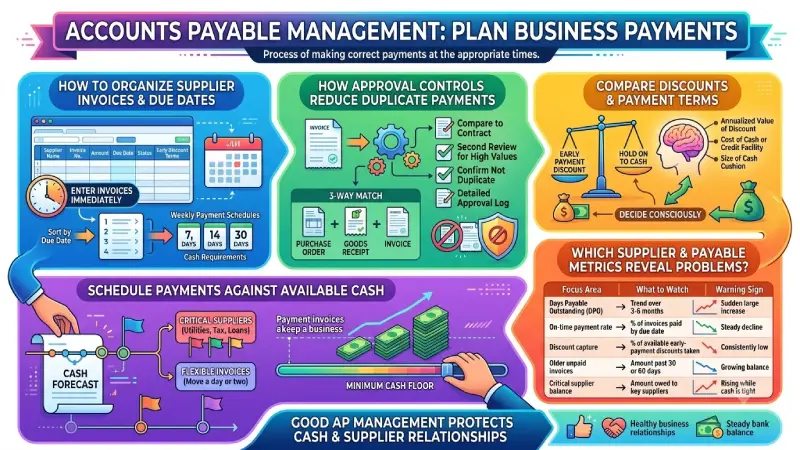
Proper handling of the Accounts Payable involves making the correct payments at the appropriate times, in such a way that you have full control to prevent mistakes and visibility to safeguard your cash.
How do you organize supplier invoices and due dates?
The starting point is an organized and timely list of what you owe and when it’s due. Typically, most businesses have their accounting software or Excel spreadsheet listing:
- Supplier name
- Invoice number and date
- Amount
- Due date
- Status (received, approved, scheduled, paid)
- Any terms for early payment discounts
Sort your list in order of due date. Often, companies divide all their invoices into weekly payment schedules and see the total cash requirement for upcoming 7, 14, and 30 days. It’s much better than analyzing single invoices separately.
A good practice would be to enter every invoice you receive as soon as you get it and sort it out immediately. Any invoices that remain unrecorded create black holes. You can’t schedule what you don’t know
How do approval controls reduce duplicate payments?
Duplications occur much more frequently than many think, especially where multiple invoices are presented in various formats or by different individuals. Approval controls will keep most duplications at bay.
Some of these useful controls are:
- The comparison of the invoice against a purchase order or contract prior to any approval
- A second review above a specific monetary value
- The confirmation that the invoice is not a duplicate entry
- The maintenance of an accurate and detailed log of all approvals made
Three-way match (purchase order, goods receipt, and invoice) is considered the best practice in case of large or complicated transactions. If the transaction is relatively small or repetitive, a dual-match system could work. The point is not to generate excessive paperwork, but to prevent double payments.
How should you compare discounts and payment terms?
Discounts given by vendors for early payments are very much prevalent (as in getting a 2 percent discount for payment within 10 days versus 30 days which is the standard period). The choice to take benefit of such discounts would depend on one’s financial standing and borrowing cost.
A simple approach to consider:
- The annualized value of the discount
- How that compares with the cost of your cash or your credit facility
- The size of your cash cushion for the next few weeks
In some cases, it makes sense to take the discount. In others, it makes sense to hold on to your cash longer. The most important thing is to decide consciously and not out of habit. That goes for negotiating conditions too. Longer payment terms help you with cash flow management, but only if your supplier is reliable and the cost of the product or service does not go up as compensation.
How do you schedule payments against available cash?
Herein lies the connection between payables management and the cash forecast. Having identified due dates and approved invoices, match these against your expected cash flow on a weekly basis.
A workable procedure includes:
- Prepare a list of all approved invoices according to their due dates.
- Categorize the invoices into those which cannot wait (critical suppliers, utilities, tax, loan repayments).
- Refer to the cash forecast for that period.
- Determine which of these flexible invoices can be moved a day or two, if necessary.
- Arrange the payment run so that your closing cash position is above your minimum floor level.
In a situation where cash is tight, prioritize. Critical suppliers and obligations that affect business operations take priority. Invoices that may not be urgent can at times be delayed if there is a brief discussion. Suppliers like honest discussions about dates more than silence.
Which supplier and payable metrics reveal problems?
A few simple metrics are usually enough:
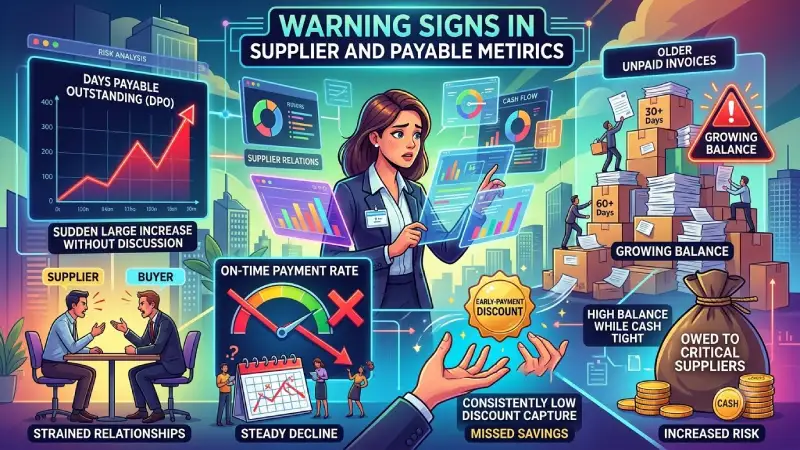
- Days Payable Outstanding (DPO) — average number of days you take to pay suppliers. Track the trend. A rising DPO can free cash but may strain relationships. A falling DPO may mean you are paying faster than necessary.
- Percentage of invoices paid on time — shows how reliable you are as a customer.
- Early-payment discount capture rate — how often you actually take discounts that are offered.
- Duplicate or erroneous payment rate — should be very low if controls are working.
- Supplier concentration — how much of your payables sit with the top few suppliers. High concentration increases risk if one relationship sours.
Regional payment behaviour also varies. In some markets suppliers expect faster payment; in others longer terms are normal. If you buy across borders, local norms matter as much as the contract terms.
| Focus area | What to watch | Warning sign |
| Days Payable Outstanding | Trend over 3–6 months | Sudden large increase without discussion |
| On-time payment rate | % of invoices paid by due date | Steady decline |
| Discount capture | % of available early-payment discounts taken | Consistently low |
| Older unpaid invoices | Amount past 30 or 60 days | Growing balance |
| Critical supplier balance | Amount owed to key suppliers | Rising while cash is tight |
Practical habits that improve payables management
- Capture and code invoices quickly.
- Keep a clear due-date view and weekly payment schedule.
- Use simple approval controls to stop duplicates and errors.
- Decide deliberately on early-payment discounts.
- Line payments up against the cash forecast.
- Talk early to suppliers when timing needs to change.
Good payables management protects cash without damaging the supply relationships your business depends on. It is one of the quieter disciplines that keeps operations smooth and the bank balance more predictable.
FAQs on Accounts Payable Management
- Is it better to delay payments to suppliers to the last minute?
Not always. It may improve cash flow but only until you affect the relationship, reliability of supply, or pricing negotiations. You need controlled delays, not delayed payments.
- How often do I have to go through the payables?
No less than once a week, in line with the cash forecasting process. A look at the upcoming bills 7-14 days ahead will avoid any surprises.
- Does every invoice have to be approved by two people?
It is not mandatory. Determine the limit. The smaller regular invoices can have less strict procedures, while the bigger ones definitely need additional verification.
- What is a healthy Days Payable Outstanding number?
It depends on your industry, supplier agreements, and cash position. Focus on the trend and on whether suppliers remain supportive. A number that keeps rising without conversation is usually a risk.
- How do I handle a supplier who is chasing hard while my cash is tight?
Be proactive. Contact them before they escalate, explain the situation briefly, and offer a realistic payment date. Most suppliers prefer clarity to silence.
Conclusion
Accounts Payable management involves the process of making correct payment at the right time. You organize invoices according to their due dates, implement simple approval procedures, carefully choose discounts and terms and make the payment according to the available cash balance. Track a couple of simple ratios and communicate if there is any need for change in timing. This will ensure that your suppliers remain constant and you do not run out of cash.