


The cash flow statement is among the three main financial statements, which include the statement of profit and loss, as well as the balance sheet. Since the statement of profit and loss gives us information on whether or not the company has made profits in accounting terms, the cash flow statement helps us find out whether these profits have been coming through in the form of bank balance. In terms of operations, this is what counts.
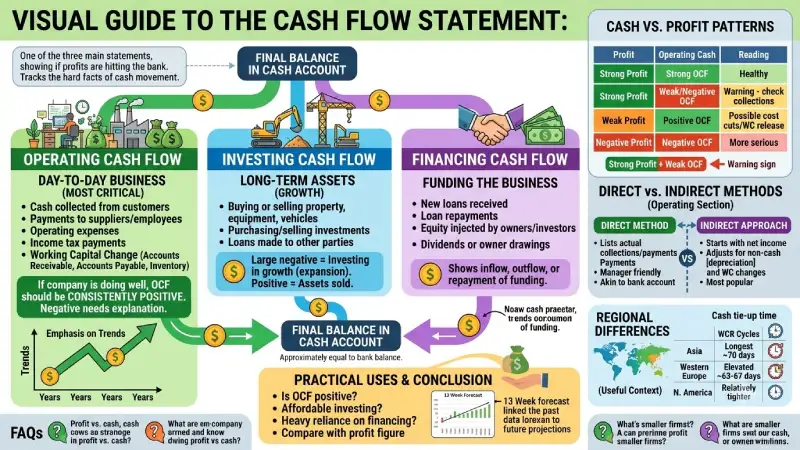
Cash flows are classified into three neat categories: operating, investing, and financing. Once you know what belongs where, the statement gets a lot easier to read.
What does a cash flow statement show?
The simplest way to think about the cash flow statement is that it attempts to answer three questions:
- What was the net effect of cash flows related to core operations?
- What was the net effect of cash flows related to long-term investments?
- What was the net effect of cash flows related to financing sources?
The statement starts from the starting balance in the cash account, then proceeds by adding/subtracting the fluctuations in the account categories and determines the final balance in the cash account. The final balance should be approximately equal (considering some time lags) to the balance in the bank.
What makes the statement important? A firm may be recording profits yet having poor cash flows at the same time.
Which activities belong in operating cash flow?

Cash flow from operations relates to the activities that form part of running the business on a day-to-day basis. This is generally the most critical section of the cash flow statement for managers.
These will typically consist of:
- Cash collections from customers
- Payments made to suppliers and employees
- Operating expenses paid such as rent and utilities
- Interest paid (in some case studies)
- Income tax payments
- Working Capital Change (Accounts Receivable, Accounts Payable & Inventory)
If the company is doing well, the cash flow from operations should be consistently positive. The business could be earning a profit but still have poor or even negative cash flow from operations because of late payments by customers, excessive inventories, and quick payments made to suppliers.
Trends in operating cash flow receive a lot more emphasis than just one year’s results. Positive operating cash flow is generally a favorable sign. Operating cash flow that is negative receives an explanation each time.
Regional patterns also differ. Recent studies show clear variation in how long cash stays tied up:
Regional differences in cash pressure (useful context)
| Region | Approx. Cash Conversion / WCR (2024–2025) | What it often means for operating cash flow |
| Asia | Longest cycles (~70 days) | Cash stays tied up longer in receivables |
| Western Europe | Elevated (~63–67 days) | Inventory and receivables often pressure operating cash |
| North America | Relatively tighter | Generally faster conversion |
| Global average | ~67–78 days (rose in 2024) | Higher than pre-2020 levels in many markets |
How do investing and financing cash flows differ?
Investing cash flows relate to long-term assets. Common examples:
- Buying or selling property, equipment, or vehicles
- Purchasing or selling investments
- Loans made to other parties (and repayments received)
Large negative investing cash flow often means the business is investing in growth (new equipment, expansion). Positive investing cash flow can mean assets are being sold, which may be normal or a sign of stress depending on the context.
Financing cash flows relate to how the business is funded. Common examples:
- New loans received
- Loan repayments
- Equity injected by owners or investors
- Dividends or owner drawings paid out
- Share buybacks
The financing cash flow shows whether there is an inflow, outflow, or repayment of cash by the business. It is possible that even though a business has good inflows in terms of financing activities, the underlying operations of the business may not have sufficient cash flows.
How do direct and indirect methods compare?
There are two ways to present the operating section.
Direct method
Lists the actual cash receipts and payments:
- Cash collected from customers
- Cash paid to suppliers
- Cash paid to employees
- etc.
This approach is logical and simple to comprehend. It has been embraced by many managers because it is more akin to the bank account.
Indirect approach
Starting with the net income, it should be adjusted by:
- Non-cash expenses (depreciation, amortization, allowance)
- Any changes in the working capital (increases in receivables, decreases in payables, and so forth).
The most popular financial statements use an indirect method since it is easier to get it using the available accounting data. The cash flows from operations derived with the help of both methods are the same; the only difference is the presentation of the information.
In terms of management uses, the Large negative investing cash flow suggests that the firm is engaged in growth activities (new equipment, expansion). Positive investing cash flow could imply that assets are being sold and this could either be routine activity or stress related to the situation. The direct method is more prevalent.
How do you interpret cash flow alongside profit?

Looking at profit and cash flow together is more useful than looking at either one alone.
A few common patterns:
- Strong profit + strong operating cash flow — Healthy situation.
- Strong profit + weak or negative operating cash flow — Often a warning sign. Customers may be paying slowly, inventory may be rising, or working capital is being absorbed by growth.
- Weak or negative profit + positive operating cash flow — Possible if the business is cutting costs, collecting old receivables, or reducing inventory. Worth understanding the drivers.
- Negative profit + negative operating cash flow — More serious. The business is both losing money and consuming cash.
Also observe the trends in several time frames. A poor performance during one quarter may have its explanations. If there is always a difference between profits and cash, then there may be some structural issue.
Common profit vs cash patterns
This can sit right under the bullet list of patterns in the “How do you interpret cash flow alongside profit?” section. It makes the patterns easier to scan.
| Profit | Operating Cash Flow | Typical reading |
|---|---|---|
| Strong | Strong | Healthy |
| Strong | Weak / Negative | Warning – check collections & inventory |
| Weak / Negative | Positive | Possible cost cuts or working-capital release |
| Weak / Negative | Negative | More serious – both profitability and cash are under pressure |
Practical ways to use the cash flow statement
You do not need to be an accountant to get value from it. Focus on these questions:
- Is operating cash flow consistently positive?
- Are investing outflows planned and affordable?
- Is the business relying heavily on new financing to stay afloat?
- How does the change in cash compare with the profit figure?
Many managers also link the cash flow statement back to the 13-week forecast. The statement shows what happened. The forecast shows what is expected next. Using both keeps the picture complete.
FAQs on Cash Flow Statements
- Is the cash flow statement more important than the profit and loss account?
The two serve different purposes. The profit statement tells us if the company is making any profits. Cash flow statement tells if the profits made are converted into cash. In case of survival and daily operations, cash flow is a more important statistic.
- How is it possible that profitable firms run out of cash?
It is because profit takes into consideration the non-cash transactions and timing. A firm may make a sale, record the income and book a profit well ahead of the cash receipt from the customer. It may be facing shortage of cash during the period when there are expenses to meet.
- Do small firms need to make a formal cash flow statement every month?
No, not necessarily. Smaller firms benefit more by preparing a cash flow summary on a weekly or monthly basis and a 13 week forecast. The formal cash flow statement remains an excellent instrument at the end of the month or quarter.
- What is a healthy operating cash flow amount?
It is not one particular amount. Operating cash flow should be consistently positive and sufficient to fund investment activities and debt obligations without continuous financing.
- What is the frequency of cash flow statement analysis?
The minimum is once a month. Most companies examine their cash position on a weekly basis and analyze the cash flow statement along with the income and balance sheets on a monthly basis.
Conclusion
Cash Flow Statement translates the subjective concept of “the state of the business” into hard facts in terms of actual movement of cash. Operating Cash Flow demonstrates the state of the main business operation. The sections on investments and financing demonstrate changes in the structure of assets and sources of finance. Compare it with the profit and see the trends, using it for testing the consistency of the accounting picture with reality. This alone will save you from many unpleasant surprises.