

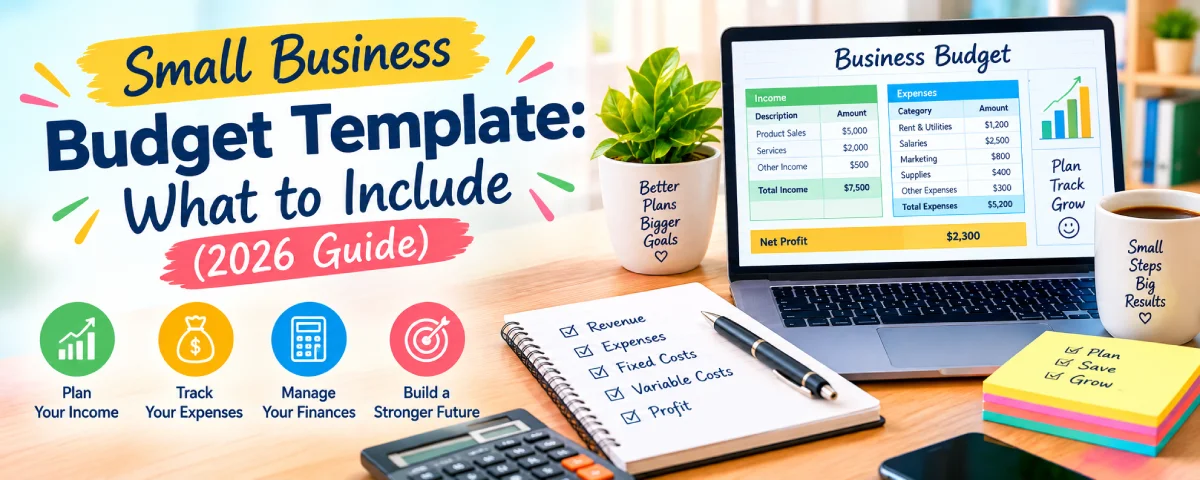
A small business budget template is exactly that – a simple system which enables you to organize and review your financials. A budget template will reveal your expected revenues and expenditures as well as tell you if they are a good balance for your business or not.

Many businessmen know the significance of budgeting, yet they either tend to overcomplicate their budgeting process or do not update their budget at all. The most useful small business budget templates are the ones that are easy to maintain and informative enough to add value.
Here you will learn how to create a small business budget template, handle both fixed and variable costs, distinguish between assumptions and facts, deal with different points of view such as monthly and yearly one as well as customize your template.
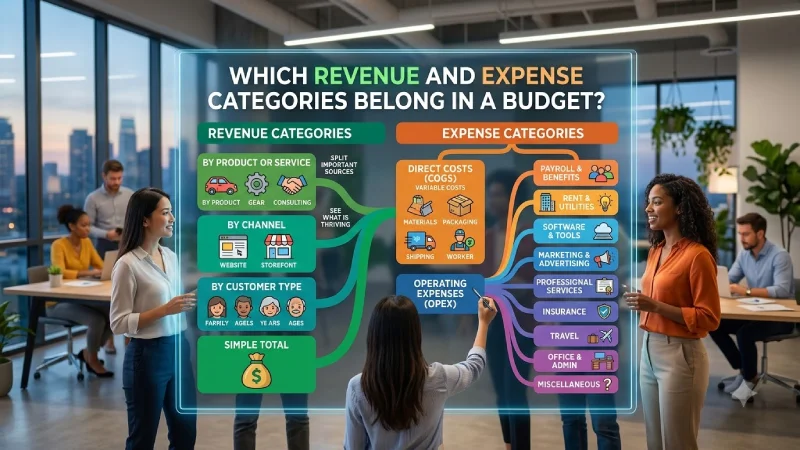
Which Revenue and Expense Categories Belong in a Budget?
Good budget templates begin with clean categories. In case you have dirty categories, then you will not only have dirty budgets but also budgets that are difficult to analyze in the future.
Categories for Revenue
The way you categorize your revenues will depend on the nature of your business. Some of the ways you can go about it are:
| Revenue Category Style | Best For | Example Breakdown |
| By product or service | Businesses with clear offerings | Product A, Product B, Consulting, Maintenance |
| By channel | Businesses that sell in different ways | Website, Marketplace, Direct sales, Wholesale |
| By customer type | Businesses with distinct segments | Small clients, Mid-market, Enterprise |
| Simple total | Very small or simple businesses | Total Sales |
If there are multiple sources of revenue that matter, it is often helpful to split them up. This allows one to see what is thriving and what is not.
Expense categories
Expenses are usually divided into two big groups: direct costs and operating expenses.
Direct costs (Cost of Goods Sold)
These are costs that go up or down with sales. Examples include materials, product costs, packaging, shipping, and direct labour tied to delivering the service.
Operating expenses
These are the costs of running the business. Useful categories often include:
| Category | Examples |
| Payroll and benefits | Salaries, wages, bonuses, contractor payments, benefits |
| Rent and utilities | Office or workshop rent, electricity, internet, water |
| Software and tools | Subscriptions, apps, online platforms |
| Marketing and advertising | Ads, content, tools, agencies, events |
| Professional services | Accounting, legal, consulting |
| Insurance | Business insurance, liability, equipment cover |
| Travel | Transport, accommodation, meals related to work |
| Office and admin | Supplies, postage, small equipment, bank fees |
| Miscellaneous / Contingency | Unexpected or hard-to-classify costs |
You don’t need every category. Choose the ones that matter most in your business and keep the list manageable. Too many categories make the budget harder to update and review.
How Do You Estimate Fixed and Variable Costs?
Knowing the distinction between fixed and variable expenses is going to make your budget a whole lot more valuable.
Fixed expenses
Expenses that remain constant despite whether sales increase or decrease. Some examples are rent, salaries, insurance, and most software services.
Variable expenses
Expenses that vary depending on the level of sales or activity. Some examples are raw materials, packaging, shipping, sales commission, and contractor expenses..
| Type of Cost | Behaviour | Examples | Budgeting Tip |
| Fixed | Stays relatively stable | Rent, salaries, insurance, core software | Easier to predict |
| Variable | Rises or falls with sales | Materials, shipping, commissions | Link them to revenue assumptions |
| Semi-variable | Has a fixed part and a variable part | Phone plans, some utilities, mixed contractor arrangements | Split them if the amounts are significant |
As you construct the model, it’s useful to categorize each cost as either fixed or variable. That way, it will be simpler to create your scenarios down the road (like what will happen if your sales are 20% below expectations).
Realistic method of costing
- Best to use last year’s actual numbers, if available
- Take into account any known changes (new employee, higher rent, new equipment, etc.)
- For variable costs, estimate them as a % of sales or per unit where possible
- Stay realistic, not overly optimistic
How Do You Separate Assumptions from Actual Results?

Perhaps the most valuable practice in budgeting is making sure your assumptions are on display.
Assumptions are the beliefs that lie behind the figures. Such as:
- We will receive 40 new clients per month
- The average sale will be worth $850
- The cost of materials will remain at 32% of our sales
- We will recruit one more person in September
The moment you jot down all those assumptions in the budgeting framework (even in some notes column), it becomes much easier to figure out why the actual outcome was so different.
Simple way to organise this in your template
| Section | What to Include |
| Budget numbers | The planned revenue and expenses |
| Key assumptions | The main drivers behind the numbers |
| Actual results | What really happened |
| Variance | The difference between budget and actual |
| Explanation | Short note on why the difference occurred |
The above structure makes the budget an education device. Rather than only realizing that there is less income, it is easy to find out whether this is due to fewer customers, reduced prices, etc.
How Do Monthly Totals and Annual Summaries Connect?
In most cases, small firms would derive maximum value from both the monthly and annual perspectives.
Monthly budget
This is a perspective that shows the budget broken down by months. This provides the firm with the ability to manage its cash flow better.
Annual summary
This is a perspective that sums up the months into an annual perspective.
These two perspectives function optimally if they are integrated. This means that the totals in the annual perspective must match the totals of the monthly perspective. If one month’s forecast changes, so should the annual total.
Why both views matter
| View | Main Benefit | Best Used For |
| Monthly | Helps manage cash and short-term decisions | Tracking progress and cash flow |
| Annual | Shows the overall direction of the business | Planning, goal setting, and big-picture review |
Most templates have sections for monthly information as well as a summary page where everything will be added together automatically.
How Do You Adapt the Template as the Business Changes?
A budget template should not stay frozen. As the business grows or changes, the template usually needs to evolve too.
Common reasons to update the template
- You add new products or services
- You enter a new sales channel
- You hire more people or open a new location
- Some cost categories become much more important
- The old structure feels too simple or too complicated
Practical approach to adapting the template
- Review the template once or twice a year (or when something significant changes).
- Ask what information you actually use during monthly reviews.
- Remove categories that no longer matter.
- Add new categories only if they help decision-making.
- Keep the structure as simple as possible while still being useful.
The best template is the one you will keep updating. A slightly imperfect structure that you use every month is far more valuable than a perfect-looking template that gets abandoned.
Best Thoughts
The small business budgeting template should not be difficult. On the contrary, it should be simple, clear, realistic, and sustainable. Focus only on those income and expense heads that are truly significant; make distinction between fixed and variable cost heads if need be; mention your key assumptions; and analyze monthly and annual figures.
Create a simplified template in case you feel the need to do so. Make use of this template on a regular basis, every month, and compare the planned with the actual. Modify your budgeting template as your business evolves. In due time, this practice will give you far greater control and understanding of your finances.
It is not about creating a perfect spreadsheet. It is about having a tool that works for you.
Frequently Asked Questions
- What is the most elementary budget template a small business can use?
The template containing income, expenses, main operating costs, and profit will do fine. Later, you can elaborate on it.
- Should I use Excel or accounting software for my budget?
Use whatever you want. Excel or Google Sheets will provide more opportunities. If you use accounting software for your accounting, it can be more convenient.
- How frequently should I change my budget template?
Check all the numbers every month. Check the form of the template once or twice a year or whenever you undergo changes in your business.
- Is it necessary to include all little expenses?
It is not. Pay attention to those categories that actually matter. Small and occasional expenses can be put into Miscellaneous category.
- What is the most typical mistake when dealing with budget templates?
Making them overly complicated. The budget template which is difficult to update will never be updated.
Conclusion
The proper template of budgeting in a small business gives a good sense of what you expect to earn, spend, and make as profits. It’s important to be realistic in the categories you include, separate fixed and variable expenses if needed, state your assumptions, and use the figures on a monthly and annual basis. Adjust your template accordingly as your business grows. The regular use of the template, even the simple one, becomes invaluable.