

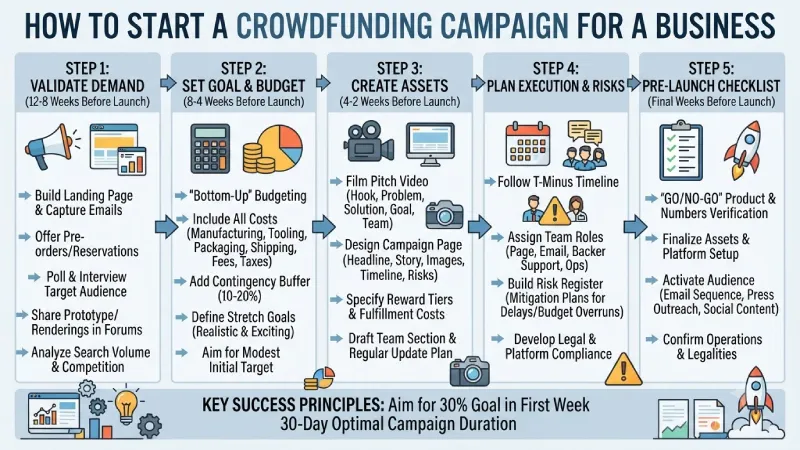
Crowdfunding Campaign Preparation is the process of preparation to start a crowdfunding project. According to the overall guide to Crowdfunding for Business and comparison of the crowdfunding platforms, this is what one needs to do in order to prepare the project: test the real demand, set the fundraising goal and budget, create the campaign page and video, manage time frames and risks, and carry out pre-launch checklists. Even in 2026, the numbers prove that campaigns which consider the live stage the end point, rather than the starting point, succeed better.
Where This Fits
Now, you need to prepare your campaign. The logical order of the process would be:
- Properly plan your rewards and pricing strategy → Rewards-Based Crowdfunding
- Learn about rules if you raise the ownership capital → Equity Crowdfunding for Business
- Prepare and engage your audience → Crowdfunding Marketing Strategy
- Learn how to ship your product after the campaign is over → Crowdfunding Fulfillment
This will make your knowledge continuous.
How Do You Validate Demand Before Launch?
The lack of proof that consumers really need your product or service is one of the most frequent problems. Validation lowers the risk and gives you hard numbers for establishing your objective.
Simple, low-cost validation methods
- Build a simple landing page that highlights the product and captures emails. Attract some traffic to it (organics, ads, or contacts from your personal network) and assess the conversion rate.
- Provide a pre-order or a “reserve” feature with a refundable deposit. Having actual money backing up the commitment is better evidence than an email subscription.
- Do quick polls or interviews of the target customers and know what problem does this product solve, how much is he willing to pay for it, and what makes him commit on the first day?
- Upload your product prototype or rendering to the right forums and gather not only the qualitative responses but also their interest in getting information regarding the campaign..
- Survey existing search volume, competition reviews, and similar past successful campaigns to verify the demand in the category.
What “enough” validation looks like
Universal numbers are not known, but many people who have been in the creation field for years prefer to see at least a few hundred people who have shown a high level of engagement on the mailing list, or people who start asking when they will be able to purchase their project. The bigger the list before the launch, the better the chances of getting 30% or more within the first 48 hours.
Red flags that mean you need more validation
- Almost no one outside your immediate circle shows interest.
- People say “cool idea” but will not leave an email or a small deposit.
- Recurring feedback highlights the same issues that have not been solved (price, features, trust).
The aim of validation is not to prove how great an idea is but to collect sufficient information to believe that the real audience will support the campaign in its execution.
How Do You Set a Funding Goal and Budget?
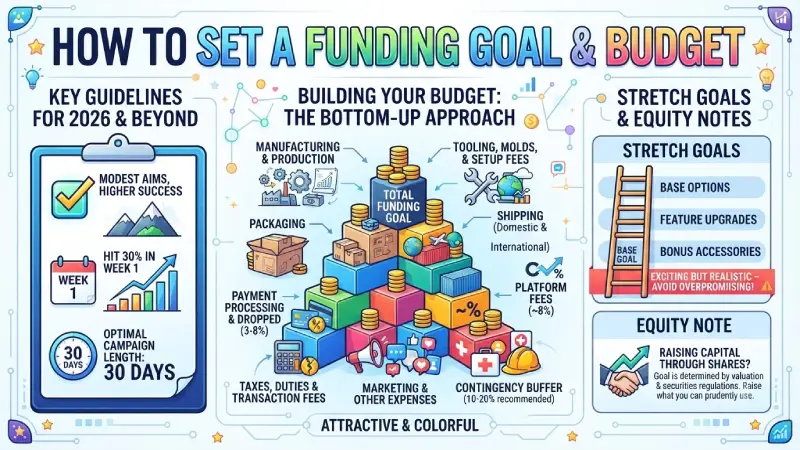
The funding target is the most impactful decision you’ll make. Make the target too high, and you will miss it altogether (particularly true of all-or-nothing sites). Make the target too low, and you may not raise sufficient funds for an excellent job.
Build the budget from the bottom up
List every real cost required to deliver what you are promising:
- Product manufacturing or production
- Tooling, molds, or setup fees
- Packaging
- Shipping (including international if offered)
- Platform fees (typically ~8% on rewards platforms)
- Payment processing and expected dropped pledges (budget 3–8%)
- Taxes, duties, and transaction fees
- Contingency (10-20 percent is typical for the initial hardware development or complicated products)
- Marketing and other expenses incurred and those that need to be covered
- Payment processing and currency exchange costsAdd these together. That total (or a number slightly above it) is a realistic minimum funding goal. Many creators then add a small buffer so that even after fees and a few refunds they can still deliver.
Stretch goals
Beyond the base requirement, you can incorporate stretch goals to provide additional features, colors, or bonuses. Make sure that they are exciting yet realistic enough. Overpromising stretch goals is a common cause of trouble post-campaign.
Goal-setting guidelines that still hold in 2026
- A campaign with modest aims is more likely to be successful than one with lofty ambitions.
- Reaching 30 percent of your goal within the first week is strongly indicative of success.
- Thirty days seems to be the optimal campaign length; too long and you might lose steam.
Equity note
If you are raising capital through the issue of shares, the “objective” is determined by securities regulations, valuation considerations, and the proportion of shares that you are prepared to sell off. In essence, the same applies: Raise capital that you can prudently use.
What Belongs on the Campaign Page and Video?
Your main tool to sell during the live period is the campaign page and video. The message needs to be clear and trustworthy.
Essential page elements
- Clear headline that states the main benefit or outcome
- Short supporting description
- High-quality images and, if possible, prototypes or real product shots
- Transparent funding goal and what the money will be used for
- Detailed reward tiers with prices that already include production and shipping costs
- Timeline for production and delivery
- Risks and challenges section that is honest about what could go wrong and how you plan to handle it
- Team section that shows who is responsible
- Regular update plan so backers know they will hear from you
The video
Projects with video succeed at roughly double the rate of those without. Keep it focused:
- Hook in the first 3–10 seconds (show the problem or the product in use)
- Explain what the product does and who it is for
- Show the team briefly
- State the funding goal and the main reward
- End with a clear call to action
You do not need a Hollywood production. A clear, honest video shot on a good phone often outperforms an over-produced one that feels salesy.
Tone and trust signals
Write in plain language. Avoid hype that you cannot back up. Include specifics (materials, dimensions, tested features). Show real progress rather than only renderings when possible. Backers respond to competence and transparency.
How Do You Plan Timelines, Responsibilities, and Risks?
A campaign is a project with a hard deadline. Treat it like one.
High-level timeline (typical rewards campaign)
- T-12 to T-8 weeks: validation, audience building, early content
- T-8 to T-4 weeks: finalize product specs, pricing, manufacturing quotes, campaign page draft
- T-4 to T-1 weeks: finish video, build email sequence, line up press and partners, test messaging
- Launch week: concentrated push from owned channels
- Live campaign (usually 30 days): daily monitoring, updates, engagement
- Post-campaign: finalize orders, production, fulfillment, ongoing communication
Assign clear responsibilities
Even a small team needs named owners for:
- Campaign page and content
- Email and social communication
- Backer questions and comments
- Manufacturing and quality control
- Shipping and customer support
- Financial tracking
Being alone, be realistic about what you can do, and think about hiring some freelancers to assist with videos, designs, or fulfillment plans.
Risk register
Identify the possible risks (e.g. manufacturing delays, budget overruns, transportation issues, unexpected low demands, capacity constraints) and briefly describe how you plan to mitigate them. It will form the content for the “Risks and Challenges” in your campaign page.
What Should a Pre-Launch Campaign Checklist Include?
Use this as a working checklist in the final weeks before launch.
Product and numbers
- Final product specifications locked
- Manufacturing quote and timeline confirmed
- Full budget built (production + fees + shipping + contingency)
- Funding goal set and justified
- Reward tiers priced with margin and shipping included
- Stretch goals defined and costed
Assets
- Campaign page copy complete and reviewed
- Video filmed, edited, and approved
- Product images and graphics ready
- Risk and timeline sections written honestly
Audience and promotion
- Email list built and segmented
- Launch-day email sequence written
- Social content calendar for the first two weeks
- Press list and outreach templates ready
- Any partner or influencer agreements confirmed
Operations
- Team roles and daily responsibilities assigned
- Backer communication plan (who answers comments, how fast)
- Tracking system for pledges, sources, and questions
- Post-campaign fulfillment outline drafted
Legal and platform
- Platform account approved and verified
- Any required business or tax information submitted
- Terms and privacy language reviewed
- Refund and delay policy drafted
Work through the list item by item. Anything still open in the final week becomes a risk to the launch.
Practical Tables
Pre-launch timeline example
| Phase | Timing Before Launch | Main Focus |
| Validation | 12–8 weeks | Landing page, emails, early feedback |
| Planning | 8–4 weeks | Budget, manufacturing, page draft |
| Asset creation | 4–2 weeks | Video, final copy, images |
| Audience activation | 2–0 weeks | Email sequences, press, partners |
| Launch | Day 0 | Owned-channel push |
Budget building categories
| Category | What to Include | Typical Buffer |
| Production | Unit cost, tooling, setup | 10–15% |
| Platform & processing | Fees + expected dropped pledges | Actual % |
| Shipping & packaging | Domestic + international estimates | 15–20% |
| Contingency | Delays, quality issues, extra support | 10–20% |
| Marketing already spent | Ads, freelancers, tools | Tracked |
Frequently Asked Questions
How long should the pre-launch period be?
8-12 weeks is typical for the debut of new products. Some cases with complex equipment or raising capital require a longer time.
What would be a good size of the pre-launch email list?
It depends on the specifics of the product but a typical successful campaign would prefer to have at least a couple of hundred active subscribers. It is not unusual to see 3-10% conversion rates from a warm list on launch day.
Should I reveal the product before the final version was created?
Yes – only if the stage of development is clearly mentioned (prototype, rendering, pre-production). builds a lot more trust in disclosing the actual situation instead of trying to make it look perfect.
How can I find out if my fundraising objective is realistic?
If the amount is based on the real quotes and it seems feasible for your community size and validation efforts then it will be much closer to realism than any round number.
What about raising capital instead of rewards?
The same logic for preparation plus extra tasks like securities disclosures and valuation work.
Troubleshooting Common Pre-Launch Problems
Email List Growth Too Slow
Make the offer more tight on the landing page, work on the lead magnet, or drive higher quality traffic. A smaller and engaged email list beats a larger one that is cold.
Quotes for manufacturing keep shifting
Lock the quote with assumptions in place (how much, when, how to pay) and add more buffer to your goal. Don’t launch until you have the numbers nailed down.
Page/video not finished
Launch a page that is complete but honest, rather than delaying until it is perfect. It’s always easier to refine your assets once you’ve launched.
Overwhelmed team
Narrow your scope. Better to have a simple reward system with a shorter campaign than an ambitious one that can’t be done.
Conclusion
The launching of a crowdfunding campaign largely relies on well-organized preparation. This involves verifying demand, making a bottom-up budget and goal, building an effective page and video, organizing tasks, and following all pre-launch checklist items. Once everything is prepared properly, then launching the campaign will simply be the implementation of an existing strategy. For more information on rewards design, equity regulations, marketing, and fulfillment after preparing for the launch of a campaign, refer to the related cluster guide below.