


Crowdfunding for Business: Plan, Launch, and Deliver
Crowdfunding in businesses is defined as the activity of raising money from a community of people including customers and fans, as well as investors, and not necessarily from banks, angel investors and venture capitalists. By the year 2026, there will be two forms of business crowdfunding, namely reward crowdfunding, where people get incentives for rewards, and equity crowdfunding, where people get equity.
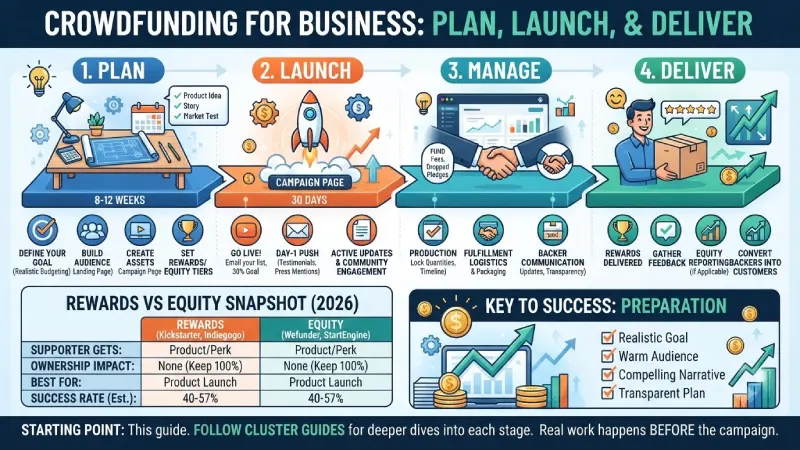
The success rates range from 40 to 57 percent on major reward platforms, whereas the success rate is even smaller for equity campaigns. The projects that succeed invariably have something in common: meticulous planning, an appreciative crowd beforehand, realistic expectations, and consistent delivery afterwords.
Where to Begin
This Crowdfunding for Business Guide is where you should begin. This guide will help you learn how the process operates, what the difference is between reward-based and equity-based crowdfunding, which crowdfunding platforms to use, how to organize your campaign, etc. When you get the general idea, proceed to the specific cluster guides:
- Comparison of specific sites → Crowdfunding Sites for Business
- Prepare a crowdfunding campaign step-by-step → Starting a Crowdfunding Campaign
- The detailed story of product pre-sales → Reward-Based Crowdfunding
- Fundraising through selling shares → Equity Crowdfunding for Business
- Crowdfunding strategy for reaching the audience → Crowdfunding Marketing Strategy
- Logistics and follow-up after the campaign → Crowdfunding Fulfillment
This sequence keeps the information continuous and practical.
How Does Crowdfunding for Business Work?
Crowdfunding is the act of raising funds for a business venture by soliciting contributions from many individuals, normally through online channels. The process of crowdfunding for companies goes through a predictable process:
- 1. You choose the type of financing (rewards-based or equity crowdfunding) and the crowdfunding website.
- You make a crowdfunding campaign page, where you introduce the project or the firm, funding goals, the term and rewards for the investors/backers.
- You generate the audience prior to starting the campaign (this is crucial; most of the successful projects get 70% or more of initial backers from their own database).
- The campaign works for some period (usually for 30 days).
- If your fundraising goals are met (or if they are met under flexible terms), the platform takes its commission and pays out the rest to you.
- You honor your promises to the investors and backers and keep in contact with them.
There are two essential crowdfunding funding principles:
- All-or-nothing — You receive the money only if you hit the goal. This is the standard on Kickstarter and, as of late 2026, the primary model on Indiegogo as well. It protects you from having to deliver on a half-funded project.
- Flexible funding — You get to keep what is raised even when the aim is not met. This was once common practice at Indiegogo, but this is less frequent today since unfunded projects often fail to fulfill their promises.
And even by 2026, the success rate of reward campaigns conducted on major platforms will be 40-57%, and that of newbies will be 35-40%.In contrast, equity crowdfunding (also called Regulation Crowdfunding in the USA) demonstrates lower rates of success – they vary approximately 20% for projects that manage to reach their goals – but an average sum raised is higher – about $100K+.
The real work happens before the campaign launches. The platform provides you with the page and the payment processing, but you provide the viewership, the narrative, and the delivery.
How Do Reward and Equity Crowdfunding Differ?
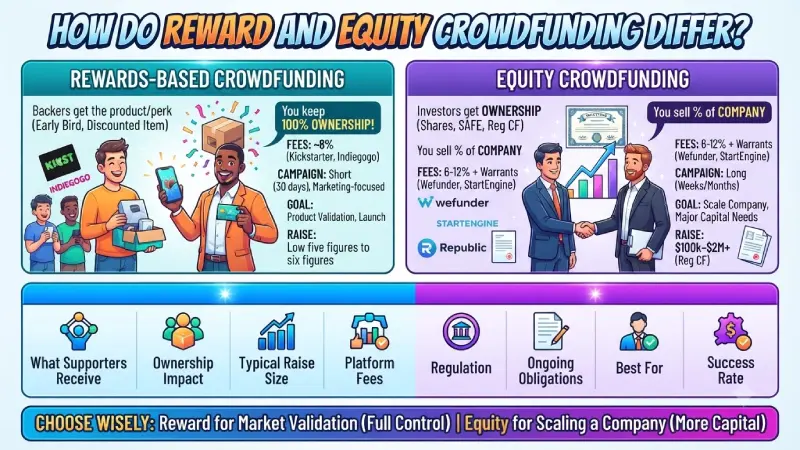
The choice between rewards or equity will influence all subsequent decision-making: legal obligations, the things you’ll have to sacrifice, how much you’ll be getting for the raise, and the future relationship with your investors.
Rewards-based crowdfunding
The backer puts in money in return for the reward, which is normally the item at a discounted price, or early bird specials, among others (exclusive versions and merchandising). The entire ownership belongs to you. There will be no securities law issues if you do not offer an investment, but rather just a simple pre-ordering of the product. Fees for Kickstarter and Indiegogo account for 8% (5% on the platform + 3% payment processing). The length of the campaign is short (about 30 days), and extremely marketing-oriented. Successful campaigns collect money on average at the level of low-five-digit amounts, but exceptional products could collect six figures and beyond.
Equity crowdfunding
The investor gets the actual ownership in the form of shares, SAFE, and other instruments. In the US, it works via SEC Regulation Crowdfunding (Reg CF), which currently allows raising up to $5M in one year from both accredited and non-accredited investors. WeFunder, StartEngine, and Republic provide the intermediary service. Platform fees usually vary between 6–10%, and sometimes there is even a small warrant on top of that on some platforms. It takes longer to launch due to legal and disclosure costs, weeks to months of preparation are required, and you have to prepare ongoing reporting
Side-by-side comparison (2026)
| Factor | Rewards Crowdfunding | Equity Crowdfunding |
| What supporters receive | Product, perk, or experience | Ownership stake (shares, SAFE, etc.) |
| Ownership impact | None – you keep 100% | You sell a percentage of the company |
| Typical raise size | $10k–$500k (many successful campaigns under $100k) | $100k–$2M+ (Reg CF average often $300k–$600k) |
| Platform examples | Kickstarter, Indiegogo | Wefunder, StartEngine, Republic |
| Typical total fees | ~8% | 6–12% + possible equity warrant |
| Regulation | Light (consumer protection mainly) | SEC Reg CF (or equivalent in other countries) |
| Ongoing obligations | Deliver the rewards | Investor updates, annual reports, cap-table management |
| Best for | Product launches, market validation | Scaling a company, larger capital needs |
| Success rate (approx.) | 40–57% overall | Lower (often cited ~20% fully funded) |
Reward your investors with shares when you have an actual product that customers want to purchase and when you like having full control. When you need a lot more capital and you are setting up an actual company that can scale, then reward them with equity.
How Do You Choose a Crowdfunding Platform?
Match the platform to your model, audience, and goals.
Rewards platforms
- Kickstarter — Largest audience for creative and consumer products, strong organic discovery, strict all-or-nothing. Best for design, games, technology gadgets, and publishing.
- Indiegogo — Similar fee structure; historically offered more flexible options and strong post-campaign sales tools (InDemand / Late Pledge). Good for hardware and tech products that may continue selling after the main campaign.
Equity platforms (U.S. focus)
- Wefunder — High volume of Reg CF raises, founder-friendly fee structure (cash fee, typically no equity warrant), large community of repeat investors.
- StartEngine — Large registered investor base, secondary market for potential liquidity, accepts a broad range of companies.
- Republic — More selective acceptance, community-oriented, offers both Reg CF and other structures.
Other options
Donation-style platforms (GoFundMe) suit causes more than commercial product launches. Debt or revenue-sharing platforms exist but are less common for pure product or startup equity needs.
Decision factors
- Does the platform’s audience match your customer or investor profile?
- What is the exact fee structure (cash + any equity)?
- All-or-nothing or flexible?
- How selective is acceptance (especially important for equity)?
- What tools exist for pre-launch building, analytics, and post-campaign sales?
- Geographic availability and payment processing for your backers.
Usually, entrepreneurs have shortlisted two options, studied their category of recent successes on that platform, and consulted with the platform’s representatives.
How Do You Plan and Promote a Campaign?
The campaigns that succeed treat the live period as the final stage, not the first.
Pre-launch (8–12 weeks is common)
- Validate demand with landing pages, email sign-ups, or small pre-orders.
- Build an owned audience—email list is the single strongest predictor of Day-1 performance. Industry patterns show that 3–10% of a warm list often converts in the opening hours.
- Create the campaign page and video early so you can test messaging.
- Line up press, influencers, and partners so coverage can appear in the first 48–72 hours.
- Set a realistic funding goal based on production costs, fees, and a safety margin—not on the maximum you hope to raise.
Campaign assets
- Clear, benefit-focused headline and short description.
- High-quality video (projects with video succeed at roughly double the rate of those without). Show the product in use within the first few seconds.
- Transparent budget and timeline.
- Reward tiers that feel valuable and are priced with production and shipping costs fully covered.
- Stretch goals that are exciting but still deliverable.
Promotion during the campaign
- Start off with a bang with a day-1 campaign from your own list and contacts (most successful campaigns aim to hit 30% or more on the first day).
- Ensure that your progress and achievements are always updated, along with any press you receive.Include social proof (amount of backers, press logos, testimonials).
- If testing paid campaigns, do so only once the organic efforts have started bearing fruit and always watch the cost-per-pledge very closely.
- Answer all comments and messages promptly.
Common 2026 benchmarks
- 30-day promotions outperform 60-day ones.
- Succeeding in making about 30% of your goal in the first week correlates with success.
- The majority of the traffic and pledges still come from the creator’s effort instead of platform discovery alone.
How Do You Manage Funding, Delivery, and Backer Updates?
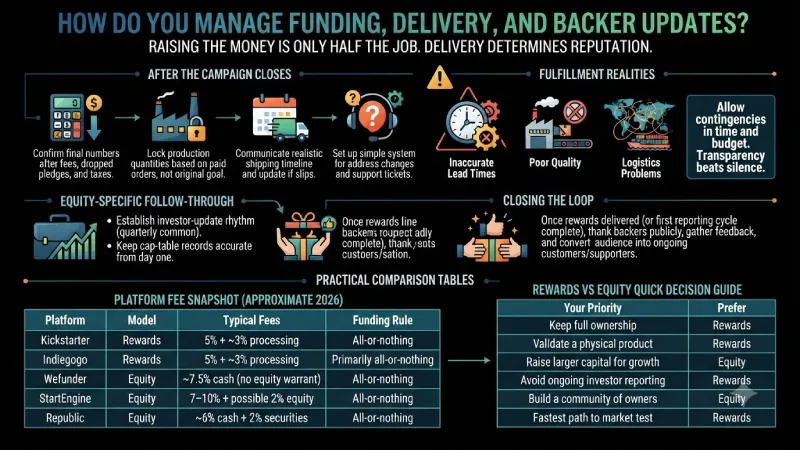
Raising the money is only half the job. Delivery determines reputation.
After the campaign closes
- Confirm final numbers after fees, dropped pledges, and any taxes or duties.
- Lock production quantities based on actual paid orders, not the original goal.
- Communicate a realistic shipping timeline and update it if anything slips.
- Set up a simple system for address changes and support tickets.
Fulfillment realities
Inaccurate lead times, poor quality, and logistics problems can often be encountered in most campaigns. Allow yourself contingencies both in time and in budget. Notify your stakeholders of any delays that may arise; transparency beats silence hands down as silence creates more frustrations.
Equity-specific follow-through
If you raised equity, you now have reporting obligations. Establish a simple investor-update rhythm (quarterly is common) and keep cap-table records accurate from day one.
Closing the loop
Once rewards are delivered (or the first major equity reporting cycle is complete), thank backers publicly, gather feedback, and convert the campaign audience into ongoing customers or supporters where appropriate.
Practical Comparison Tables
Platform fee snapshot (approximate 2026)
| Platform | Model | Typical Fees | Funding Rule |
| Kickstarter | Rewards | 5% + ~3% processing | All-or-nothing |
| Indiegogo | Rewards | 5% + ~3% processing | Primarily all-or-nothing |
| Wefunder | Equity | ~7.5% cash (no equity warrant) | All-or-nothing |
| StartEngine | Equity | 7–10% + possible 2% equity | All-or-nothing |
| Republic | Equity | ~6% cash + 2% securities | All-or-nothing |
Rewards vs Equity quick decision guide
| Your Priority | Prefer |
| Keep full ownership | Rewards |
| Validate a physical product | Rewards |
| Raise larger capital for growth | Equity |
| Avoid ongoing investor reporting | Rewards |
| Build a community of owners | Equity |
| Fastest path to market test | Rewards |
Frequently Asked Questions
What kind of success rates can I expect?
Overall, the success rate of rewards campaigns varies from around 40% to 57%, depending on the crowdfunding site and year. Newbies have somewhat lower rates. Successful equity campaigns are less common but bigger once they do reach their goals. Audience size before prelaunch is more important than average on the site.
How much money should I set as my funding goal?
Calculate your production costs, fees, shipment costs, and add contingency, not the maximum possible amount. Many professional creators calculate a conservative goal that they will be able to deliver.
Do I have to have a big audience already?
It helps greatly. Crowdfunding projects which launch with a cold audience don’t reach their goals. Just several hundred people subscribed by email can do wonders right from the start.
Why do campaigns tend to fail?
Because of unrealistic expectations, insufficient pre-launch preparation, lack of clarity about rewards/messaging, and underestimation of fulfillment difficulty.
Is it possible to run reward and equity campaigns simultaneously?
Yes, but rarely on the same narrative line. Companies normally conduct rewards for products testing and follow up with equity to raise growth capital.
Troubleshooting Common Problems
Campaign is live but pledges are slow
Double down on your own list and network first. Add urgency with limited early-bird tiers or stretch goals. Reach out personally to potential backers. Avoid panic discounting that erodes margin.
You hit the goal but production costs rose
Communicate early and forthrightly. Provide alternatives (small delay, slight specification change, or brief refund period) rather than silence.
Equity raise is not attracting investors
Review the valuation, the clarity of the use of funds, and the quality of financial disclosures. Warm introductions and a strong existing customer or community base help more than cold traffic.
Backers are asking for refunds after a delay
Always have your policy in place, and make sure that it is reasonable and just. Many artists provide partial refunds, credits, or the product when available. Proper communication decreases the number of requests.
Conclusion
It should be noted that when you conduct the crowdfunding for the purposes of your business, you should treat it like an entire project including planning, audience building, performance, and delivery. Use this pillar as the roadmap and proceed to the cluster guidelines with more information on crowdfunding platforms, the process of the campaign creation, rewards design, rules concerning equity, marketing, and delivery. When you set realistic goals, have a warm audience, and proper delivery strategy, crowdfunding can either validate your product or become your growth funding source.