

How to Apply for a Business Loan: Step-by-Step Guide
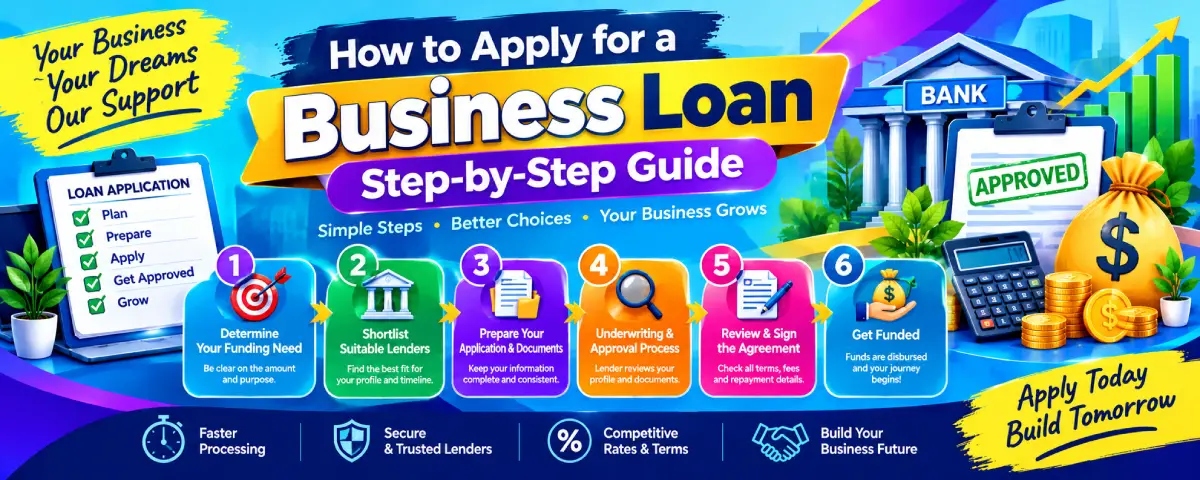
How to apply for a business loan becomes much clearer once you break the process into practical stages: deciding how much you need, shortlisting lenders who actually fit your profile, preparing a complete application, understanding what happens in underwriting, and reviewing the final agreement before you sign. After the main Business Loans pillar and the guides on types, requirements, and interest rates, this page walks you through the real-world sequence so you can move from decision to funding with fewer surprises.
Where This Fits
You already know the common loan types, the typical eligibility bars, and how rates and fees work. Now put that knowledge into action. The natural next pages after this one are usually:
- Decide between secured and unsecured structures → Secured vs Unsecured Business Loans
- Plan how you will repay the loan and manage cash flow → Business Loan Repayment
This keeps the information continuous and useful.
- How Much Funding Does Your Business Need?
Start with a precise number and a clear purpose. Lenders respond better to specific, justified requests than to vague “I need working capital” statements.
Calculate the real need
List every cost the funds will cover. For equipment, include the purchase price, taxes, shipping, installation, and a small buffer. For inventory, use current supplier quotes plus a realistic turnover period. For expansion or hiring, project the costs for the next 6–12 months and show how the investment is expected to generate revenue that covers the new payments.
Add a modest buffer, not a large one
Most experienced owners add 5–15% for unexpected costs. Asking for far more than you can clearly justify often raises questions about planning and can lead to a lower approval amount or higher rate.
Test affordability before you apply
Estimate the monthly payment for the amount and term you have in mind. Subtract that payment from your projected monthly net cash flow. Leave a realistic cushion (many owners aim for 20–30% remaining). If the payment consumes most of the available cash, reduce the request or choose a longer term (while still watching total interest cost).
Match amount to product
A $40,000 equipment purchase often fits equipment financing cleanly. A $300,000 expansion may point toward an SBA 7(a) or bank term loan. A fluctuating $15,000–$25,000 monthly need is usually better served by a line of credit than a fixed term loan.
A clear, costed purpose strengthens every later stage of the application.
- How Do You Shortlist Suitable Lenders?
Not every lender is a good match for every business. Narrow the field before you submit applications so you avoid unnecessary credit pulls and wasted time.
Match lender type to your profile and timeline
- Strong credit, 2+ years in business, solid revenue, can wait 30–90 days → Traditional banks and SBA preferred lenders.
- Decent credit, 6–12 months in business, need funds in days or a couple of weeks → Online and fintech lenders.
- Buying specific equipment → Equipment financing specialists.
- B2B invoices outstanding → Invoice financing or factoring companies.
- Very fast capital and higher tolerance for cost → Short-term online or revenue-based products.
Use prequalification tools when available
Many online lenders and some marketplaces offer soft-pull prequalification. This lets you see likely amounts and rates without a hard credit inquiry. Use these to create a short list of 3–5 realistic options.
Check current lending appetite
Lenders change focus. Some emphasize certain industries or loan sizes at different times. A quick conversation or online chat can confirm whether your profile is currently in their target range.
Consider relationship value
If you already bank with a strong small-business lender, start there. Existing relationships sometimes produce better terms or faster decisions. Still compare at least one or two outside options so you know the market rate.
Practical short-list criteria
- Minimum credit score and time-in-business requirements you meet
- Typical funding speed that fits your timeline
- Reputation for clear communication and reasonable documentation requests
- Transparent fee structure
Aim for three solid candidates rather than ten scattered applications.
- How Do You Prepare the Application and Documents?
Preparation is the step that most improves both speed and approval odds. A complete, consistent file moves faster and looks more professional.
Core document checklist (2026 norms)
| Document | Banks / SBA | Online Lenders | Equipment Financing |
| Business tax returns (1–3 years) | Required | Often 1–2 years | Frequently |
| Personal tax returns (guarantors) | Required | Often required | Often required |
| Business bank statements (3–12 mo) | Usually 12 months | Usually 3–6 months | 3–6 months |
| Year-to-date P&L and balance sheet | Required | Frequently | Helpful |
| Debt schedule | Required | Strongly preferred | Helpful |
| Use-of-funds / business plan summary | Required (esp. SBA) | Sometimes | Quote or invoice |
| Formation docs, EIN, ownership | Required | Required | Required |
| Personal financial statement | Often required | Sometimes | Sometimes |
Organize digitally
Create clearly labeled PDF folders. Name files so an underwriter can find them instantly (e.g., “2025 Business Tax Return – ABC LLC.pdf”). Inconsistent or missing pages are one of the most common sources of delay.
Ensure numbers tell the same story
Revenue on the tax return should align reasonably with bank deposits. The debt schedule should match what appears on the credit reports and financial statements. Large unexplained transfers or cash activity should have a short written explanation ready.
Write a clear use-of-funds paragraph
Two to four sentences that state the exact purpose, the amount, and how the investment is expected to support repayment. Specificity helps.
Timing
Start gathering documents 3–6 weeks before you plan to submit. Tax-season delays, accounting lags, or missing bank statements can stretch the process.
- What Happens During Underwriting and Approval?
Once you submit, the file enters underwriting—the lender’s detailed risk review. Understanding the stages reduces anxiety and helps you respond quickly to requests.
Typical stages
- Initial verification — Confirms basic identity, business existence, ownership, and that required documents are present. Often partially automated.
- Credit and data review — Personal and business credit reports are pulled. Bank statements and financials are analyzed for cash-flow patterns, existing debt, and consistency.
- Underwriting analysis — A human underwriter (especially on larger or more complex files) examines debt-service coverage, industry risk, collateral value if any, and overall repayment capacity. They may request clarifications or additional documents.
- Decision — Approval, conditional approval (with items still needed), counter-offer (different amount or terms), or denial.
- Closing preparation — If approved, final documents, guarantees, and any collateral paperwork are prepared.
Timelines in 2026
- Online term loans and lines of credit: often 24 hours to 7–10 days.
- Traditional bank term loans: 2–6 weeks is common.
- SBA loans: frequently 30–90 days, sometimes longer for more complex files.
- Equipment financing: often 3–14 days once the vendor quote and basic documents are in.
What underwriters focus on
Cash-flow stability and the ability to cover the new payment with a cushion (DSCR), credit history, consistency across documents, and—when relevant—the value and quality of collateral. A clean, well-organized file with consistent numbers moves faster than a stronger but messy one.
How to help the process
Respond to document or clarification requests within 24–48 hours. Keep your phone and email available. If something in the financials looks unusual (a one-time large expense or revenue spike), provide a short written explanation proactively.
- What Should You Check Before Signing the Loan?
Approval is not the finish line. The final agreement contains the actual terms you will live with.
Key items to review carefully
- Loan amount and any fees deducted from the funded amount
- Interest rate (fixed or variable) and how variable rates can change
- APR and full fee schedule (origination, closing, prepayment, late fees, etc.)
- Repayment schedule, payment frequency, and first payment date
- Prepayment terms — can you pay early without penalty?
- Collateral description and conditions under which the lender can seize assets
- Personal guarantee language and who must sign
- Default provisions and what constitutes a default
- Any reporting requirements or financial covenants after funding
- Governing law and dispute-resolution clauses
Compare the final documents to the earlier offer
Numbers sometimes shift slightly between verbal or email offers and the final paperwork. Confirm everything matches what you expected.
Ask questions
If any clause is unclear, ask for a plain-language explanation before you sign. It is normal and expected.
Final affordability check
Look at the actual payment amount and schedule against your current cash-flow forecast one more time. If the payment feels tight, discuss options (slightly longer term, lower amount, or different product) before signing.
Once you sign and the funds are disbursed, the repayment phase begins. Set up automatic payments if possible and track the loan the same way you track any major business expense.
Practical Comparison Tables
Typical application-to-funding timelines (2026)
| Lender / Product Type | Typical Time from Complete Application to Funding |
| Online term loan / line | 1–10 days |
| Equipment financing | 3–14 days |
| Traditional bank term loan | 2–6 weeks |
| SBA 7(a) or 504 | 30–90 days (sometimes longer) |
| Invoice financing | 1–5 days once invoices are verified |
Document readiness impact
| File Quality | Likely Effect on Process |
| Complete, consistent, labeled | Faster review, fewer questions |
| Missing pages or mismatched numbers | Delays, additional requests, higher chance of decline |
| Vague use of funds | Extra scrutiny or lower approval amount |
| Proactive explanations for anomalies | Smoother underwriting |
Frequently Asked Questions
How long does the whole process usually take?
From first document gathering to funding: a few days to a couple of weeks for many online products; 1–3 months for many bank and SBA loans.
Will applying hurt my credit?
Hard credit pulls can cause a small, temporary dip. Prequalification tools that use soft pulls let you explore options with less impact. Space out formal applications when possible.
What if I am denied?
Ask for the specific reason. Common fixes include improving credit, reducing the requested amount, adding collateral, or waiting until time-in-business or revenue is stronger. Reapply only after addressing the issue.
Can I apply to more than one lender at the same time?
Yes, but limit it to a small number of well-matched lenders to avoid multiple hard pulls in a short window.
Do I need a business plan for every loan?
A full formal plan is more common for SBA and larger bank loans. A clear, concise use-of-funds summary helps in almost every case.
Troubleshooting Common Application Problems
Documents keep getting requested
Your original package was likely incomplete or inconsistent. Pause, organize everything cleanly, and resubmit a full set rather than sending pieces one at a time.
Underwriting is taking longer than expected
Follow up politely once a week. Ask whether any items are still outstanding. Complex files, high volume at the lender, or SBA secondary review can extend timelines.
The approved amount is lower than requested
This is common. Evaluate whether the lower amount still solves the core need. You can sometimes accept the partial approval and seek a second facility for the remainder if cash flow allows.
Terms changed between offer and final documents
Do not sign until the discrepancy is resolved. Ask for a corrected agreement or a written explanation.
Applying for a business loan is a process you can manage with preparation and clear sequencing. Decide the exact amount and purpose, shortlist lenders that fit your profile and timeline, assemble a complete and consistent file, understand what underwriters look for, and review every important term before you sign. When those steps are handled carefully, the path from decision to funding becomes more predictable and the financing is more likely to support the business rather than strain it. Use the related cluster pages for deeper detail on secured versus unsecured options and repayment planning once the loan is in place.