

What Is b2b marketing? A Complete Guide for 2026
B2B marketing is how one business promotes its products or services to other businesses. It is different from marketing to individual consumers. The buyers are companies, the decision process is usually longer, and more people are involved in choosing a vendor.
Many companies still run B2B marketing the same way they would run consumer campaigns. They focus on volume, run generic ads, and push product features. That approach often fails because business buyers care more about solving real problems, reducing risk, and showing clear return on investment.
This guide explains what B2B marketing actually is, how it differs from B2C, which channels tend to work, how to build a practical strategy, and how to measure results. The goal is to give you a clear, usable picture without unnecessary theory.
What Is B2B Marketing?
B2B marketing means creating and running activities that help one business attract, engage, and convert other businesses into customers. The focus is on building relationships and trust over time rather than triggering quick impulse purchases.
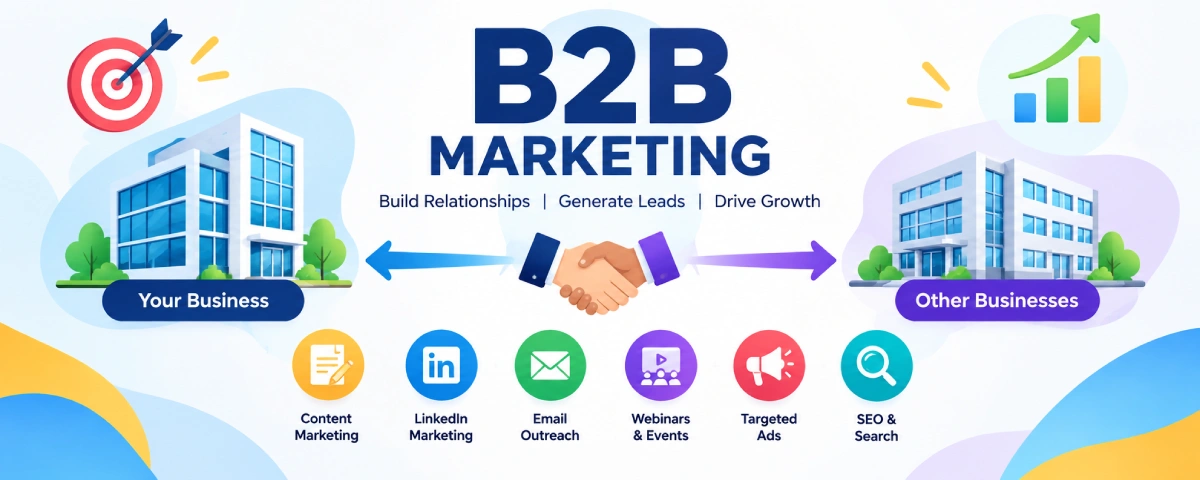
Typical B2B marketing activities include content that educates buyers, LinkedIn presence, email outreach, webinars, targeted ads, events, and working closely with sales teams.
Key characteristics of B2B marketing
| Characteristic | What It Means in Practice | Why It Matters |
| Longer sales cycles | Decisions can take weeks or months | Marketing must support the full journey |
| Multiple decision-makers | Several people influence the final choice | Messaging needs to address different concerns |
| Higher average deal size | One customer can be worth a lot | Quality of leads matters more than pure volume |
| Relationship-driven | Trust and credibility play a big role | Consistent, useful communication wins |
| Logic and ROI focused | Buyers want proof and clear business value | Features alone are rarely enough |
B2B marketing works best when it helps buyers make confident decisions rather than just trying to interrupt them.
How B2B Marketing Has Changed
B2B marketing used to be mostly about brochures, trade shows, cold calling, and relationship selling. Buyers had limited information, so sales teams controlled most of the conversation.
That has changed. Today buyers do a lot of their own research before they ever speak to a salesperson. They read articles, compare options, watch videos, check LinkedIn, and ask peers for recommendations. By the time they contact a vendor, they often already have a shortlist.
This shift means marketing now plays a much bigger role in the early and middle stages of the buying process. Companies that only focus on late-stage sales tactics usually miss a large part of the journey.
Traditional B2B Marketing vs Modern B2B Marketing
| Aspect | Traditional Approach | Modern Approach |
| Main focus | Selling features and building personal relationships | Helping buyers understand problems and solutions |
| Buyer control | Sales controlled most of the information | Buyers research independently first |
| Content | Brochures, case studies, product sheets | Educational content, comparisons, practical guides |
| Channels | Trade shows, cold calls, print | LinkedIn, content, email, webinars, search, targeted outreach |
| Goal of early marketing | Generate awareness and hand leads to sales | Build trust and stay useful throughout the journey |
| Success measure | Number of leads or meetings | Pipeline quality and revenue contribution |
Modern B2B marketing does not replace sales. It supports sales by making sure the right buyers already understand the problem and see your company as a credible option.
Who Is Usually Involved in B2B Buying Decisions
B2B purchases rarely depend on just one person. Several roles often influence the final decision.
| Role | What They Care About | How Marketing Should Speak to Them |
| End user | Ease of use, daily impact, whether it solves their problem | Practical benefits and real-life examples |
| Manager / Team lead | Team performance, efficiency, risk | How it improves results and reduces friction |
| Executive / Decision maker | ROI, strategic fit, overall business impact | Clear business outcomes and proof |
| Procurement / Finance | Cost, terms, risk, vendor reliability | Transparency, trust signals, and commercial clarity |
| IT / Technical evaluator | Security, integration, technical requirements | Clear technical information and reliability |
Good B2B marketing considers these different concerns instead of using one generic message for everyone.
Simple Examples Across Industries
SaaS / Software
A project management tool creates content about common team coordination problems, runs LinkedIn campaigns targeting operations managers, and offers a clear free trial. Marketing focuses on showing how the product reduces wasted time.
Professional Services
A consulting firm publishes practical insights on industry challenges, hosts webinars, and uses LinkedIn to stay visible with decision-makers. The goal is to build credibility so that when a need appears, the firm is already trusted.
Manufacturing / Industrial
A equipment supplier uses case studies, technical guides, and targeted outreach to plant managers and procurement teams. Marketing supports longer sales cycles with proof of reliability and performance.
Agencies or Consultants
They often rely on content, personal branding on LinkedIn, referrals, and selective outreach. The marketing focus is on demonstrating expertise and making it easy for potential clients to start a conversation.
Across all these examples, the common thread is the same: useful information, clear targeting, and consistent presence over time.
B2B Marketing vs B2C Marketing
The difference between B2B and B2C is not just the audience. The entire approach changes.
Clear comparison
| Aspect | B2B Marketing | B2C Marketing |
| Buyer | Businesses and professionals | Individual consumers |
| Decision process | Often involves multiple people | Usually individual or household |
| Sales cycle | Weeks to months (sometimes longer) | Minutes to days |
| Main motivation | Solving business problems, efficiency, ROI | Personal wants, emotions, convenience, status |
| Message style | Practical, proof-based, problem-focused | Emotional, aspirational, benefit-driven |
| Channels that often work | LinkedIn, email, content, webinars, search, events | Social media, influencer, paid social, TV, retail |
| Relationship length | Often long-term | Can be transactional or loyalty-based |
Important practical point
Some tactics overlap. Content, email, and paid search can work in both worlds. The big difference is in the message, the length of the relationship, and how success is measured. Treating B2B buyers like consumers usually leads to weak results.
Core B2B Marketing Channels
Not every channel works equally well for every B2B company. The best results usually come from focusing on a smaller number of channels and doing them well.
Common B2B marketing channels
| Channel | How It Helps | Best For | Difficulty |
| Visibility, thought leadership, direct outreach | Almost all B2B companies | Medium | |
| Content & SEO | Attracts people searching for solutions | Companies that can create useful content | Medium–High |
| Nurturing leads and staying in touch | Most B2B businesses | Medium | |
| Webinars & virtual events | Education and lead capture | Complex or higher-consideration offers | Medium |
| Paid search (Google Ads) | Captures high-intent demand | Offers with clear search demand | Medium |
| LinkedIn Ads | Targeted visibility to specific roles and companies | Companies with budget | Medium |
| Outbound / Sales outreach | Direct conversations with target accounts | Higher-ticket offers | Medium–High |
| Partnerships & referrals | Warm introductions | Companies with strong customer relationships | Low–Medium |
| Industry events | Face-to-face relationships | Relationship-heavy industries | Medium–High |
Practical advice on channels
Most companies perform better when they master one or two primary channels before adding more. Spreading effort across too many places usually leads to average results everywhere.
Buyer Psychology Differences
The biggest difference between B2B and B2C is not the channel. It is how people decide.
In B2C, many purchases are driven by emotion, convenience, status, or immediate desire. A person can see something, like it, and buy it relatively quickly.
In B2B, the decision is usually more careful. Buyers are spending company money, not just their own. They often need to justify the choice to other people. They worry about risk, implementation effort, and whether the solution will actually deliver results. Because of this, trust, proof, and clarity matter more than clever or emotional advertising.
B2B buyers also tend to move through a longer process. They research options, compare vendors, talk to colleagues, and sometimes run trials or demos before deciding. Marketing that only tries to create instant excitement usually falls short.
Messaging Style Examples (B2B vs B2C)
Here is how the same type of offer might be framed differently:
| Type of Offer | Typical B2C Style Message | Typical B2B Style Message |
| Project management tool | “Get organised and feel in control of your life” | “Help your team reduce missed deadlines and wasted time” |
| Training or course | “Transform your career in 30 days” | “Give your team practical skills that improve performance” |
| Software subscription | “Join thousands of happy users” | “Reduce manual work and improve accuracy across your process” |
| Consulting service | “Unlock your potential” | “Solve specific operational problems with a clear approach” |
B2C messaging often focuses on how the individual will feel. B2B messaging works better when it focuses on the business problem, the outcome, and the reduced risk.
When B2B and B2C Tactics Can Overlap
Some methods work in both worlds:
- Clear and useful content
- Email follow-up
- Search marketing (Google Ads or SEO)
- Strong landing pages
- Social proof (reviews, testimonials, case studies)
The tactics can look similar, but the message and the level of detail usually need to change. A B2B case study, for example, needs more concrete results and business context than a typical consumer testimonial.
Common Mistakes When B2B Companies Copy B2C Approaches
| Mistake | What Usually Happens | Better Approach |
| Using overly emotional or hype-driven language | Feels unprofessional or exaggerated to business buyers | Focus on clear problems and outcomes |
| Chasing high volume of low-quality leads | Sales gets flooded with poor-fit conversations | Prioritise lead quality and fit |
| Relying mainly on short-form social content | Limited trust and weak pipeline impact | Combine visibility with deeper useful content |
| Expecting fast purchase decisions | Frustration when deals take longer | Support the full buying journey |
| Ignoring multiple stakeholders | Message only connects with one type of buyer | Address the concerns of different roles |
The companies that perform better in B2B usually adapt their approach to the way businesses actually buy, instead of forcing consumer-style marketing into a business environment.
Deeper Look at the Most Important Channels
LinkedIn
LinkedIn remains one of the strongest channels for B2B. It works for both visibility and direct conversations. Companies that post useful insights consistently and also use polite, relevant outreach usually see better results than those who only run ads or only send connection requests. The key is to sound like a helpful professional, not a salesperson in every post.
Content and SEO
Content works when it answers real questions buyers are already asking. Comparison pages, problem-focused guides, and practical how-to articles tend to perform better than generic thought leadership. SEO takes time, but once pages start ranking, they can bring steady inbound interest without constant paid spend.
Email
Email is still one of the most effective ways to stay in front of people who already know you. It works well for nurturing leads, sharing new content, and supporting sales conversations. The best B2B email is useful and respectful of the reader’s time. Long, overly salesy sequences usually get ignored.
Outbound / Direct Outreach
Outbound works best when it is targeted and personal. Generic mass messages have very low reply rates. Short, relevant messages that show you understand the prospect’s situation perform much better. Outbound is often most effective when combined with content or LinkedIn visibility so the name is not completely cold.
Channel vs Best Goal
| Channel | Awareness | Lead Generation | Nurture | Supporting Close |
| LinkedIn (organic) | Strong | Medium | Medium | Medium |
| LinkedIn Ads | Strong | Strong | Low | Low |
| Content & SEO | Strong | Strong | Medium | Low–Medium |
| Low | Medium | Strong | Medium | |
| Webinars | Medium | Strong | Medium | Medium |
| Paid Search | Medium | Strong | Low | Low |
| Outbound outreach | Low | Strong | Low | Medium |
| Events & partnerships | Medium | Medium | Medium | Strong |
No single channel does everything well. Most companies need a small combination.
How to Choose Primary vs Secondary Channels
A practical way to decide:
- Choose one primary channel you can run consistently every week.
- Choose one supporting channel that helps the primary one.
- Treat everything else as experimental until the first two are working.
For example:
- Primary: LinkedIn + Content
- Supporting: Email nurture
- Experimental: Paid ads or webinars
Companies that try to run five or six channels at full effort usually end up doing all of them poorly.
Realistic Expectations in 2026
| Channel | Realistic Expectation | Common Misconception |
| LinkedIn organic | Steady visibility and conversations over time | Fast flood of leads from posting only |
| Content & SEO | Takes months to build, then compounds | Immediate traffic |
| Strong for nurture and re-engagement | High conversion from cold email alone | |
| Outbound | Works with good targeting and messaging | High reply rates from generic templates |
| Paid channels | Can generate leads quickly but needs optimisation | Easy set-and-forget results |
Most channels need consistency for at least 60–90 days before you can fairly judge them.
Simple Channel Mix Examples by Company Size
Small team / early-stage
- Primary: LinkedIn (content + light outreach)
- Supporting: Simple email follow-up
- Focus: Start conversations and learn what messaging works
Growing company
- Primary: Content/SEO + LinkedIn
- Supporting: Email nurture + selective outbound
- Focus: Build a steady flow of qualified leads
Established company
- Primary: Content + targeted paid + LinkedIn
- Supporting: Webinars, email, partnerships
- Focus: Pipeline contribution and efficient growth
The best channel mix is the one your team can actually execute well. A simple system run consistently almost always beats a complicated system that is only half-executed.
How to Create a B2B Marketing Strategy
A good B2B marketing strategy does not need to be a long document. It needs to be clear enough that the team knows what to do and what to ignore.
Practical steps to build a strategy
- Define your ideal customer
Be specific about company size, industry, role, and the main problems they face. - Clarify the value you offer
Write a simple statement of the problem you solve and why your approach is different. - Set a small number of goals
Examples: number of qualified leads, pipeline value, or sales-accepted opportunities. - Choose primary channels
Pick one or two channels you can run consistently. - Decide your main messages and content themes
Focus on the problems your buyers care about most. - Align with sales
Agree on what a good lead looks like and how handoff will work. - Create a simple operating rhythm
Weekly activity + monthly review of results. - Review and adjust every 90 days
Keep what works and stop what does not.
Simple one-page strategy format
Many teams find it useful to keep the strategy visible on one page:
- Target customer
- Main problem we solve
- Key message
- Primary channels
- Content themes
- Monthly goals
- Main metrics
This keeps everyone aligned without overcomplicating things.
Detailed Breakdown of Each Step
- Define your ideal customer
Be specific. Broad descriptions like “mid-sized companies” are usually too vague. Clarify industry, company size, main challenges, and the roles involved in the decision. - Clarify the value you offer
Write a plain statement of the problem you solve and the outcome you help create. Avoid internal jargon. - Set a small number of goals
Choose goals that connect to revenue, such as qualified leads, sales-accepted opportunities, or pipeline value. Avoid tracking only traffic or social engagement at this stage. - Choose primary channels
Pick one or two channels you can run consistently. It is better to do two channels well than five channels poorly. - Decide your main messages and content themes
Focus on the problems your buyers already care about. Product features can come later. - Align with sales
Agree on what a good lead looks like, how leads will be handed over, and what feedback sales will give marketing. - Create a simple operating rhythm
Decide what happens weekly (content, outreach, posting) and what happens monthly (review of results). - Review and adjust every 90 days
Look at what produced real conversations and opportunities. Keep the effective parts and improve or stop the rest.
How to Define an Ideal Customer Profile (ICP)
A clear ICP keeps marketing and sales focused on the same type of company.
| Element | What to Define | Example |
| Industry / Type | Which sectors you serve best | B2B SaaS companies |
| Company size | Employee count or revenue range | 50–300 employees |
| Key problem | Main pain you solve | Manual reporting takes too much time |
| Decision roles | Who is usually involved | Head of Operations, Finance Manager |
| Triggers | What makes them look for a solution | Rapid growth, new compliance needs, failed tools |
| Poor-fit signals | Who you should avoid | Companies with no dedicated operations person |
The more clearly you define the ICP, the easier it becomes to create relevant messages and choose the right channels.
How to Write a Strong Value Proposition
A good value proposition is clear and specific. It should answer three questions:
- Who is it for?
- What problem does it solve?
- What meaningful outcome does it create?
Weak example:
“We offer innovative solutions to help businesses grow.”
Stronger example:
“We help operations teams in mid-sized companies reduce manual reporting so they can spend less time on spreadsheets and more time improving performance.”
The second version is easier for a buyer to understand and harder for a competitor to copy vaguely.
Example of a Simple 90-Day B2B Marketing Plan
| Period | Main Focus | Key Activities |
| Days 1–30 | Foundation | Finalise ICP, clarify messaging, set up basic tracking, choose primary channels |
| Days 31–60 | Consistent execution | Publish content regularly, run outreach or campaigns, begin lead follow-up |
| Days 61–90 | Review and improve | Analyse which activities created conversations or opportunities, adjust messaging and channel effort |
This kind of simple plan is realistic for most small and mid-sized teams.
How to Align Marketing and Sales Properly
Poor alignment is one of the most common reasons B2B marketing underperforms.
Practical ways to improve alignment:
- Agree in writing on what a qualified lead looks like
- Decide how quickly sales will follow up
- Create a simple feedback loop (sales tells marketing which leads were good and which were not)
- Review pipeline contribution together each month
- Use the same language when talking about targets and results
When both teams share the same definition of success, marketing stops optimising for volume alone and sales receives better opportunities.
Common Strategy Mistakes at This Stage
| Mistake | What Usually Happens | Better Approach |
| Making the strategy too broad | Team tries to reach everyone | Narrow the ICP first |
| Choosing too many channels | Effort becomes scattered | Start with one or two |
| Focusing only on lead volume | Sales receives many low-quality leads | Measure quality and pipeline too |
| Writing a long strategy document that no one uses | Strategy stays theoretical | Keep it short and visible |
| Never reviewing the strategy | Team keeps doing the same things even when results are weak | Review every 90 days |
| Creating messaging that sounds good internally but not to buyers | Low engagement and weak conversion | Test messaging with real prospects |
A useful strategy is one that the team can actually follow every week. Clarity and focus almost always beat complexity.
How to Measure B2B Marketing
Measuring B2B marketing is different from measuring consumer campaigns. Vanity metrics such as likes or total website visits matter less than pipeline and revenue contribution.
Useful B2B marketing metrics
| Metric | What It Tells You | Why It Matters |
| Marketing Qualified Leads (MQLs) | Volume of leads that meet basic criteria | Early indicator of activity |
| Sales Accepted Leads / Opportunities | Leads that sales agrees are worth pursuing | Better measure of quality |
| Pipeline generated | Value of opportunities influenced by marketing | Shows real business impact |
| Revenue influenced or sourced | Closed deals connected to marketing | Ultimate measure of contribution |
| Cost per opportunity | Efficiency of generating real opportunities | Helps control spend |
| Win rate of marketing leads | How often marketing leads turn into customers | Shows quality of leads |
| Content or channel engagement | Which topics and channels attract the right people | Guides future effort |
Practical measurement approach
- Track leads all the way to opportunity and revenue when possible.
- Review performance monthly.
- Compare channels by quality, not just volume.
- Look at trends over time rather than reacting to one good or bad week.
The companies that measure marketing by pipeline and revenue usually make better decisions than those that only track traffic and form fills.
Leading vs Lagging Metrics
Not all metrics tell you the same thing.
- Leading metrics show activity and early progress. They help you see whether your marketing engine is moving. Examples include website visits from target accounts, content downloads, email reply rates, and number of qualified conversations started.
- Lagging metrics show final business results. These include pipeline generated, opportunities created, revenue influenced, and closed deals.
Both are useful. Leading metrics help you manage the process week to week. Lagging metrics tell you whether the process is actually creating business value. Companies that only watch leading metrics often feel busy but struggle to prove impact. Companies that only watch lagging metrics find out too late when something is broken.
Metrics by Goal
| Goal | Useful Metrics | What They Help You Understand |
| Awareness | Reach, impressions, branded search, content views from target roles | Whether the right people are seeing you |
| Demand generation | MQLs, form fills, webinar registrations, content offers taken | Whether interest is being captured |
| Pipeline | Sales-accepted leads, opportunities created, pipeline value | Whether marketing is creating real sales potential |
| Revenue | Closed-won revenue influenced or sourced, win rate of marketing leads | Whether marketing is contributing to actual growth |
| Efficiency | Cost per opportunity, cost per qualified lead | Whether the results are coming at a reasonable cost |
The further a metric is from revenue, the more carefully you should treat it. A high number of leads means little if very few become opportunities.
How to Build a Simple Monthly Reporting Rhythm
A light and effective monthly review can look like this:
- Look at the volume of qualified leads or conversations.
- Check how many of those became sales-accepted opportunities.
- Review pipeline value influenced by marketing.
- Compare performance by channel.
- Note what improved and what declined.
- Decide one or two changes for the next month.
Keep the report short. A one-page summary is often more useful than a long dashboard that nobody reads.
What Good Performance Can Look Like
Exact numbers vary widely by industry, deal size, and sales cycle. Still, some practical patterns appear often:
- Many B2B teams are satisfied when a reasonable percentage of marketing-sourced leads become sales-accepted opportunities.
- Channels that consistently create opportunities (not just leads) deserve more budget.
- A rising cost per opportunity is usually a warning sign, even if lead volume looks healthy.
- Win rates on marketing-sourced opportunities that are close to overall win rates suggest lead quality is acceptable.
Instead of chasing universal benchmarks, compare your own results month to month and channel to channel. Improvement over your own baseline matters more than matching someone else’s numbers.
How to Avoid Vanity Metrics
Vanity metrics look good in reports but do not help much with decisions. Common examples include total website traffic, social media likes, raw lead volume without quality filters, and email open rates taken in isolation.
A simple test helps: ask “If this number improves, are we likely to create more pipeline or revenue?” If the answer is unclear, the metric should not be a primary success measure.
Focus most of your attention on metrics that connect marketing activity to sales opportunities and revenue. That shift alone usually improves the quality of marketing decisions.
Best Practices and Common Mistakes
Best practices
- Focus on one primary audience before expanding
- Make sales and marketing share the same definition of a good lead
- Create content that helps buyers solve problems
- Stay consistent on a small number of channels
- Measure contribution to pipeline and revenue
- Review results regularly and adjust
- Build trust over time instead of pushing for instant meetings
Common mistakes
- Trying to target too many types of customers
- Copying consumer marketing tactics without adaptation
- Chasing lead volume at the expense of quality
- Changing strategy every month
- Creating product-focused content that ignores buyer problems
- Running channels without proper follow-up
- Measuring only vanity metrics
The biggest problem in B2B marketing is usually not lack of activity. It is lack of focus and consistency.
Focus on one primary audience before expanding
When teams try to speak to too many types of customers at once, the message becomes generic. Starting with one clear ideal customer makes content, outreach, and campaigns much sharper. You can expand later once the first audience is working.
Make sales and marketing share the same definition of a good lead
If marketing celebrates one type of lead and sales wants another, friction is inevitable. A shared definition reduces wasted handoffs and improves trust between the teams.
Create content that helps buyers solve problems
Buyers are more likely to trust companies that teach them something useful. Content that only promotes features usually performs worse than content that addresses real challenges.
Stay consistent on a small number of channels
Most B2B teams get better results by showing up regularly in one or two places rather than posting occasionally across many platforms. Consistency builds familiarity and trust.
Measure contribution to pipeline and revenue
Tracking only leads or traffic can create a false sense of progress. Linking marketing activity to opportunities and closed revenue gives a clearer picture of what is actually working.
Review results regularly and adjust
A strategy that is never reviewed slowly becomes outdated. A simple monthly or quarterly review helps the team keep what works and stop what does not.
Build trust over time instead of pushing for instant meetings
B2B buyers often need time. Helpful visibility and useful follow-up usually create better conversations than aggressive calls-to-action from the first interaction.
Expanded Common Mistakes
Trying to target too many types of customers
The message becomes diluted and campaigns lose relevance. Results usually improve when the focus narrows.
Copying consumer marketing tactics without adaptation
Emotional or hype-driven approaches that work in B2C often feel out of place in B2B. Business buyers tend to respond better to clarity and proof.
Chasing lead volume at the expense of quality
High lead numbers can look good in reports while creating little pipeline. Sales teams become frustrated and marketing loses credibility.
Changing strategy every month
Constant changes make it hard to know what is working. Most channels need consistent effort for at least a couple of months before fair judgment is possible.
Creating product-focused content that ignores buyer problems
When content talks only about the company and its features, it rarely attracts serious buyers. Problem-led content performs better.
Running channels without proper follow-up
Generating interest and then responding slowly (or not at all) wastes the effort. Speed and relevance of follow-up matter a lot.
Measuring only vanity metrics
Likes, raw traffic, or total leads can create a false picture of success. These numbers matter less when they do not connect to opportunities and revenue.
Focused B2B Marketing vs Scattered B2B Marketing
| Aspect | Focused Approach | Scattered Approach |
| Audience | Clear ideal customer | Tries to reach many different types of companies |
| Channels | One or two primary channels done well | Many channels with inconsistent effort |
| Messaging | Consistent and problem-focused | Changes often or stays generic |
| Content | Built around real buyer challenges | Mostly product announcements and promotions |
| Measurement | Pipeline and revenue contribution | Mostly leads, traffic, and engagement |
| Sales relationship | Shared definition of good leads | Frequent disagreement about lead quality |
| Results over time | More predictable pipeline | Busy activity with uneven outcomes |
The difference is usually not about working harder. It is about working with more focus. Teams that narrow their audience, simplify their channels, and measure the right outcomes tend to make steadier progress.
Final Thoughts
B2B marketing works best when it is treated as a system for starting and supporting business relationships. The companies that do well usually get clear on who they serve, speak about real problems, show up consistently in the right places, and measure what actually turns into pipeline and revenue.
You do not need every channel or a complicated plan. You need clarity, focus, and steady execution. Start with a simple strategy, run it consistently for a few months, review the results honestly, and improve from there.
That practical approach still produces better long-term results than constantly chasing new tactics.
Frequently Asked Questions
- What is the main difference between B2B and B2C marketing?
B2B focuses on business buyers with longer decision cycles and multiple stakeholders. B2C focuses more on individual consumers and shorter purchase decisions. - Which channel is best for B2B marketing?
There is no single best channel. LinkedIn, content, email, and targeted outreach work well for many companies. The right choice depends on your audience and resources. - How long does it take for B2B marketing to show results?
Some activities (like outreach or paid campaigns) can generate conversations relatively quickly. Content and brand-building efforts usually take longer but create more lasting value. - Should small B2B companies invest in marketing?
Yes. Even simple, focused marketing helps small companies start conversations and build credibility. The key is to stay focused and consistent. - What matters more in B2B — leads or pipeline?
Pipeline and revenue matter more. A smaller number of good-fit opportunities is usually better than a large number of low-quality leads.
Conclusion
B2B marketing is about helping other businesses understand how you can solve their problems and making it easier for them to choose you. The most effective approaches are clear, focused, and consistent. Define your audience, speak to their real challenges, choose a small number of channels you can run well, and measure the impact on pipeline and revenue. Companies that follow this practical path usually build more reliable growth than those that treat marketing as a series of disconnected campaigns.