


For most of the product marketing teams, life is hectic. However, only a few of them can prove what they are doing.
The metrics of product marketing are the data that will tell you if your efforts are driving the business forward. They will give you a sense of what is generating the pipeline, driving adoption, launch and driving revenue and what is only noise.
I have seen some teams reporting the vanity metrics that look pretty on the slides and mean nothing while I have also come across some small teams that made better decisions by tracking some important metrics. This guide will explain you all about the product marketing metrics – what they are, why they are important, their different types and so on.
Product Marketing Metrics: Meaning and Key Concepts
Product Marketing Metrics are metrics which are used to determine the effectiveness of product marketing activities. The metrics in question include awareness, demand creation, pipeline contribution, launch, adoption, messaging, and sales enablement.
Good metrics answer practical questions:
- Are we reaching the right people?
- Is our message resonating?
- Are our launches generating interest and pipeline?
- Are new users activating and sticking around?
- Is the product marketing helping sell and closing deals?
- What do we need to focus more on and less on?
Metrics are most effective when they’re aligned with specific objectives and consistently evaluated. Collecting metrics but not using them for decision-making is useless.
Why Product Marketing Metrics Matter
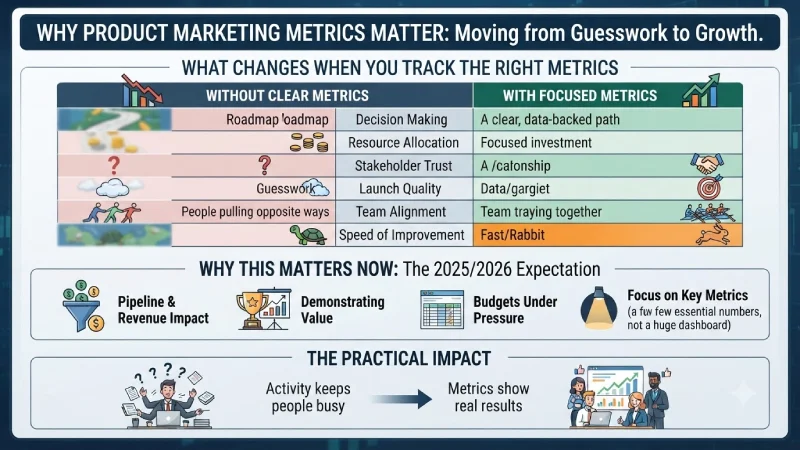
Product marketing decisions would rely mainly on opinions and actions if there were no metrics. Metrics would help identify the cause and effect in marketing efforts.
Good measurement enables you to:
- Demonstrate the effectiveness of your product marketing efforts
- Determine where you should spend time and money
- Fine-tune your launches, messaging, and adoption programs
- Eliminate efforts that aren’t delivering results
By 2025 and 2026, many organizations will be expecting product marketing to deliver more on pipeline and revenue. Teams that can demonstrate contribution are likely to receive better backing and investment. Teams that just measure activity have difficulty demonstrating their value.
What Changes When You Track the Right Metrics
| Area | Without Clear Metrics | With Focused Metrics |
| Decision Making | Based mainly on opinions and activity | Guided by evidence of what actually works |
| Resource Allocation | Time and budget spread thin | Invested in higher-impact work |
| Stakeholder Trust | Harder to prove value | Easier to show contribution to pipeline and revenue |
| Launch & Messaging Quality | Improvements are guesswork | Improvements are based on real performance |
| Team Alignment | Different views of success | Shared understanding of what matters |
| Speed of Improvement | Slow to notice what is not working | Faster to double down or change course |
Why This Matters More Now
A few trends have elevated the value of sound measurement:
- Leaders expect product marketing to demonstrate success in pipeline impact, win rates, and revenue
- Most teams measure their activities (content created, campaigns executed) much more often than their successes
- Sales and product teams need to know for sure if product marketing materials and campaigns are working
- Budgets are under pressure, and teams that do not deliver results risk their funding
- Highly successful teams usually concentrate on a limited number of key metrics and not huge dashboards
My recent experience shows that an increasing number of product marketing teams are being measured by their go-to-market impact, pipeline influence, win rate impact, and retention/expansion impact. Teams relying only on vanity metrics face a serious challenge to justify themselves.
Practical Impact
When product marketing metrics are clear and regularly reviewed, several things usually improve:
- Conversations with leadership become more grounded
- The team spends less time on ineffective activities
- Launches and communication are polished up quicker
- Collaboration with sales becomes better as everyone sees what closes the deals
- It becomes easier to prioritize what to discontinue
A simple way to think about it:
Activity keeps people busy.
Metrics help you see whether the activity is creating real results.
In an environment where product marketing is expected to contribute directly to growth, the ability to measure and show impact is one of the most practical advantages a team can build.
Key Types, Methods, and Examples
Product marketing metrics can be grouped into several practical categories.
| Category | What It Measures | Example Metrics | Why It Matters |
| Awareness & Reach | How many people see or recognize the product | Website traffic, content views, share of voice | Shows whether people are finding you |
| Demand & Pipeline | Interest that turns into opportunities | MQLs, SQLs, pipeline generated, influence | Connects marketing to revenue |
| Launch Performance | Results of product or feature launches | Sign-ups, activation, pipeline from launch | Shows if launches create real momentum |
| Adoption & Activation | How well new users succeed | Activation rate, time-to-value, feature adoption | Turns sign-ups into real users |
| Messaging & Content | Whether messages resonate | Engagement rates, conversion on key pages, feedback | Improves clarity and relevance |
| Sales Enablement | How well sales uses product marketing assets | Win rates, sales cycle length, asset usage | Supports revenue delivery |
| Retention & Expansion | Longer-term customer value | Retention rate, expansion revenue, NPS | Shows lasting impact |
Common ways to track these metrics:
- Website and product analytics
- CRM and marketing automation data
- Launch-specific dashboards
- Sales feedback and win/loss analysis
- Customer surveys and interviews
- Content and campaign performance reports
Every team does not have to measure all things. The best way would be to select few metrics which suit your objectives at present.
How to Use or Apply Product Marketing Metrics
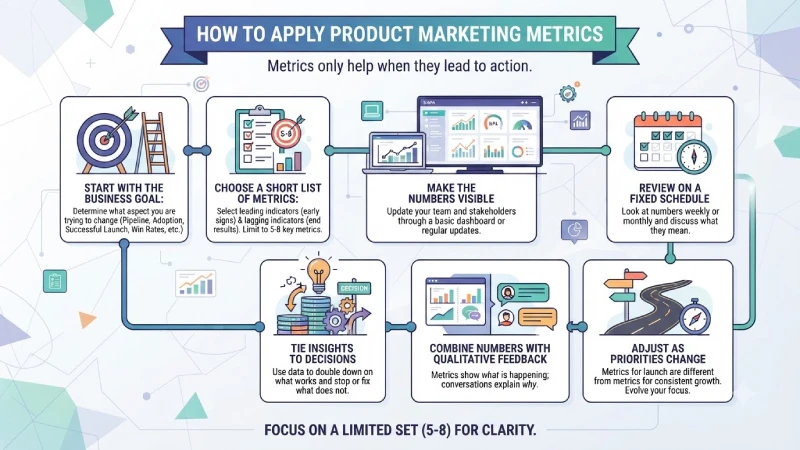
Metrics only help when they lead to action. Here’s a practical way to use them:
- Start with the business goal
Determine what aspect of product marketing you are trying to change currently (pipeline, adoption, successful launch, win rates, etc.). - Choose a short list of metrics
Select some nofollow (early signs) and select some lagging indicators (end results). - Make the numbers visible
Update your team and stakeholders through a basic dashboard or regular update. - Review on a fixed schedule
Look at the numbers weekly or monthly and discuss what they mean. - Tie insights to decisions
Use the data to double down on what works and stop or fix what does not. - Combine numbers with qualitative feedback
Metrics show what is happening. Conversations with customers and sales explain why. - Adjust as priorities change
Metrics that matter at the time of launch are not always the same metrics that will matter for consistent growth.
A practical suggestion is to have only a limited set of 5-8 metrics which you look at in detail. Otherwise, too many numbers will always make things confusing.
Best Practices and Common Mistakes
Best practices:
- Metrics must be relevant to business performance
- Concentrate on only a few important metrics
- Look into your metrics together with your colleagues
- Collect data and also draw conclusions
- Tell everything honestly and clearly
- Readjust your actions depending on metrics
- Match metrics of product marketing with those of sales and product objectives
Common mistakes:
- Basically tracking vanity metrics which look impressive but don’t help with decision making
- Trying to measure everything at once
- Calculating data points but not explaining their significance
- Overlooking qualitative data
- Using metrics only for reporting and not for improvement purposes
- Misusing metrics by changing them frequently
- Watching for the activities at the top of the funnel only and ignoring their impact
The most important issue that I see is the use of impressive dashboards and doing the same activities regardless of what the numbers say. Measurement is only helpful when it leads to behavioral change.
Frequently Asked Questions
What are product marketing metrics?
They are the metrics that measure the success of product marketing initiatives in areas like awareness, pipeline contributions, launch outcomes, adoption, messaging, and sales enablement.
What metrics are most important?
It will depend on what your objectives are right now, but some of the more valuable metrics are pipeline contributions, activation rate, launch-created demand, win rates, and retention/expansion.
How frequently should the metrics be evaluated when it comes to product marketing metrics?
Weekly/biweekly evaluation combined with monthly one will be enough for most companies.
What are leading versus lagging metrics?
Leading metrics provide initial indications (such as activation rate or content engagement), whereas lagging metrics indicate the end results (such as revenue or retention).
Who should have access to product marketing metrics?
The marketing group for the product, together with other people from sales, product, and leadership departments. Good communication is essential.
Conclusion
Product marketing metrics make action measurable. The key is in knowing which numbers to measure and using them as input for making decisions, so you don’t waste your time on things that don’t drive your business forward but rather concentrate on things that do.
Focus on what matters most. Pick a limited number of metrics. Check them frequently. Blend the metrics with customer and sales feedback. And iterate.
Groups that leverage metrics for decision-making purposes generally have greater impact compared to groups that only use metrics for reporting purposes. The habit gets reinforced over time.
For further reading, the accompanying guides on Go-To-Market Strategy, Product Positioning, Product Messaging, Product Launch Strategy, and Product Adoption will provide the actions that these metrics can optimize.