

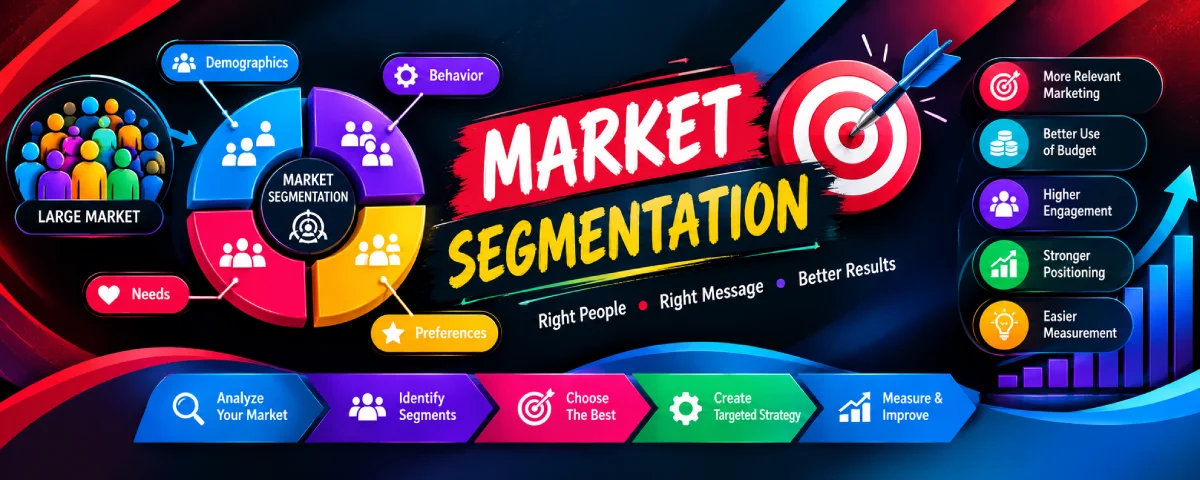
Market Segmentation is the division of an overall market into various smaller segments that possess some similar characteristics among their customers in the form of needs, behavior, or features. Now, instead of targeting everyone in the same way, you will be targeting those segments of the market which are important for your business.
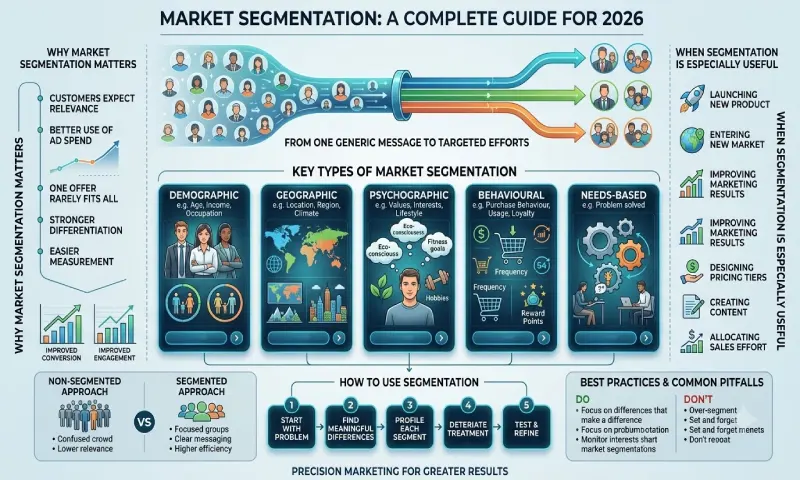
The majority of businesses ignore this step altogether, resorting to a blanket message for all their possible customers. The outcome is typically poor positioning and ineffective marketing efforts. Proper segmentation will enable you to know whom you are targeting, and how best to reach them.
In this guide, we discuss what market segmentation means, why it is important, what kinds there are, how to conduct proper segmentation, and what pitfalls to watch out for.
Market Segmentation: Meaning and Key Concepts
Segmentation of markets refers to the process of dividing a big market into smaller units. These units or segments need to have something in common. This may be anything from their needs and behavior to demographic or purchase patterns.
One does not have to aim at getting a lot of segments out of the whole market. The objective here is to get some distinctive segments that require different treatment..
Key ideas to understand
- The segment must be distinguishable and measurable
- The members of the segment must react in a fairly homogeneous way
- The segment must be sizable or valuable
- The segment must be reachable through marketing efforts
- Segmentation is most effective when it results in differentiation rather than mere classification
Simple comparison
| Approach | Description | Typical Result |
| No segmentation | One message and offer for everyone | Generic marketing, lower relevance |
| Basic segmentation | Broad groups based on simple traits | Some improvement in focus |
| Useful segmentation | Groups based on needs, behaviour, or value | Clearer messaging and better results |
| Over-segmentation | Too many tiny groups | Complexity without real benefit |
Good segmentation creates focus. Poor segmentation creates confusion.
Why Market Segmentation Matters
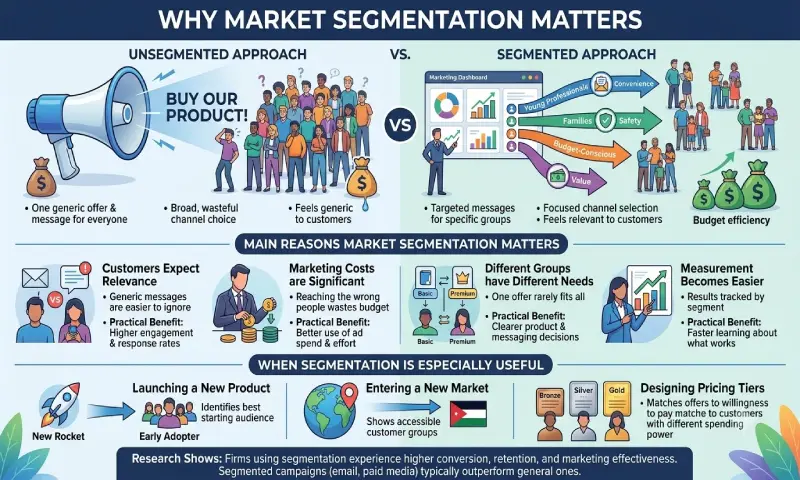
An attempt to please everyone generally ends up pleasing nobody. If an organization attempts to reach out using the same strategy, offer, and channels for all of the various audiences, there is a good deal of inefficiency in targeting the people who were not interested in buying anyway.
Segmentation helps to target the right segments.
In 2026, people will want more relevance in the communication process. At the same time, the price of marketing through different media will remain high. It is known that firms with properly established segments perform marketing much better while spending the same budget.
Main reasons market segmentation matters
| Reason | Why It Matters | Practical Benefit |
| Customers expect relevance | Generic messages are easier to ignore | Higher engagement and response rates |
| Marketing costs are significant | Reaching the wrong people wastes budget | Better use of ad spend and content effort |
| Different groups have different needs | One offer rarely fits all | Clearer product and messaging decisions |
| Focus improves positioning | You can speak more directly to specific problems | Stronger differentiation |
| Measurement becomes easier | Results can be tracked by segment | Faster learning about what works |
When segmentation is especially useful
| Situation | How Segmentation Helps | Typical Result |
| Launching a new product | Identifies which group is the best starting audience | Clearer launch messaging and targeting |
| Entering a new market | Shows which customer groups are most accessible | Better market entry focus |
| Improving marketing results | Allows different messages for different groups | Higher relevance and conversion |
| Designing pricing tiers | Matches offers to different willingness to pay | Better revenue from the same customer base |
| Creating content or campaigns | Guides topics, tone, and channels | Less generic content |
| Allocating sales or success effort | Helps prioritise higher-value segments | Better use of team time |
Segmented vs Non-Segmented Approach (Simple Comparison)
| Area | Without Clear Segmentation | With Useful Segmentation |
| Messaging | One general message for everyone | Different emphasis for different groups |
| Channel choice | Broad and often wasteful | More focused on where key segments spend time |
| Product decisions | Based on mixed feedback | Guided by the needs of priority segments |
| Budget efficiency | Lower | Higher |
| Customer experience | Feels generic | Feels more relevant |
What research and practice consistently show
Firms which make the right use of segmentation usually witness improvement in terms of conversion, retention, and marketing effectiveness. Segmented campaigns, particularly through email and paid media, usually outperform general campaigns since the message resonates well with the intended audience. Most companies usually experience a greater clarity of what products to focus on after they stop seeing everyone as one segment.
Segmentation does not entail making a whole host of tiny segments. It entails understanding the differences which really matter and putting your efforts where the results will matter the most.
Firms which know about the segments they target usually craft more precise messages, pick better channels, and do not waste their budgets on the people who will never purchase their products. In a crowded marketplace, that level of precision is perhaps the easiest advantage to gain.
Key Types, Methods, and Examples
There are several common ways to segment a market. The best approach depends on your business and the data you have.
Main types of market segmentation
| Type | Basis of Grouping | Example | Best For |
| Demographic | Age, gender, income, education, occupation | Young professionals aged 25–40 | Broad targeting and media planning |
| Geographic | Location, region, climate, urban/rural | Customers in major cities vs smaller towns | Local businesses and regional offers |
| Psychographic | Values, interests, lifestyle, attitudes | People focused on sustainability | Brand positioning and messaging |
| Behavioural | Purchase behaviour, usage, loyalty, benefits sought | Frequent buyers vs one-time purchasers | Retention, pricing, product focus |
| Needs-based / Problem-based | The specific problem being solved | Businesses that need faster invoicing | Product development and sales |
Practical examples
- The fitness app divides its customers into beginners, intermediates, and professional players and creates an individual program for each group.
- The B2B software vendor segments based on the size of the company, which can either be small, medium-sized, or enterprise, as the requirements and sales process will differ.
- The online shop selling clothes segments its customers according to their fashion preferences and purchasing habits rather than age and gender only.
How segments are often identified
- Customer surveys and interviews
- Website and purchase data
- Sales team feedback
- Market research reports
- Simple observation of buying patterns
You do not always need complex data science. Many useful segments start from clear patterns already visible in customer behaviour.
How to Use or Apply Market Segmentation
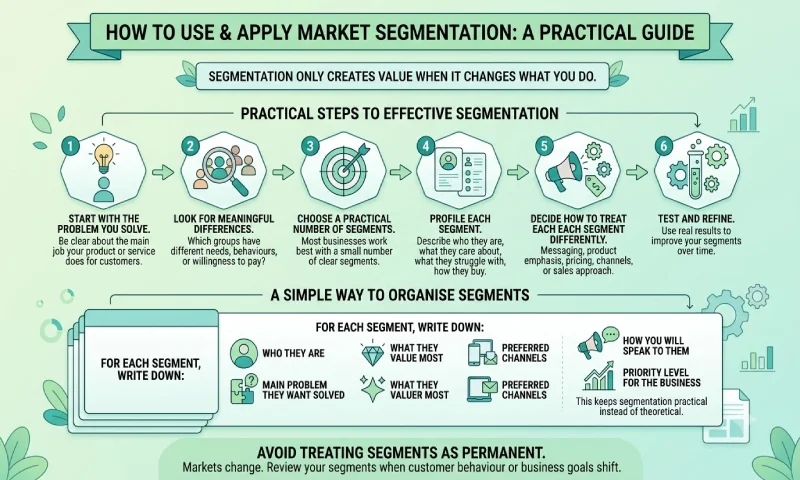
Segmentation only creates value when it changes what you do.
Practical steps
Practical Steps
Begin by defining the problem that you solve
Identify the core task your product or service fulfills for your customers.
Find significant distinctions
Are there distinct customer groups with different needs, behaviors, or willingness to pay?
Select a realistic number of segments
Most companies find it more effective to focus on a few distinct segments instead of many small ones.
Characterize each segment
Who are they? What are their interests, problems, and purchase behavior?
Define how to target each segment
Think in terms of messaging, product positioning, pricing, marketing channel, or selling strategy.
Review and improve
Use actual feedback to improve your segments.
Do not consider segments as immutable
Marketplaces evolve. Re-evaluate your segments if the customer behavior or business objectives change.
Simple way to organise segments
For each segment, write down:
- Who they are
- Main problem they want solved
- What they value most
- Preferred channels
- How you will speak to them
- Priority level for the business
This keeps segmentation practical instead of theoretical.
Best Practices and Common Mistakes
Best practices
- Concentrate on differences that make a difference
- Maintain a reasonable number of segments
- Use actual data or patterns if possible
- Connect segments to action (communications, products, prices)
- Regularly review segments
- Begin with simplicity and gradually refine
- Concentrate especially on high-value segments
Common mistakes
- Over-segmentation
- Segmentation based on variables not influencing purchasing behavior
- Segmentation for marketing purposes only, neglecting product/sales
- Equating importance of all segments
- Failure to update segments as time goes by
- Mixing up demographics and needs
- Segmentation done just once and never updated again
One of the biggest problems is businesses that create detailed segment documents but continue using the same generic message for everyone. Segmentation only works when it leads to different actions.
Final Thoughts
Market segmentation will allow you to avoid treating all of your possible customers the same way. It gives you a focus and helps with relevance and decision-making in marketing and products.
There is no need for complex models to begin. Just work with the simplest and most relevant differences between your customers; choose a few segments that make sense and change your communication or offers.
Those businesses that know who their customers are and who they are not communicate clearly and are more efficient in their use of resources. This is always one of the key strengths.
Frequently Asked Questions
- How many market segments should an organization have?
A business organization does well with few numbers of market segments. Between three and five are realistic choices. Too many will lead to complications without much benefits.
- Is demographic segmentation enough?
This type of segmentation may serve as the starting point but needs or behavioral segmentation would be more effective for the organization’s message or product.
- Can market segmentation be used by small organizations?
Yes. Actually, small organizations may benefit much from market segmentation due to the clear definition of their target market.
- How often should we check our segments?
Check the segments whenever customers’ behavior changes, a new offer has been introduced or at least once per year.
- What is the most common pitfall in market segmentation?
Making segments which look fine in theory but do not affect any decision making in respect of products, pricing or marketing.
Conclusion
The concept of market segmentation is quite useful in helping you achieve focus. Segmentation helps break down a large market into smaller units. It will help you become more organized, prioritize, and utilize your marketing endeavors in an efficient manner.
Try to keep it simple. Segment on the basis of actual differences in need or behavior and ensure that these segments translate into concrete action steps. Firms that do this tend to develop better positioning and waste less effort on the wrong people.