

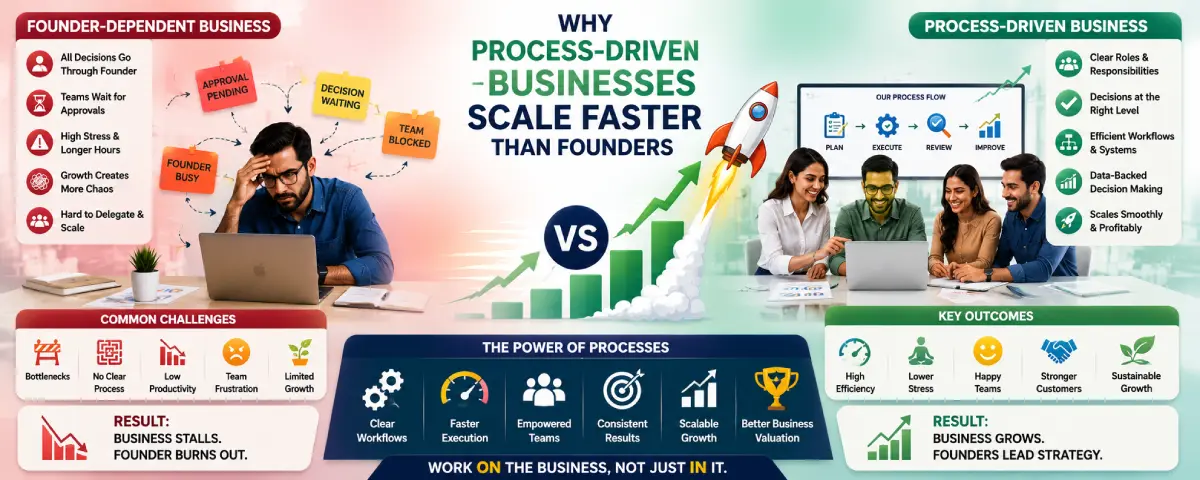
Why Process-Driven Businesses Scale Faster Than Founders
Most businesses don’t struggle because of low demand.
They struggle because everything depends on the founder.
Approvals wait. Decisions slow down. Teams hesitate. Growth creates stress instead of momentum. As revenue increases, complexity grows—but systems don’t. The founder becomes the bottleneck, firefighting replaces strategy, and scaling feels exhausting instead of exciting.
This is where many growing businesses get stuck. The difference between companies that scale smoothly and those that stall is not talent or funding. It is whether the business runs on people—or on processes.
Table of Contents
ToggleFounder-Led Businesses: Why Growth Feels Heavy
Founder-led businesses are common, especially in early stages. The founder sells, decides, fixes problems, hires, manages customers, and approves everything. At the start, this feels efficient.
But as the business grows, cracks begin to show.
Common signs include:
-
Teams waiting for approvals
-
Decisions stuck in the founder’s head
-
Repeated mistakes with no learning loop
-
Founder working longer hours but achieving less leverage
-
Growth creating stress instead of stability
This model works when the business is small. It fails when complexity increases. Revenue grows faster than structure, and the business becomes fragile.
This is one of the core reasons behind why small businesses fail to scale even when demand exists.
Process-Driven Businesses: What Actually Changes
Process-driven businesses do not remove people from the equation. They remove uncertainty.
Instead of relying on memory, heroics, or informal instructions, they define:
-
How work flows
-
Who owns which decisions
-
What “done” looks like
-
How success is measured
Processes turn effort into systems. Systems turn growth into something repeatable.
This shift is not about bureaucracy. It is about clarity.
Businesses that focus on business process optimization create operational calm even as they grow.
Founder-Led vs Process-Driven: A Simple Framework
| Area | Founder-Led Business | Process-Driven Business |
|---|---|---|
| Decision-making | Centralized | Distributed |
| Speed at scale | Slows down | Improves |
| Founder workload | Always high | Becomes strategic |
| Team confidence | Low | High |
| Growth stability | Fragile | Sustainable |
This difference explains why two businesses with similar revenue can feel completely different internally.
Why Founder Dependency Slows Scaling
Founder dependency creates invisible delays.
When every approval adds friction, progress slows down. Unanswered questions quietly pause work. Decisions routed to one person turn into growing queues across the business.
If you want a slightly sharper version, here’s an alternative:
Founder dependency creates invisible delays.
Approvals add friction, unanswered questions stall momentum, and decision bottlenecks form when everything flows through one person.
As the business grows:
-
More decisions appear daily
-
More coordination is required
-
More context is needed
The founder becomes the slowest part of the system, even when working hard.
Process-driven companies solve this by designing decisions into the system itself.
Processes Reduce Founder Burnout
Founder burnout is rarely about working too much.
It is about carrying too much mentally.
When everything depends on one person:
-
Context switching increases
-
Strategic thinking disappears
-
Stress becomes constant
Processes reduce cognitive load. They allow founders to step back from execution and focus on direction.
This is why scalable business systems are not optional for long-term growth.
Process Does Not Kill Speed (Common Misconception)
Many founders fear processes will slow them down.
In reality:
-
Lack of clarity slows execution
-
Re-explaining tasks slows teams
-
Fixing repeated mistakes slows growth
Good processes speed things up by removing guesswork.
Fast-growing companies are not chaotic. They are clear.
Where Process-Driven Businesses Gain Speed
Process-driven businesses move faster because:
-
Onboarding is quicker
-
Decisions don’t wait
-
Errors reduce over time
-
Teams act with confidence
Speed comes from predictability, not urgency.
Key Business Areas Where Processes Matter Most
Not every activity needs documentation. Focus on areas where mistakes are costly or frequent.
High-impact areas include:
-
Sales handoffs
-
Customer onboarding
-
Service delivery
-
Billing and collections
-
Hiring and training
-
Issue escalation
These areas directly affect customer experience and cash flow.
Processes Create Accountability Without Micromanagement
In founder-led businesses, accountability is personal.
In process-driven businesses, accountability is structural.
When roles, outputs, and handoffs are clear:
-
People know what success looks like
-
Feedback becomes objective
-
Performance improves naturally
This reduces emotional friction and improves trust.
The Role of Business Technology in Process Scaling
Technology should support processes, not replace thinking.
Tools help when:
-
Workflows are defined
-
Data is needed for decisions
-
Visibility matters
Technology investments make sense only after process clarity exists. Otherwise, tools amplify chaos.
This is why process maturity must come before heavy business technology investments.
Why Process-Driven Businesses Handle Growth Better
Growth introduces:
-
More customers
-
More staff
-
More complexity
-
More risk
Processes absorb complexity. Without them, growth increases fragility.
This is why businesses focused on business growth eventually need operational discipline to survive.
Process-Driven Businesses Build Institutional Knowledge
Founder-led businesses rely on tacit knowledge.
Process-driven businesses build institutional memory.
This means:
-
Knowledge stays even when people leave
-
Learning compounds
-
Errors are documented and prevented
This is critical for long-term stability.
Scaling Teams Without Losing Quality
Quality drops when speed increases without structure.
Process-driven companies protect quality through:
-
Standard operating procedures
-
Checkpoints
-
Clear escalation paths
This allows growth without customer dissatisfaction.
Founder-Led Businesses and the Illusion of Control
Many founders believe staying involved means staying in control.
In reality:
-
Over-involvement hides problems
-
Systems reveal issues early
-
Data replaces guesswork
Letting go of execution increases control, not reduces it.
How Process-Driven Businesses Support Delegation
Delegation fails when:
-
Expectations are unclear
-
Authority is limited
-
Feedback loops are missing
Processes solve this by defining:
-
What decisions teams can make
-
What outcomes are expected
-
How results are reviewed
Delegation becomes safer and more effective.
Process Maturity and Business Valuation
Businesses that rely heavily on founders:
-
Are harder to sell
-
Carry higher risk
-
Depend on individual effort
Process-driven businesses:
-
Look stable to investors
-
Are easier to evaluate
-
Command better valuations
This matters even if selling is not the goal.
When Founder-Led Models Still Make Sense
Founder-led models are useful:
-
During ideation
-
During early validation
-
When flexibility matters most
But staying there too long limits growth.
The transition matters more than the starting point.
How to Start Becoming Process-Driven (Practical Steps)
Start small:
-
Document one recurring task
-
Clarify one decision boundary
-
Remove one approval bottleneck
-
Review one workflow monthly
Momentum builds through small wins.
Process Improvement Is Ongoing, Not One-Time
Processes should evolve with the business.
Regular reviews help:
-
Remove outdated steps
-
Adjust ownership
-
Improve efficiency
Static processes fail. Adaptive systems scale.
Cultural Benefits of Process-Driven Businesses
Processes reduce:
-
Blame
-
Stress
-
Confusion
They increase:
-
Trust
-
Autonomy
-
Ownership
Culture improves when clarity exists.
Common Mistakes When Building Processes
Avoid:
-
Over-documentation
-
Copying large-company systems
-
Ignoring team input
-
Treating processes as rigid rules
Processes should serve people, not control them.
Process-Driven Businesses Recover Faster from Mistakes
Mistakes happen in every business.
Process-driven companies:
-
Identify root causes
-
Fix systems, not people
-
Learn faster
Founder-led businesses repeat mistakes because learning is informal.
Long-Term Advantage of Process-Driven Growth
Over time, process-driven businesses:
-
Scale predictably
-
Reduce founder dependency
-
Handle change better
-
Maintain performance during growth phases
This creates resilience.
FAQs
Do processes reduce creativity?
No. They remove chaos so creativity can focus on value.
When should founders start building processes?
When tasks repeat or decisions slow execution.
Can small teams benefit from processes?
Yes. Early structure prevents future overload.
Conclusion: Growth Needs Structure
Founders build momentum.
Processes build sustainability.
Process-driven businesses scale faster because they replace effort with systems, confusion with clarity, and burnout with control.
Growth should feel challenging—but not chaotic.
If growth feels heavy, the solution is not more effort.
It is better structure.