

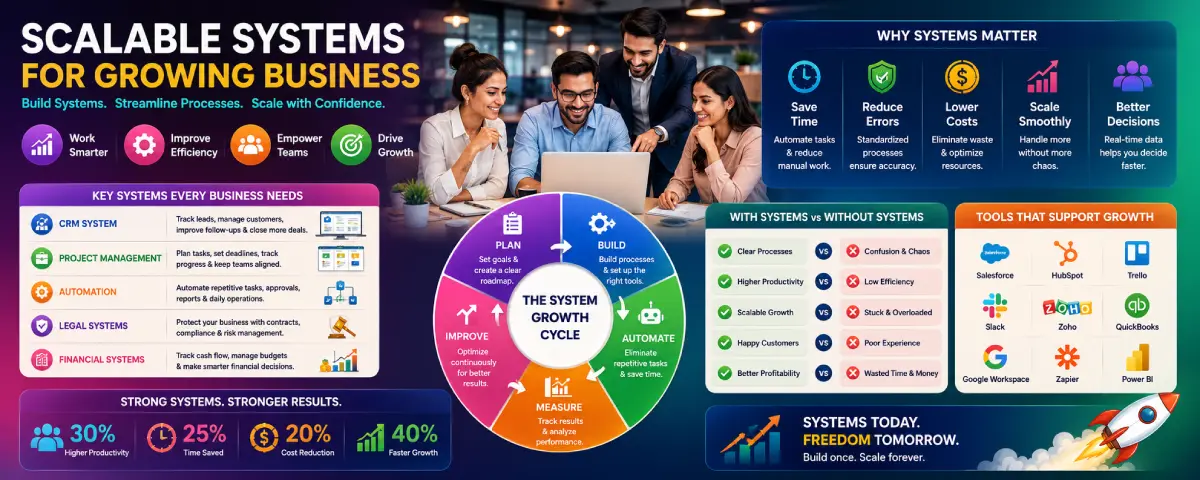
Introduction: Growth Without Systems Creates Stress
Scalable systems for growing business: Every business wants growth. More customers. Sales. More visibility.
But here’s something many founders learn the hard way:
Growth without systems creates stress.
When a business grows faster than its internal structure, problems show up everywhere:
-
Confusion about who owns what
-
Burnout across teams
-
Rising costs with little clarity
-
Poor customer experience
-
Constant firefighting
In my experience, most companies don’t fail because of a lack of ideas or motivation. They fail because they outgrow their systems.
The business starts small. Everything feels manageable. Then sales increase, teams expand, tools multiply, and suddenly nothing feels clear anymore.
If you want stable business growth, you must build systems early — not after problems appear.
This guide explains how to build scalable systems for a growing business, using simple tools, clear processes, and practical thinking that works in the real world.
No theory. No buzzwords. Just what actually helps businesses scale without burning out their people.
What Are Scalable Business Systems?
Scalable systems are repeatable ways of working that continue to function even when:
-
Customers increase
-
Employees grow
-
Sales double
-
Operations expand
In simple words, a scalable system works today and still works tomorrow — even if your business becomes 3x bigger.
Common Examples of Scalable Systems
-
CRM for sales tracking
-
Project management systems
-
Automated approvals
-
Documented workflows
-
Clear reporting structures
Without systems, founders become the system.
And that never scales.
When everything depends on one or two people:
-
Decisions slow down
-
Teams wait for approvals
-
Mistakes increase
-
Growth feels heavy
Scalable systems reduce dependence on individuals and create consistency.
Why Systems Are Critical to Scale a Business
Many founders try to scale a business by doing the following:
-
Hiring more people
-
Spending more on ads
-
Adding more tools
-
Working longer hours
But without systems, this creates chaos, not growth.
What Happens Without Systems
-
Leads fall through gaps
-
Tasks are repeated
-
Teams get confused
-
Costs increase
-
Results become unpredictable
Systems Impact Comparison
| Area | Without Systems | With Systems |
|---|---|---|
| Sales | Missed follow-ups | Predictable pipeline |
| Operations | Delays | Smooth workflows |
| Teams | Confusion | Clear ownership |
| Growth | Stressful | Sustainable |
Scalable systems make growth calm and controlled, not rushed and reactive.
CRM: The Backbone of Growth Systems
A CRM is not just a sales tool.
It’s a growth control center.
As soon as your business starts getting consistent leads, a CRM becomes essential.
What CRM Systems Help With
-
Lead tracking
-
Sales forecasting
-
Customer history
-
Follow-up automation
-
Deal visibility
Without a CRM:
-
Leads are tracked in spreadsheets
-
Follow-ups depend on memory
-
Sales forecasting becomes guesswork
Using CRM correctly improves:
-
Conversion rates by 15–25%
-
Sales transparency
-
Customer trust
This is where business tech directly supports business growth.
CRM vs No CRM (Realistic Impact)
| Metric | Without CRM | With CRM |
|---|---|---|
| Lead response time | Slow | Fast |
| Follow-up consistency | Poor | High |
| Conversion rate | 8–12% | 18–25% |
| Sales visibility | Low | High |
CRM systems help you scale sales without losing control.
Project Management Systems Keep Teams Aligned
As teams grow, communication breaks first.
Emails increase. Meetings multiply. Messages get missed.
Project management systems bring structure.
What Project Management Systems Do
-
Assign responsibility
-
Track deadlines
-
Reduce follow-ups
-
Improve accountability
Without this:
-
Managers chase updates
-
Teams feel micromanaged
-
Work slows down
Simple Project Tools That Work
| Tool Type | Purpose |
|---|---|
| Task boards | Daily work |
| Project timelines | Delivery tracking |
| Dashboards | Team visibility |
Good systems improve employee focus, not control.
Automation Saves Time and Money
Automation is often misunderstood.
It’s not about replacing people.
It’s about removing:
-
Repetitive tasks
-
Manual errors
-
Approval delays
Tasks That Are Easy to Automate
-
Automated invoices
-
CRM email workflows
-
Attendance tracking
-
Reporting dashboards
Automation supports business process optimization by saving 10–30% operational time.
That time can be used for:
-
Customer relationships
-
Strategy
-
Product improvement
Manual vs Automated Work
| Task | Manual | Automated |
|---|---|---|
| Invoicing | Time-consuming | Instant |
| Follow-ups | Missed | Scheduled |
| Reporting | Error-prone | Accurate |
| Approvals | Delayed | Fast |
Automation reduces stress and improves consistency.
Office & Tool Customization Matters More Than You Think
Many businesses buy tools but don’t set them up properly.
As a result:
-
Tools feel heavy
-
Teams avoid using them
-
Data becomes messy
Office setup and tools must match:
-
Team size
-
Work style
-
Growth plan
Using an office customization tool helps standardize:
-
Software access
-
Security
-
User permissions
This improves:
-
Onboarding speed
-
IT efficiency
-
Tool adoption
A poorly configured tool creates friction.
A well-configured tool supports scale.
Legal Systems Protect Growth
Growth without legal structure is risky.
Many businesses ignore legal systems until there’s a problem — and that’s usually too late.
A clear company’s legal path includes:
-
Contracts
-
Compliance
-
Data protection
-
IP security
Legal Systems Help By:
-
Reducing disputes
-
Improving investor confidence
-
Protecting brand reputation
Legal clarity brings business stability.
Risk Comparison of Legal
| Scenario | Without Legal System | With Legal System |
|---|---|---|
| Client disputes | High risk | Controlled |
| Compliance issues | Reactive | Proactive |
| Brand protection | Weak | Strong |
Legal systems don’t slow growth — they protect it.
Financial Systems & Smart Investment Thinking
Many growing businesses waste money not because they spend too much — but because they don’t track clearly.
Scalable finance systems track:
-
Cash flow
-
Expenses
-
ROI
-
Budget forecasts
Even decisions like buying stocks or reinvesting surplus cash require structured thinking.
Financial Systems Help With
| Decision | With System |
|---|---|
| Budgeting | Predictable |
| Investments | Controlled risk |
| Spending | Measured |
| Growth planning | Clear |
Financial systems support smart investment for startups and growing businesses.
Competitor Strategy Comparison
When you study competitors, patterns become clear.
| Company Type | System Focus | Result |
|---|---|---|
| System-driven | CRM + automation | Stable growth |
| Tool-heavy | No integration | Confusion |
| People-dependent | No SOPs | Bottlenecks |
| Process-first | Optimization mindset | Scalability |
Winning companies don’t have more tools — they have better systems.
How Systems Drive Long-Term Business Growth
Scalable systems support growth in ways that are not always visible immediately.
Long-Term Benefits
-
Reduced burnout
-
Better decision-making
-
Easier expansion
-
Higher business value
With systems in place, founders can focus on:
-
Strategy
-
Innovation
-
Leadership
Not daily firefighting.
Common Mistakes While Building Systems
Even good intentions can go wrong.
Mistakes to Avoid
-
Overcomplicating processes
-
Buying too many tools
-
Copying enterprise systems too early
-
Ignoring team feedback
Simple systems scale better than complex ones.
How Systems Improve Employee Engagement
Employees don’t leave because of hard work.
They leave because of:
-
Confusion
-
Constant urgency
-
Lack of clarity
Scalable systems improve employee engagement by providing:
-
Clear expectations
-
Fair workloads
-
Predictable workflows
Engaged teams build better businesses.
Systems Support Marketing and Sales Growth
With systems:
-
Marketing data is cleaner
-
Campaigns are measurable
-
Sales follow-ups are consistent
This strengthens your digital marketing plan and boosts brand trust.
Growth becomes data-driven, not guess-driven.
Systems Make Scaling Feel Lighter
The biggest sign your systems are working?
Growth feels easier.
-
Fewer emergencies
-
Fewer late nights
-
Fewer repeated questions
That’s real scalability.
Final Thoughts: Systems Create Freedom
Growth doesn’t fail suddenly.
It fails slowly — due to weak systems.
If you want real business growth, build:
-
Clear processes
-
Smart business tech
-
Simple automation
-
Legal and financial structure
Systems don’t limit growth.
They enable it.