

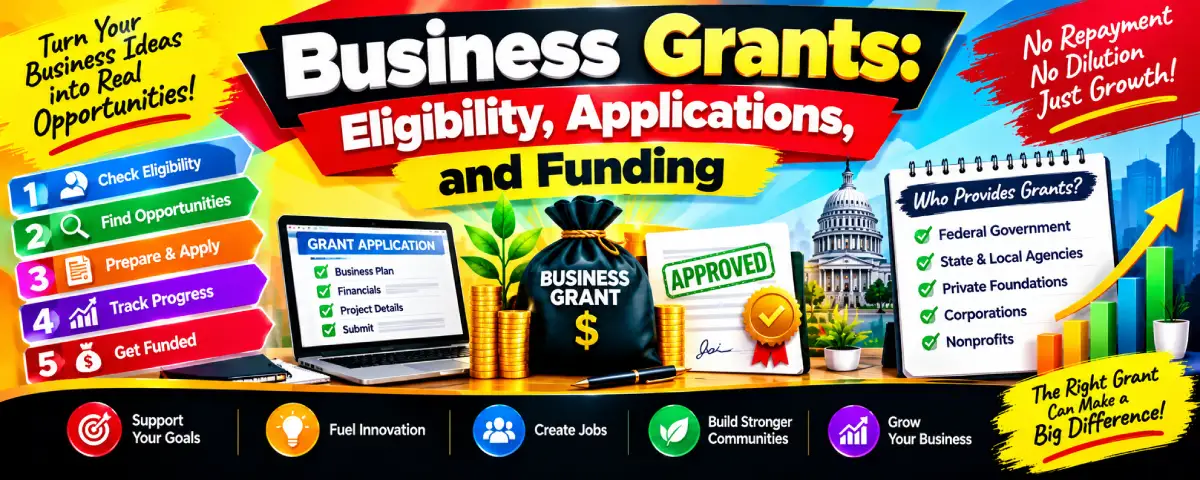
Business Grants: Eligibility, Applications, and Funding
Business grants remain one of the most misunderstood forms of capital for small business owners in 2026. People hear “free money” and picture an easy check arriving in the mail. The reality is more grounded and more useful: grants are non-repayable funds awarded for specific projects or purposes that align with a funder’s goals. They do not dilute ownership and they do not create debt, but they come with clear rules, reporting requirements, and competition.
I have walked dozens of owners through this process over the past few years. The ones who succeed treat grants like a professional relationship rather than a lottery ticket. They research carefully, match their project to the funder’s mission, prepare clean documentation, and stay organized after the award. This guide walks you through every major step so you can decide whether grants fit your business and how to pursue them without wasting time or falling for scams.
As of September 2026, roughly 158 small-business grant programs are actively accepting applications in the United States, according to tracking data from grant aggregators that verify against official sources. Federal programs (especially SBIR/STTR) still dominate the large-dollar awards, while states, cities, and private foundations offer the majority of smaller, more accessible opportunities. Median maximum awards for the open programs sit around $30,000, though federal R&D grants routinely reach six figures.
What Are Business Grants and Who Provides Them?
A business grant is money given by a government agency, foundation, corporation, or other organization to support a specific activity—research, expansion into a new market, hiring, equipment, training, or community benefit—without expecting repayment or equity. The funder usually has a public-policy or mission goal: advancing technology, creating jobs in distressed areas, supporting women- or minority-owned firms, boosting rural economies, or commercializing research.
Unlike a loan, you do not pay interest or principal. Unlike equity investment, you do not give up ownership. In exchange, you agree to use the money only for approved purposes, keep detailed records, and report progress and outcomes.
Main sources of business grants in 2026
| Source Type | Typical Award Size | Best For | Key Examples (2026) | Notes |
| Federal R&D (SBIR/STTR) | $50k–$323k Phase I; up to ~$1.8M–$2M+ Phase II | Tech, life sciences, defense, energy, agriculture innovation | NIH, DoD, NSF, DOE, USDA SBIR/STTR | Largest pool of true non-dilutive capital; ~$4B+ annually across 11 agencies |
| Other Federal | $10k–$500k+ (often via intermediaries) | Rural, manufacturing, export, workforce | USDA Rural Business Development Grants, EDA programs, STEP export grants | Many go to nonprofits or local governments that then help businesses |
| State | $5k–$150k median | Location-specific growth, job creation, industry priorities | State economic development agencies, tourism, manufacturing, workforce grants | 78+ open programs tracked in Sept 2026 |
| Local / Municipal | $2.5k–$50k | Façade improvements, storefront, local hiring | City or county economic development offices | Often faster decisions, smaller dollars |
| Private / Corporate / Foundation | $2.5k–$50k | Women-owned, minority-owned, veterans, specific industries | Amber Grant, FedEx Small Business Grant, Hello Alice programs, various corporate contests | Usually simpler applications; highly competitive |
The Small Business Administration itself does not hand out general operating grants to everyday small businesses. Most of SBA’s budget supports loan guarantees, counseling through Small Business Development Centers (SBDCs), and specialized programs. Direct SBA grants mainly flow to intermediary organizations (SBDCs, Women’s Business Centers, SCORE) that then deliver free help to you. The notable exceptions for for-profit firms are the SBIR and STTR programs, which the SBA helps coordinate but which are funded and awarded by the participating federal agencies.
SBIR (Small Business Innovation Research) and STTR (Small Business Technology Transfer) remain the gold standard for research-oriented companies. In FY2026 these programs continue to distribute more than $4 billion. Phase I awards typically fund feasibility studies (6 months, up to roughly $275,000–$323,000 depending on the agency). Phase II funds full research and development (up to about $1.8 million or more). There is no minimum company age requirement; a brand-new firm can apply if it meets the ownership and size rules (for-profit, U.S.-based, fewer than 500 employees, majority U.S. citizen or permanent resident ownership).
Private and corporate grants tend to be smaller but more approachable. The Amber Grant awards three $10,000 grants every month to women-owned businesses and larger year-end prizes. Corporate contests such as FedEx or various industry-specific programs offer $10,000–$50,000 with shorter applications. These are real opportunities, but the volume of applicants is high.
State and local grants often focus on economic development goals: job creation, downtown revitalization, export expansion, or support for specific sectors such as manufacturing, agriculture, or clean energy. Many require a local match or commitment to hire within the community.
Understanding who provides the money helps you avoid the biggest early mistake: applying for the wrong type of funding. A general “I need money to start my café” request will not succeed on Grants.gov. A targeted proposal for a rural tourism marketing project or an innovative food-safety technology has a realistic path.
How Do You Find Legitimate Grant Opportunities?
The single most important rule in 2026 is the same as it has been for years: legitimate grants never require you to pay a fee to apply or to “unlock” funds. Any unsolicited email, text, or social-media message claiming you have already been approved for a government grant is a scam. Official agencies do not operate that way.
Trusted places to search
- Grants.gov – the official federal portal. Every legitimate federal grant opportunity is listed here. Filter by eligibility category “Small Business.”
- SBIR.gov – centralized listings for all SBIR and STTR solicitations from the 11 participating agencies.
- Your state’s economic development agency or commerce department website.
- Local Small Business Development Center (find yours at sba.gov or America’s SBDC network). Counselors know the current state and local programs and will help you free of charge.
- SAM.gov – required registration for almost all federal awards. Start this early; it can take days to weeks.
- Reputable private trackers that verify against primary sources (they are useful for discovery, but always click through to the official program page).
A practical weekly routine many successful applicants use:
- Spend 30–45 minutes every Monday scanning Grants.gov and SBIR.gov for new solicitations that match your NAICS code or technology area.
- Check your state economic development site and local city/county pages once a month.
- Talk to your SBDC counselor quarterly; they often hear about opportunities before they are widely publicized.
- Set calendar reminders for recurring programs (Amber Grant monthly, certain state cycles, etc.).
Red flags that signal a scam
- Request for any upfront payment, processing fee, insurance, or “tax clearance.”
- Claim that you have already been selected or approved without applying.
- Pressure to act immediately or threats that the money will disappear.
- Requests for bank account details, Social Security number, or wire transfers early in the process.
- Look-alike websites that are not .gov or the official foundation domain.
- Guarantees of funding.
When in doubt, search the program name plus “Grants.gov” or go directly to the agency’s official site. Contact the agency using the phone number or email listed on the official page, never the contact information in a suspicious message.
Many owners also waste time on “grant finder” services that charge hundreds of dollars for lists that are publicly available. Free official portals plus a good SBDC counselor are almost always enough.
Which Eligibility Rules Apply to Your Business?
Eligibility is never one-size-fits-all. Every program writes its own rules. However, common categories appear again and again.
Typical eligibility factors
- Business structure and size: Most require a for-profit entity (sole prop, LLC, corporation). Size is often measured by employees (commonly under 500 for federal R&D) or revenue/net worth against SBA size standards for the industry.
- Ownership and control: Many federal programs require majority ownership and control by U.S. citizens or permanent residents. Special programs exist for women-owned, minority-owned, veteran-owned, or HUBZone businesses, but those usually involve separate certifications.
- Location: Rural programs, state grants, and local grants are restricted by geography. Some federal programs prioritize certain regions or labor-surplus areas.
- Industry or project type: SBIR/STTR fund R&D with commercial potential. USDA programs favor agriculture and rural. Manufacturing, clean energy, export, and workforce training each have dedicated pots.
- Stage of business: Some grants accept pre-revenue or early-stage firms (especially SBIR). Others want two or more years of operations or demonstrated revenue.
- Use of funds: Grants are almost always restricted to specific allowable costs—personnel, equipment, supplies, travel, consultants—tied to the project. General working capital or owner salary is rarely allowed.
- Matching funds or cost-share: Many programs require the business to contribute a percentage (cash or in-kind).
- Compliance history: Good standing with taxes, no debarment, clean character of principals.
Quick self-check before you invest time
Ask yourself:
- Does my project clearly advance the funder’s stated goal?
- Do I meet the size, ownership, and location rules?
- Can I document every eligibility claim with tax returns, formation documents, ownership records, and financial statements?
- Am I prepared to track every dollar and report outcomes for the full grant period (often 1–3 years)?
If the answer to any of these is “no” or “I’m not sure,” pause and talk to an SBDC counselor or review the Notice of Funding Opportunity (NOFO) carefully. Applying when you are clearly ineligible wastes everyone’s time and can sometimes create compliance headaches later.
For specialized situations—early-stage startups, women- or minority-owned firms, rural businesses, or technology companies—eligibility can be more favorable under targeted programs. Those details are covered in the dedicated cluster guides.
How Do Applications and Grant Proposals Work?
The application process is deliberate and document-heavy. Federal grants in particular follow a predictable path.
Typical federal application timeline and steps
- Register early
- Obtain a Unique Entity Identifier (UEI) and register in SAM.gov. This is mandatory for almost all federal awards and can take 7–14 days or longer if issues arise.
- Create accounts on Grants.gov and any agency-specific portals (e.g., NIH ASSIST, NSF Research.gov).
- Read the full Notice of Funding Opportunity (NOFO) or solicitation
This document is the rulebook. It lists eligibility, allowable costs, page limits, required forms, evaluation criteria, and the exact submission deadline (often with a specific time zone). Read it twice. Many applications are rejected for missing a single required attachment or exceeding a page limit. - Gather core documents
Common requirements include:- Business formation documents and bylaws/operating agreement
- Tax returns (business and personal, often 2–3 years)
- Financial statements or projections
- Resumes of key personnel
- Project narrative / technical proposal
- Detailed budget and budget justification
- Letters of support or collaboration agreements (especially for STTR)
- Certifications and representations
- Write the proposal
Strong proposals answer three questions clearly:- What problem are you solving and why does it matter to the funder?
- What exactly will you do, by when, and with what measurable outcomes?
- Why is your team the right one to do it, and how will you manage the money responsibly?
Use the funder’s evaluation criteria as an outline. If the NOFO says proposals will be scored on “Innovation (30%), Approach (25%), Team (20%), Commercialization (15%), Budget (10%),” structure your narrative to hit those points in order.
- Build a realistic budget
Break costs into categories the funder recognizes (personnel, fringe, equipment, travel, supplies, other direct costs, indirect costs). Justify every line. Many programs cap or prohibit certain costs (e.g., entertainment, most lobbying, general overhead beyond the negotiated rate). - Submit early and confirm
Federal portals can be slow on deadline day. Aim to submit at least 48 hours early. Download and save the confirmation receipt.
State, local, and private applications are often shorter—sometimes just an online form, a short narrative, and basic financials—but the same principles apply: match the mission, follow instructions exactly, and be specific.
Success rates vary widely. SBIR Phase I can be highly competitive (sometimes under 15–20% in popular topics). Smaller private grants may have higher odds simply because fewer people apply carefully. The owners who win treat the process like a professional sales cycle: research the customer (funder), tailor the pitch, and follow up with clean documentation.
What Happens After a Grant Is Awarded?
Winning is the beginning of a new set of responsibilities, not the end.
Immediate steps after the Notice of Award
- Read every page of the award letter or Notice of Grant Award (NOGA). Note the exact project period, reporting schedule, allowable costs, and any special conditions.
- Set up separate accounting (or at least clear tracking codes) so grant funds and expenses never mix with general operating money.
- Review the budget and make sure your internal systems can produce the required reports.
- If the award includes cost-share, document your contribution carefully.
Ongoing compliance and reporting
Most grants require periodic progress reports (narrative + metrics) and financial reports. Federal awards commonly use the SF-425 Federal Financial Report and program-specific progress reports. Deadlines are strict; missing them can freeze payments or jeopardize future funding.
You must keep source documentation for every expense: invoices, receipts, timesheets, contracts, and proof that the cost was necessary and reasonable for the project. Audits can occur years later, so organize from day one.
Common post-award realities
- Cash flow: Many grants are reimbursement-based. You spend first, then request payment. Plan accordingly.
- Scope changes: Significant changes in activities, timeline, or budget usually require prior written approval.
- Personnel: Key personnel listed in the proposal often need approval to change.
- Closeout: When the project period ends you must submit final reports, reconcile the budget, return any unspent funds, and complete property and invention reports if required. Federal closeout typically allows 120 days after the end of the period of performance.
Failing to report properly is the fastest way to turn a successful award into a compliance problem. The businesses that treat grant management as a core operational process—rather than an afterthought—rarely have issues.
Practical Comparison: Grants vs. Other Funding Options
| Feature | Business Grants | SBA Loans / Traditional Loans | Equity Investment | Crowdfunding / Contests |
| Repayment | None | Yes, with interest | None (but ownership given) | Varies |
| Ownership dilution | None | None | Yes | Usually none |
| Speed | Slow (months) | Moderate | Variable | Faster for some contests |
| Restrictions on use | High | Moderate | Low | Moderate to high |
| Reporting burden | High | Moderate | Moderate to high | Low to moderate |
| Best for | Project-specific, mission-aligned work | Working capital, equipment, real estate | High-growth scaling | Marketing + capital + community |
Grants shine when you have a clear project that matches a public or philanthropic goal and you are willing to accept the administrative load. They are rarely the right primary source of general operating capital.
Common Mistakes That Cost Applicants Time and Money
- Applying to programs that clearly do not match the business or project.
- Submitting incomplete packages or ignoring page limits and formatting rules.
- Writing vague narratives that never connect to the funder’s stated priorities.
- Underestimating the time required for registrations and document gathering.
- Treating the budget as an afterthought.
- Ignoring post-award requirements until the first report is due.
- Paying third-party “grant writers” or “finders” who guarantee results or charge large upfront fees.
The fix for most of these is simple: read the NOFO carefully, talk to free counselors (SBDC, SCORE, APEX Accelerators), and start early.
FAQ Section
Does the SBA give grants to small businesses?
Direct general grants to ordinary small businesses are rare. SBA primarily provides loans, counseling, and coordinates SBIR/STTR. Most “SBA grants” you see advertised are either loans or programs run by intermediaries.
How long does the process take?
From finding an opportunity to receiving funds often takes 3–9 months or longer for federal programs. State and private grants can be faster.
Can a brand-new startup get a grant?
Yes, especially through SBIR/STTR and certain private programs. Many other grants prefer or require some operating history.
Do I need a professional grant writer?
Not necessarily. Clear writing, strong project design, and careful compliance with instructions matter more. Many owners write successful proposals themselves with free help from SBDCs.
What if my application is rejected?
Request feedback when available, improve the proposal, and apply to the next relevant cycle or a better-matched program. Rejection is normal; persistence with better targeting wins.
Are there grants for specific groups (women, veterans, minorities, rural)?
Yes. Many targeted programs exist. Certification (WOSB, SDVOSB, 8(a), HUBZone, etc.) can open additional contracting and funding doors, though certification itself is separate from grant applications.
Troubleshooting Common Problems
Problem: SAM.gov registration is stuck.
Solution: Check for incomplete sections, mismatched legal names, or bank information issues. Contact the Federal Service Desk and allow extra time.
Problem: I cannot find any grants that fit.
Solution: Broaden the search to related project types, talk to your SBDC counselor, and consider whether a loan or other capital source is more realistic right now.
Problem: The budget justification feels weak.
Solution: Tie every dollar to a specific activity in the work plan and show how it produces the promised outcomes.
Problem: I won a grant but cash flow is tight because of reimbursement.
Solution: Explore short-term bridge financing carefully, accelerate eligible spending documentation, and communicate early with the program officer if delays arise.
Problem: An auditor or funder questions a cost.
Solution: Pull the original invoice, the timesheet or contract, the budget line it was charged to, and the section of the NOFO or award that makes it allowable. Good records solve most issues.
Conclusion
Business grants in 2026 are real, valuable, and competitive. They reward businesses that solve problems the funder cares about, document everything cleanly, and treat the relationship as a long-term partnership rather than a one-time cash infusion. The process is never “easy free money,” but for the right project it can provide non-dilutive capital that accelerates research, creates jobs, or opens new markets without adding debt.
Start by clarifying your project and checking eligibility against current opportunities on Grants.gov, SBIR.gov, and your state economic development site. Talk to a free counselor at your local SBDC. Then move into the detailed cluster guides for finding opportunities, verifying eligibility, preparing applications, writing strong proposals, navigating startup-specific programs, and managing reporting after the award.
The owners who succeed are the ones who treat this as a professional skill rather than a hopeful gamble. You now have the complete map. The next step is to pick the path that matches your business and begin.
Internal linking suggestions for your site:
- From this pillar link to each of the six cluster pages.
- From every cluster page link back to this pillar and to the most related sibling clusters.
- Use consistent anchor text such as “How to find legitimate business grants,” “Business grant eligibility checklist,” “Step-by-step grant application process,” etc.
This structure keeps readers moving through the silo and signals topical authority to search engines.